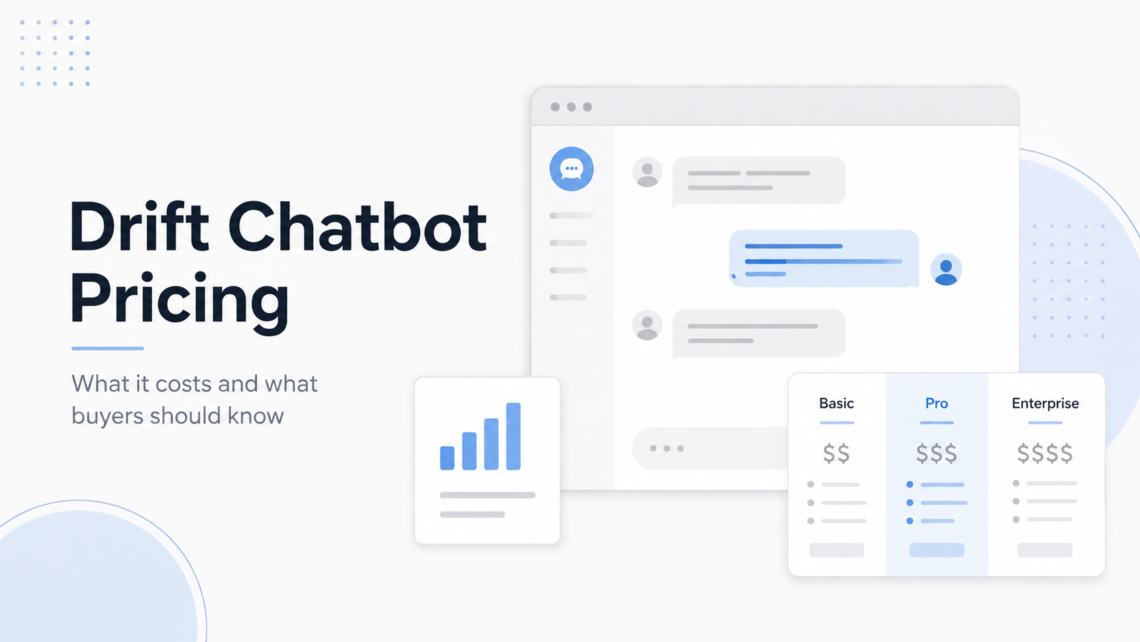
If you are searching for Drift chatbot pricing, there is an important change to understand before comparing old pricing tables online: Drift is no longer being positioned as a normal new chatbot purchase. In March 2026, Clari + Salesloft announced a gradual sunset of the Drift conversational marketing product and said existing Drift customers would be referred to 1mind as its successor.
That makes Drift pricing a little unusual in 2026. Historical pricing information can still be useful if you are an existing customer, researching an older contract, or trying to understand what Drift used to cost. But if you are choosing a chatbot today, an old “$X per month” figure should not be treated as a current Drift offer.
This guide explains how Drift’s pricing worked, what is publicly known now, what affected the total cost, and what businesses should check before making a purchasing decision.
What Is Drift?
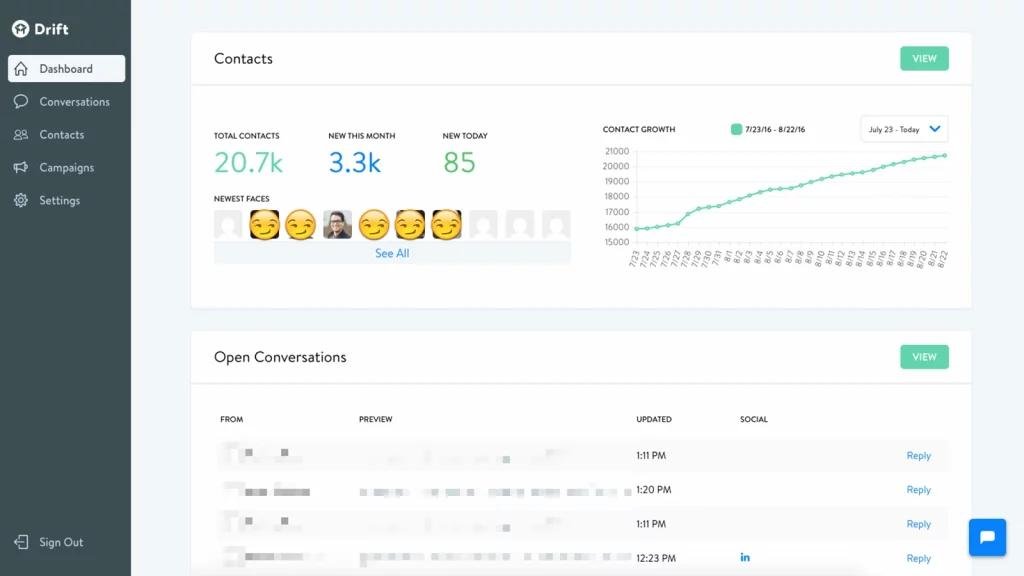
Drift was a B2B conversational marketing and sales platform built around website chat. Businesses could use it to engage visitors, answer questions, qualify prospects, route conversations to sales representatives, and schedule meetings.
Its chatbot capabilities went beyond a simple website contact form. A business could create conversation flows that asked visitors questions, collected information, and directed them toward an appropriate next step.
Drift also supported integrations and APIs that allowed organizations to connect conversations with other business systems. Its developer documentation, for example, describes use cases such as calculating information for a visitor during a conversation and connecting Drift with a company’s own CRM or other applications.
The important distinction is that Drift was primarily designed for business-to-business sales and marketing, rather than being simply a general-purpose customer-service chatbot.
Drift Chatbot Pricing: What Is the Current Situation?
The most important answer is this:
There is no straightforward current public Drift chatbot price that a new customer can rely on in 2026.
Salesloft’s current Chat Agents page says that it has transitioned from Drift to 1mind. The company announced in March 2026 that it was gradually sunsetting Drift’s conversational marketing solution and referring existing Drift customers to 1mind.
This means you should be careful with articles that present historical Drift plans as though they are still available for new customers.
At the same time, Salesloft’s legal documentation still contains Drift-specific commercial terms, including references to different Drift products and usage-based fees. That suggests that existing contractual arrangements can still matter even though the product is being transitioned.
Why Are There So Many Different Drift Prices Online?
Search results can be confusing because Drift’s pricing has changed over time.
You may encounter:
- Old monthly subscription figures
- Historical Premium pricing
- Advanced or Enterprise plans described as quote-based
- Pricing based on usage or visitor volume
- Third-party estimates
- Information written before the 2026 transition
These figures are not necessarily wrong in their historical context. The problem is treating them as a current public offer.
For an existing Drift customer, the signed order form, renewal information, and direct communication from Salesloft should take priority over an old pricing article.
How Drift Pricing Was Structured
Drift’s pricing was not simply a matter of paying for a chatbot and receiving unlimited usage.
Different products could have different pricing mechanisms.
Salesloft’s current product-specific terms, for example, describe several Drift-related billing models:
| Drift component | Pricing basis described in the terms |
|---|---|
| Drift Email | Monthly email reply volume |
| Bionic Chatbot | Yearly reply volume |
| Site Concierge | Annual unique website visits |
| Drift Engage | Monthly site-visit volume |
| Additional domains | Additional fees could apply |
These terms also state that usage above the purchased quantity could require an upgrade to an appropriate volume tier or additional purchased units.
That is an important lesson when evaluating chatbot pricing: the advertised subscription price is not always the same thing as the total cost of operating the platform.
Historical Drift Pricing vs. Current Reality
Historical pricing can still be useful for understanding the platform, but it should be labeled clearly.
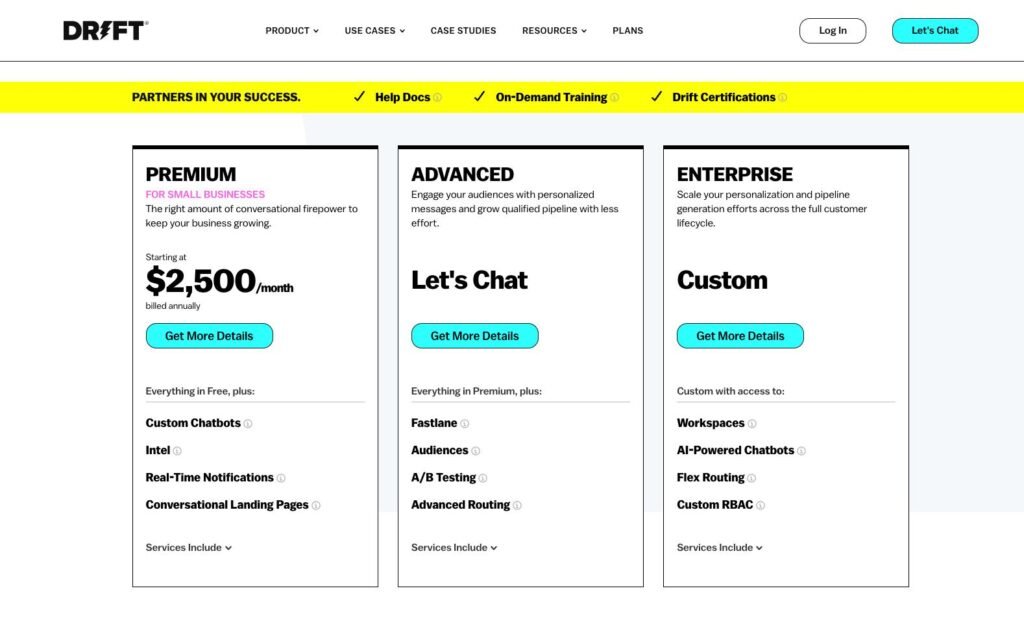
Before the current transition, third-party pricing references commonly reported Drift’s Premium offering at roughly $2,500 per month when purchased on an annual contract, while higher-level plans such as Advanced and Enterprise were generally presented as quote-based.
However, that figure should not be interpreted as a current 2026 Drift purchase price.
The current situation is different because Salesloft has announced the gradual sunset of Drift and the transition toward 1mind.
If you find a website claiming that you can simply purchase a new Drift chatbot today for a specific monthly price, verify the information directly with Salesloft before relying on it.
What Actually Affected the Cost?
Understanding the pricing factors is more useful than memorizing one historical number.
1. Website traffic
Some Drift services were connected to website visitor volume.
For example, Salesloft’s terms describe Site Concierge pricing around annual unique website visits and Drift Engage around monthly site visits.
This matters because a high-traffic website can have very different requirements from a smaller B2B site.
2. Conversation volume
Bionic Chatbot fees were described around annual reply volume.
In a usage-based model, a business that generates significantly more conversations may need a higher volume allowance.
3. Number of domains
The terms state that Drift was enabled on one domain per instance by default and that additional domains could involve additional fees.
For organizations operating multiple brands or websites, this can become an important cost consideration.
4. Features and product level
A basic chatbot experience and a sophisticated sales-engagement system are not necessarily priced the same way.
Features such as:
- Lead qualification
- Meeting scheduling
- Conversation routing
- CRM integration
- Analytics
- Personalization
- Advanced automation
- Multiple websites
- Professional services
can affect the overall commercial arrangement.
5. Implementation and onboarding
Software subscription costs are not always the entire project cost.
Drift’s published onboarding documentation described services including installation, CRM and marketing-platform integrations, playbook design, routing configuration, testing, reporting, and administrator training.
For a larger organization, implementation can therefore be a meaningful part of the budget.
What Did Drift’s Chatbot Actually Do?
To understand whether the historical price made sense, it helps to look at what businesses were paying for.
A Drift chatbot could be configured to guide website visitors through a conversation rather than simply displaying a generic “How can we help?” message.
For example, imagine a software company selling an enterprise platform.
A visitor arrives on the pricing page.
The chatbot might ask:
- Are you evaluating the product for yourself or your company?
- How many people are on your team?
- What problem are you trying to solve?
- Would you like to speak with a sales representative?
The answers could then be used to determine what happens next.
A high-intent visitor might be directed toward a sales representative or meeting-booking process, while another visitor could be sent toward relevant information.
Drift’s developer documentation also describes using conversation information and custom attributes to personalize interactions.
Real-World Example: Lead Qualification
Consider a B2B cybersecurity company.
Without automated qualification, every website visitor might submit the same contact form. A sales representative then has to determine which leads are worth contacting.
A chatbot can ask qualifying questions before the sales team becomes involved.
For example:
- Company size
- Business requirement
- Product interest
- Current stage of evaluation
- Whether the visitor wants a demonstration
The important value is not simply “having a chatbot.”
The value comes from collecting useful information before a human spends time on the conversation.
Also Read: Yellow.ai Features
Real-World Example: Booking Sales Meetings
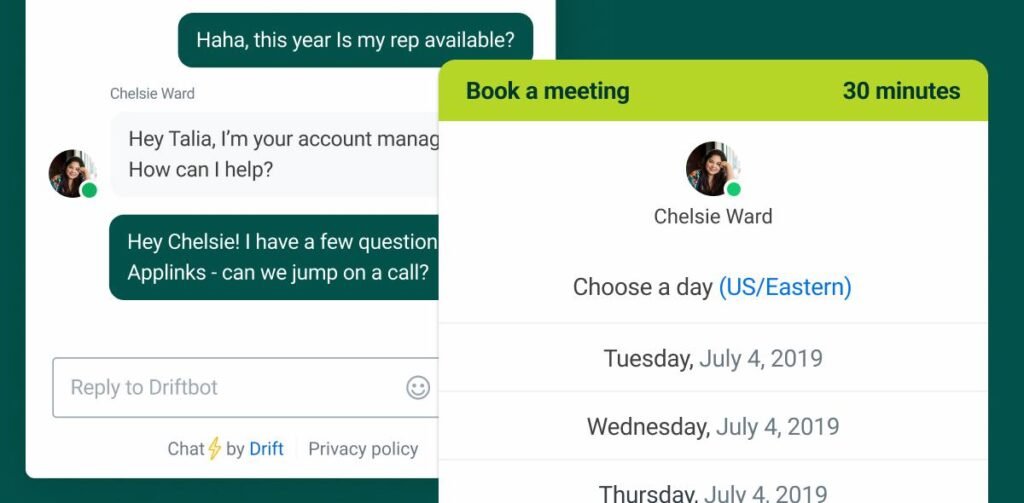
A second use case is meeting scheduling.
A visitor researching an enterprise product may already know what they want. Sending them through a long contact form creates unnecessary friction.
A conversational system can instead move the visitor toward a meeting.
This is particularly useful for companies where a qualified sales conversation is more valuable than simply collecting a large number of form submissions.
Real-World Example: Personalized Website Conversations
Drift also supported visitor attributes that could be used to change messaging.
Its documentation gives examples such as showing a particular message to a visitor during a trial period or presenting different messaging to premium users.
The broader idea is simple:
The chatbot does not have to treat every visitor identically.
A returning customer, a trial user, and a first-time prospect can have different needs.
Is Drift Still Worth Paying for in 2026?
For a new buyer, this is where the answer becomes straightforward.
Drift should not be evaluated as though it were an ordinary new chatbot product with a stable public pricing page.
Salesloft has announced the gradual sunset of Drift’s conversational marketing product and its move toward 1mind. Its current Chat Agents page explicitly says, “We’ve transitioned from Drift to 1mind.”
Therefore, a company starting a new chatbot project in 2026 should investigate the current product being offered by Salesloft rather than basing its decision on an old Drift pricing tier.
Existing customers are different.
If your company already has Drift, check:
- Your current contract
- Renewal date
- Purchased usage
- Included products
- Migration communications
- Support arrangements
- Any transition information from Salesloft
Advantages of Drift’s Original Approach
Drift had several characteristics that made it attractive to B2B organizations.
Faster visitor engagement
A chatbot can respond immediately instead of waiting for a salesperson to notice a new inquiry.
Lead qualification
Automated questions can collect useful information before a human sales representative takes over.
Sales routing
Conversations can be directed toward the appropriate team or representative.
Personalization
Visitor information and attributes can be used to create different experiences.
Integrations
Drift provided APIs and integrations that allowed businesses to connect conversations with other systems.
Limitations and Costs to Consider
Chatbot software is not automatically a good investment simply because it uses AI.
Pricing complexity
Usage-based limits, domains, product components, implementation services, and contract terms can make the actual cost harder to estimate than a simple monthly subscription.
Setup requires planning
A poorly designed chatbot can create more frustration than value.
For example, asking five unnecessary questions before allowing a visitor to contact sales adds friction instead of removing it.
Automated answers can be wrong
AI-powered conversational systems can misunderstand questions or provide inappropriate answers. Important product, pricing, legal, security, or technical information should be controlled and reviewed carefully.
Integration work can add cost
Connecting a chatbot to CRM, marketing automation, calendars, analytics, or internal systems can require technical work.
Product transition matters
The biggest limitation for someone evaluating Drift in 2026 is not a chatbot feature. It is the product’s strategic transition away from Drift toward 1mind.
What Should You Ask Before Buying a Chatbot?
Whether you are researching Drift or another conversational AI platform, ask these questions before signing a contract:
- What exactly is included in the subscription?
- Is pricing based on users, conversations, replies, visitors, or another metric?
- What happens when usage exceeds the included allowance?
- Are additional websites or domains charged separately?
- Are implementation services included?
- Which CRM and business integrations are supported?
- Can the chatbot hand conversations to human agents?
- How is customer data stored and protected?
- What happens to the product during the contract term if the vendor changes its strategy?
- What is the renewal price and contract length?
These questions often tell you more about the real cost than the headline subscription price.
Common Mistakes When Researching Drift Chatbot Pricing
Mistake 1: Trusting an old pricing table
A pricing article published several years ago may accurately describe Drift at that time but still be completely unsuitable for a 2026 purchasing decision.
Mistake 2: Assuming the cheapest tier is the total cost
A subscription can have usage limits, implementation requirements, add-ons, or additional-domain charges.
Mistake 3: Ignoring the company’s product direction
Pricing is only useful if the product is actually available and supported for the type of purchase you are considering.
Mistake 4: Comparing chatbots only by monthly price
Two chatbots with similar subscription prices can have very different capabilities, usage limits, integrations, and implementation requirements.
Frequently Asked Questions
What is Drift chatbot pricing in 2026?
There is no simple current public Drift chatbot price that should be treated as a standard new-purchase rate. Salesloft announced a gradual sunset of Drift’s conversational marketing product in March 2026 and identified 1mind as its successor.
Is Drift still available?
Drift is being transitioned rather than continuing as a normal standalone conversational marketing product for new buyers. Salesloft’s current Chat Agents page states that it has transitioned from Drift to 1mind. Existing customers should check their individual contracts and migration information.
How much did Drift cost historically?
Historical pricing varied by plan and product. Third-party references have reported figures such as approximately $2,500 per month for a historical Premium plan on an annual contract, with higher plans often quote-based. These historical figures should not be treated as current 2026 pricing.
Was Drift chatbot pricing based only on the number of users?
No. Drift’s commercial terms described different pricing bases, including reply volume and website-visitor volume, depending on the product. Additional domains could also incur fees.
Did Drift offer an AI chatbot?
Yes. Drift offered automated chatbot capabilities, including Bionic Chatbots, for website conversations. Its broader platform was designed around B2B buyer engagement, lead qualification, and sales conversations.
Should a new business buy Drift in 2026?
A new business should not assume that Drift is a normal new product available under its historical plans. Because Salesloft is transitioning from Drift to 1mind, a new buyer should evaluate the current offering and verify availability and pricing directly with the vendor.
What should existing Drift customers do?
Existing customers should review their contract, renewal date, usage allowances, and communications from Salesloft. The correct transition date and commercial terms can depend on the individual customer agreement.
Is Drift pricing the same as 1mind pricing?
No. Drift and 1mind should not be treated as interchangeable pricing plans. Salesloft has described 1mind as the successor as it transitions away from the Drift conversational marketing product. Current pricing should therefore be verified separately rather than carried over from historical Drift pricing.
Conclusion
Drift chatbot pricing is no longer a simple question with a single monthly number. Historical Drift plans can help explain what businesses previously paid, but they do not represent a reliable new-purchase price in 2026.
The more important development is Drift’s transition. Salesloft announced the gradual sunset of the Drift conversational marketing product and said existing Drift customers would be referred to 1mind. Its current Chat Agents page now describes the transition directly.
For existing customers, the best source of truth is the current contract and direct communication from Salesloft. For businesses choosing a chatbot today, the better approach is to compare currently available platforms based on total cost, usage limits, integrations, implementation requirements, AI capabilities, and long-term product support rather than relying on an outdated Drift pricing table.