

Artificial intelligence systems can process large amounts of information, but understanding individual pieces of data is not the same as understanding how they relate to an organization’s goals, rules, and real-world conditions. Businesses need ways to check whether AI-generated insights fit their operational context before using them to make decisions.
AI contextual organizational sight validation refers to the idea of evaluating AI outputs against an organization’s actual context, including its policies, business processes, available evidence, and intended outcomes. The phrase is not a widely established technical term with one universally accepted definition, so it is best understood as a descriptive approach to contextual AI validation rather than a formally standardized methodology.
This approach matters because an AI system can produce a convincing answer that is incomplete, outdated, or inappropriate for a particular business. By checking outputs against reliable organizational information and involving people where necessary, companies can reduce avoidable errors and make AI-assisted decisions more dependable.
What Is AI Contextual Organizational Sight Validation?
AI contextual organizational sight validation describes a process for checking whether an AI system’s outputs make sense within the environment where an organization plans to use them.
The term combines several ideas:
- AI: Systems that analyze information, recognize patterns, generate content, or support decisions.
- Contextual understanding: Interpreting information in relation to surrounding facts, circumstances, and requirements.
- Organizational insight: Understanding a company’s processes, objectives, policies, customers, and operational constraints.
- Validation: Checking whether a result is sufficiently accurate, relevant, supported, and appropriate for its intended use.
The word “sight” can be interpreted here as organizational visibility: the ability to see how an AI-generated result relates to the broader business environment. It should not be confused with a formally defined AI discipline unless a particular organization or source explicitly defines it that way.
For example, an AI assistant might recommend giving a customer a refund. The recommendation may appear reasonable based on the customer’s complaint, but the organization may have a policy requiring proof of purchase or limiting refunds after a specified period.
Contextual validation checks the recommendation against the relevant policy, transaction details, and applicable approval rules before the business acts on it.
The objective is not to make AI infallible. It is to identify unsupported conclusions, missing information, and contextual mismatches before they cause problems.
Why Context Matters in Organizational AI
AI systems often work with information that has been separated from the conditions in which it was created. A document may describe an old policy, a report may exclude recent transactions, or a customer message may omit details that are available elsewhere in a company’s records.
Without suitable context, a system can generate a plausible answer that does not reflect the current situation.
Consider three common problems.
1. Information may be outdated
A company updates its return policy, but an AI assistant continues using an older document. The answer may accurately reflect the old policy while being wrong for current customers.
Contextual validation checks the source’s date, version, and status before relying on it.
2. Different departments may use different definitions
A sales team may classify a customer as active if they have contacted the company recently. The finance team may define an active customer based on completed transactions.
An AI-generated report could use one definition while presenting its findings as if the other definition applied.
Validation should identify the relevant definition and make it explicit.
3. A correct answer may still be inappropriate
A recommendation can be factually reasonable but conflict with an organization’s budget, contractual obligations, security requirements, or risk tolerance.
For instance, an AI tool may recommend a convenient cloud service without recognizing that a project contains confidential information that cannot be uploaded to an unapproved platform.
Checking organizational context helps distinguish what is technically possible from what is appropriate and authorized.

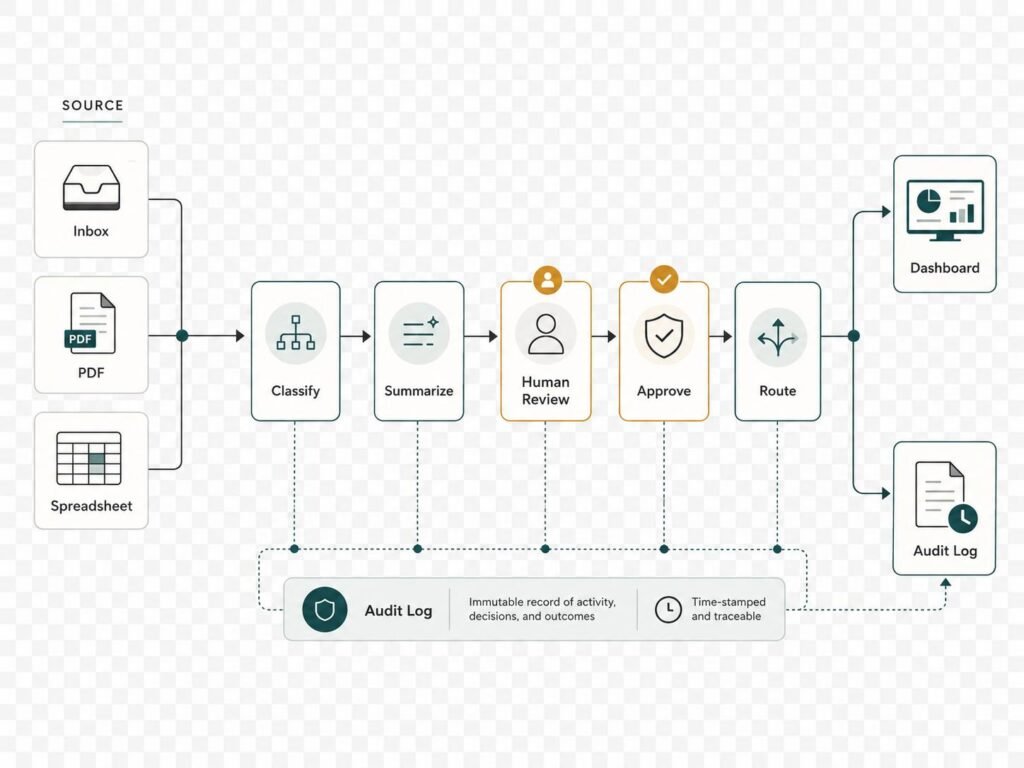
How AI Contextual Organizational Sight Validation Works
There is no single required workflow associated with this phrase. However, organizations can implement its underlying principles through a structured validation process.
Step 1: Define the decision or task
Start by identifying what the AI system is expected to do and how its output will be used.
Examples include:
- Summarizing customer feedback.
- Recommending which support request needs attention first.
- Identifying unusual transactions.
- Answering employee questions about internal policies.
- Preparing a draft report for management.
The validation requirements should reflect the consequences of the task. A draft meeting summary does not need the same level of review as a recommendation that could affect a person’s employment or access to financial services.
Step 2: Gather the relevant organizational context
The system needs access to the information necessary to answer the question correctly.
Depending on the task, that may include:
- Current internal policies.
- Approved procedures and documentation.
- Relevant customer or transaction records.
- Department-specific definitions.
- Contractual requirements.
- Applicable legal and regulatory obligations.
- The date and scope of the decision.
More information is not always better. The system should receive the information relevant to its task while respecting access permissions and data minimization requirements.
Step 3: Check the quality and status of the sources
Before relying on retrieved information, determine whether it is authoritative, current, and applicable.
For example, an AI assistant answering a question about employee expenses should prioritize the currently approved expense policy over an old presentation or an unverified discussion in a team chat.
Useful checks include document ownership, revision dates, approval status, and whether the source applies to the relevant business unit or location.
If sources conflict, the system should identify the conflict instead of silently choosing whichever document is easiest to use.
Step 4: Compare the AI output with the evidence
The next step is to examine the answer or recommendation against the available context.
Questions to ask include:
- Does the output accurately represent the source material?
- Are its assumptions justified?
- Does it follow the relevant business rules?
- Is important information missing?
- Does it confuse correlation with causation?
- Does it claim certainty when the evidence is incomplete?
- Does it recommend an action the system is authorized to take?
For important decisions, checking each significant claim against its source is more reliable than judging an answer solely by how professional or confident it sounds.
Step 5: Apply risk-based review
Not every output requires the same level of human involvement.
A low-risk task, such as categorizing internal meeting notes, may need automated checks and occasional sampling. A high-impact recommendation may require evidence review, testing, and approval by an authorized employee.
A practical approach is to establish review thresholds. If a system encounters conflicting policies, missing evidence, sensitive information, or an unfamiliar situation, it should stop, request clarification, or refer the case to a person.
Step 6: Monitor performance and update the process
Validation should continue after deployment.
Organizations can review incorrect answers, employee overrides, customer complaints, policy changes, and other signs that the system is not behaving as expected.
These findings can inform improvements to the source documents, retrieval process, prompts, business rules, or underlying model. Monitoring is especially important when organizational procedures change or when the system begins handling tasks beyond its original scope.
Real-World Examples of Contextual AI Validation
The following examples illustrate how organizations can apply these principles. They are practical scenarios, not claims about specific companies using a named methodology.
Example 1: Customer support
A company uses an AI assistant to draft replies to customer complaints.
A customer requests a refund for an item purchased several months earlier. The assistant identifies the complaint and drafts a sympathetic response, but the appropriate outcome depends on the current return policy, purchase date, product category, and any applicable exceptions.
A contextual validation process checks those details before presenting a final recommendation.
If the records are incomplete or the case requires an exception, the assistant sends it to a human support representative rather than inventing a policy or promising an unauthorized refund.
Why it matters: The business can improve response consistency without allowing the AI system to make unsupported commitments.
Example 2: Human resources
An organization uses AI to answer employees’ questions about leave, benefits, and workplace procedures.
An employee asks whether they qualify for a particular type of leave. The answer may depend on the employee’s location, employment arrangement, applicable policy, and current rules.
A contextual system identifies the relevant approved documents and distinguishes general information from individual eligibility decisions.
Sensitive employment decisions should receive appropriate human review, and access to personal records should be limited to authorized purposes.
Why it matters: Employees receive more relevant guidance while the organization reduces the risk of applying a general rule to the wrong circumstances.
Example 3: Financial operations
A finance team uses AI to flag transactions that may need further investigation.
A transaction could appear unusual because its amount differs from recent purchases. However, the company may have a legitimate reason for the expense, such as an approved annual payment or a one-time equipment purchase.
Contextual validation compares the transaction with available invoices, approval records, spending rules, and relevant historical information.
The AI system can prioritize cases for review, but a flagged transaction should not automatically be treated as evidence of fraud.
Why it matters: Context helps reduce misleading alerts and supports better-informed investigations.
Example 4: Internal knowledge management
A company uses an AI-powered search assistant to answer questions from internal documents.
An employee asks which software tools are approved for handling confidential project information. The system retrieves an old onboarding guide that lists a tool no longer permitted by the security team.
A validation process checks the source’s current status and gives priority to the latest approved security policy.
If the documents disagree, the assistant explains that the information requires confirmation.
Why it matters: Employees can find information more quickly without treating every retrieved document as equally authoritative.
Example 5: Supply chain planning
A business uses AI to summarize inventory data and suggest replenishment orders.
The system identifies a product with low stock and recommends ordering more. However, the product may be discontinued, a shipment may already be in transit, or demand may be temporarily unusual.
A contextual check incorporates current inventory, purchase orders, supplier lead times, and product status before recommending an action.
Why it matters: Decisions reflect operational conditions instead of relying on a single data point.
Also Read: Best Ways to Earn with AI
Benefits of AI Contextual Organizational Sight Validation
When implemented well, contextual validation can improve the usefulness of AI in several ways.
More relevant outputs
AI systems can produce answers that better reflect the organization’s actual requirements rather than relying only on general information or patterns learned during training.
Better error detection
Checking outputs against trusted evidence can reveal outdated policies, unsupported claims, inconsistent definitions, and missing details.
Greater accountability
A documented validation process can show which sources informed a recommendation, what checks were performed, and who approved a consequential action.
This does not guarantee that every decision will be correct, but it makes the process easier to review.
Improved consistency
Organizations can apply the same approved definitions, policies, and validation rules across similar tasks. This can reduce unnecessary variation between teams, provided that legitimate differences are also recognized.
More appropriate human oversight
Risk-based checks allow people to focus on ambiguous or high-impact cases instead of reviewing every routine output in the same way.
Stronger operational decision-making
When AI recommendations are connected to relevant business information, employees can use them as better-informed inputs to decisions. The quality of the result still depends on the underlying data, rules, and review process.
Limitations and Challenges
Contextual validation is useful, but it cannot eliminate all AI-related risks.
Incomplete or incorrect organizational data
A validation process cannot reliably confirm the truth of information if its source is itself wrong or outdated. Organizations need to maintain their records and establish clear ownership for important documents.
Hallucinations and unsupported reasoning
Generative AI can produce statements that sound credible without being supported by evidence. Connecting a system to internal documents can help, but it does not guarantee that the system will retrieve or interpret the right information.
Important claims should be checked directly against their sources.
Conflicting policies and unclear ownership
Departments may maintain inconsistent procedures, and no single team may be responsible for resolving disagreements. These problems require organizational decisions, not just a more capable model.
Privacy and security concerns
Context-aware systems may need access to internal documents, customer information, or business records. Excessive access can expose sensitive information, while poorly configured integrations can create new security risks.
Use access controls, appropriate data retention rules, approved tools, and security reviews. Avoid sending confidential information to external services without authorization.
Cost and implementation effort
Building reliable context retrieval, document versioning, evaluation tests, monitoring, and review procedures can require engineering work and ongoing maintenance.
Organizations should compare these costs with the expected value and the consequences of errors.
False confidence
An output may pass several automated checks and still be wrong. A system might retrieve an authoritative document but misunderstand an exception, or confirm that a statement appears in a source without verifying whether the source applies to the case.
Validation should therefore be treated as a risk-reduction process, not proof of correctness.
How to Implement Contextual AI Validation in an Organization
A practical implementation does not need to begin with a complex platform. Start with a limited use case and expand only after the process demonstrates value.
- Choose a defined task. Select a workflow with clear inputs, expected outputs, and manageable risks.
- Identify authoritative sources. Decide which documents, systems, and policies the AI may rely on.
- Set validation criteria. Specify what counts as a correct, relevant, supported, and acceptable result.
- Create test cases. Include ordinary examples, missing information, conflicting sources, outdated documents, and unusual situations.
- Establish escalation rules. Define when the system must request clarification or involve an authorized person.
- Test before deployment. Compare the system’s outputs with reviewed examples and assess errors that matter for the intended task.
- Monitor real-world results. Track failures, overrides, user feedback, and changes in the organization’s procedures.
- Review access and governance. Confirm that the system uses only appropriate information and that responsibility for decisions is clear.
For a knowledge assistant, for example, a useful evaluation set might contain questions about current policies, questions whose answers are missing from the documents, and questions where two sources disagree. The system should answer supported questions accurately and recognize when the evidence is insufficient.
Where relevant, organizations can align this work with established AI risk-management practices, such as the NIST AI Risk Management Framework. The framework provides broader guidance for managing AI risks; it does not define “AI contextual organizational sight validation” as a standardized named process.
Frequently Asked Questions
1. What does AI contextual organizational sight validation mean?
It describes checking AI-generated information or recommendations against an organization’s actual context, including its policies, processes, reliable evidence, and intended goals. The phrase does not have one universally established technical definition.
2. Is AI contextual organizational sight validation a recognized AI framework?
The phrase is not widely recognized as the name of a standardized AI framework. Its underlying concepts overlap with contextual AI evaluation, grounding, information retrieval, human oversight, and AI governance.
3. How is contextual validation different from ordinary AI testing?
Ordinary testing may assess whether a model performs well on defined examples or benchmarks. Contextual validation also asks whether its outputs are appropriate for a particular organization, its current rules, its available evidence, and the decision being made.
4. Can contextual validation prevent AI hallucinations?
It can help detect unsupported or incorrect outputs by comparing them with reliable sources. However, it cannot guarantee that hallucinations will disappear because systems may retrieve the wrong information, misinterpret evidence, or generate unsupported conclusions.
5. Which businesses can benefit from contextual AI validation?
Organizations using AI for customer support, internal knowledge search, financial operations, HR guidance, supply chain planning, compliance support, or other business workflows may benefit. The level of validation should reflect the risks and consequences of each use case.
6. Does contextual AI validation require human review?
Not every low-risk output needs individual human approval. However, human review is important for ambiguous cases, conflicting evidence, sensitive information, and decisions with significant consequences. Organizations should define review requirements according to the task’s risk.
7. What information does an AI system need for contextual validation?
It depends on the task. Relevant information may include current policies, approved documentation, transaction records, business rules, source dates, and operational constraints. The system should have access only to information necessary and authorized for its purpose.
8. How can an organization measure whether contextual validation works?
Use representative test cases and measure factors such as factual accuracy, source support, policy compliance, missing-context detection, inappropriate recommendations, and escalation quality. Continue monitoring after deployment because data, policies, and user behavior can change.
Conclusion
AI contextual organizational sight validation is best understood as a practical approach to checking AI outputs against the real conditions in which an organization operates. Its value comes from connecting AI-generated answers to trustworthy evidence, current policies, business requirements, and appropriate human judgment.
The most effective approach is not to trust every AI answer or to subject every routine task to the same level of scrutiny. Instead, organizations should establish clear validation criteria, use reliable sources, test realistic scenarios, protect sensitive information, and escalate uncertain or high-impact decisions.
AI becomes more useful when its outputs are evaluated in context. Validation helps organizations make better-informed use of the technology while recognizing that accuracy, accountability, and sound decisions still require careful management.