
Customer service has traditionally depended on people answering questions through phone calls, email, live chat, and social messaging. As customer expectations for quick responses have increased, businesses have looked for ways to handle routine interactions without making customers wait for an employee.
Conversational AI for customer service uses artificial intelligence to communicate with customers through natural-language conversations. Depending on how it is designed, it can answer common questions, help customers find information, troubleshoot problems, collect details, and hand complicated cases to human agents.
This guide explains how conversational AI works in customer service, what it can realistically handle, where it can go wrong, and how businesses can use it without turning customer support into a frustrating automated maze.
What Is Conversational AI for Customer Service?
Conversational AI is technology that allows software to interact with people using natural language. In customer service, that interaction can happen through a website chat window, mobile app, messaging platform, voice system, or another communication channel.
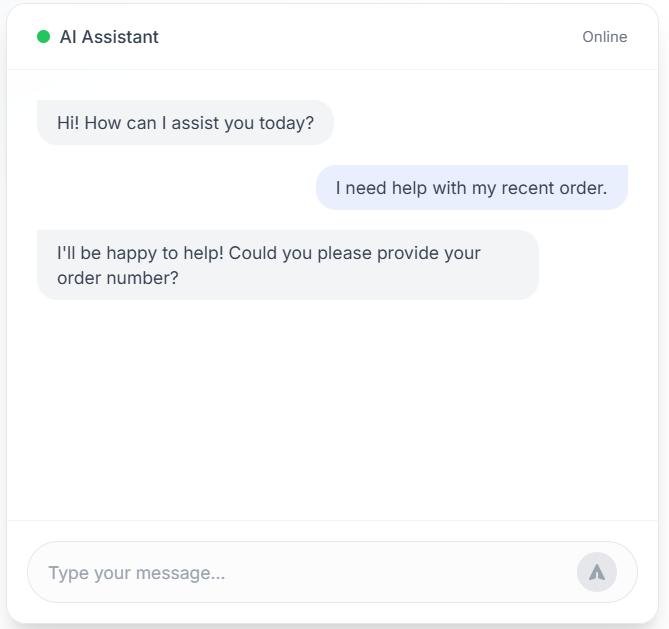
A simple customer-service interaction might look like this:
- A customer asks, “Where is my order?”
- The AI identifies that the customer wants an order-status update.
- It requests or retrieves the necessary order information.
- It checks an appropriate business system.
- It gives the customer the available status.
- If something unusual happens, it can transfer the conversation to a human agent.
The important distinction is that conversational AI is more than a collection of prewritten buttons. Modern systems can interpret different ways of asking the same question and use context from a conversation to determine what the customer needs.
For example, these questions can express essentially the same intent:
- “When will my package arrive?”
- “Can you check my delivery?”
- “Where’s my order?”
- “Is my package still coming today?”
A capable system should recognize the underlying request rather than requiring the customer to use one exact phrase.
How Does Conversational AI Work?
Several technologies can contribute to a conversational AI customer-service system. The exact architecture varies between implementations, but the process generally involves language understanding, conversation management, business-system integration, and response generation.
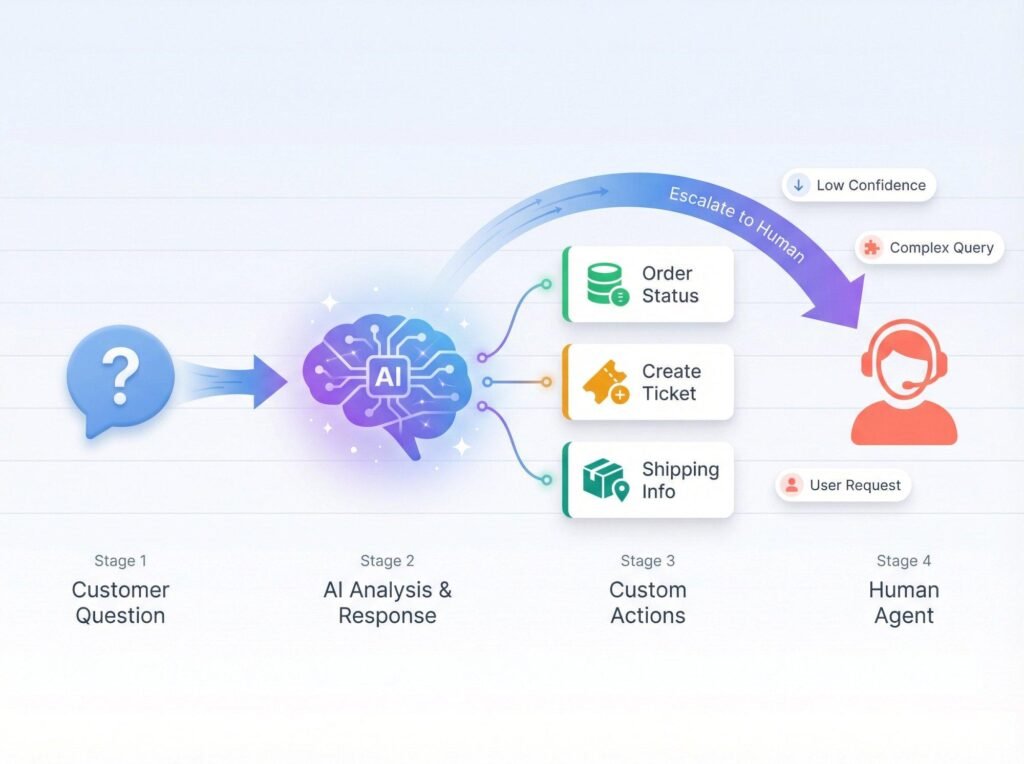
1. The customer sends a message
The interaction starts when a customer types or speaks a request.
For example:
“I was charged twice for the same purchase.”
The system receives the message and analyzes it.
2. The AI determines the customer’s intent
The system needs to understand what the customer is trying to accomplish.
In this example, the likely intent could be a duplicate-charge issue rather than a general billing question.
Intent detection is important because the same words can mean different things depending on context.
3. The system considers context
A conversation rarely consists of isolated questions.
Suppose a customer first asks:
“Can you help me change my delivery address?”
After the system asks which order they mean, the customer responds:
“The one I placed yesterday.”
The second message makes little sense on its own. The AI needs conversational context to understand what “the one” refers to.
4. The AI retrieves or accesses information
A customer-service AI becomes considerably more useful when it can connect to business systems.
Depending on the implementation, those systems might contain:
- Order information
- Shipping status
- Account details
- Product documentation
- Appointment information
- Return policies
- Troubleshooting instructions
- Knowledge-base articles
The AI should not simply guess an answer when the requested information requires access to current customer or business data.
5. The system generates or selects a response
The final response can come from predefined workflows, retrieved information, an AI-generated answer, or a combination of these approaches.
For higher-risk requests, businesses may intentionally restrict what the AI is allowed to do.
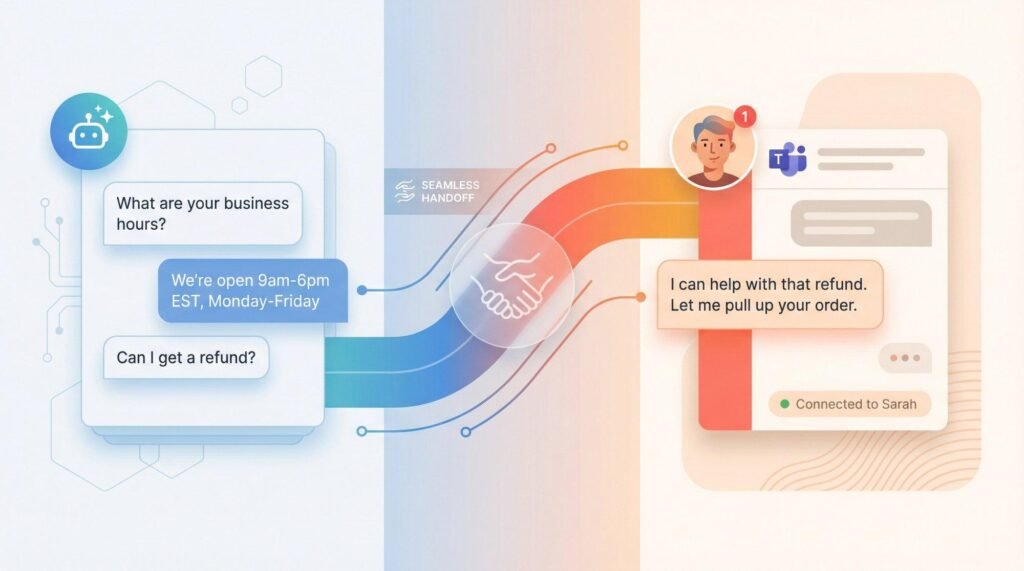
6. The conversation may be transferred to a human
A good customer-service system needs an escalation path.
If the customer has a complicated complaint, the AI cannot verify the necessary information, or the customer explicitly requests an agent, the conversation can be routed to a human representative.
That handoff is not a failure. In many situations, it is exactly what the system should do.
Conversational AI vs. Traditional Chatbots
The terms chatbot and conversational AI are sometimes used interchangeably, but they can describe different levels of technology.
A traditional rule-based chatbot might work like a decision tree:
Customer: “I need help with an order.”
Bot: “Choose one option:
- Track order
- Cancel order
- Return order”
The customer must follow the available path.
Conversational AI can allow a more flexible interaction:
Customer: “My shoes arrived but they’re the wrong size. Can I exchange them?”
The system can potentially identify that the customer is asking about an exchange, determine what information is required, and guide the customer through the appropriate process.
| Traditional chatbot | Conversational AI |
|---|---|
| Often relies on fixed flows | Can interpret natural-language requests |
| Usually follows predefined paths | Can handle more flexible conversations |
| Limited context | Can maintain conversational context |
| Responses may be scripted | Responses may be dynamically generated |
| Often handles simple tasks | Can support more complex workflows |
| Usually easier to constrain | Requires stronger controls and testing |
This does not mean conversational AI automatically understands everything. A sophisticated system can still misunderstand customers or produce an incorrect response.
What Can Conversational AI Handle in Customer Service?
The best applications are usually tasks that are frequent, relatively predictable, and supported by reliable information.
Answering common questions
AI can help customers find answers to questions such as:
- What are your business hours?
- What is your return policy?
- How long does shipping normally take?
- Do you offer a particular service?
- How can I reset my account password?
- Where can I find a product manual?
A well-maintained knowledge base is particularly important here. If the source information is outdated, the AI may provide outdated answers.
Order and delivery assistance
For ecommerce businesses, conversational AI can potentially help customers:
- Check order status
- Find tracking information
- Understand shipping updates
- Start a return
- Ask about delivery procedures
- Locate relevant order information
For these tasks, integration with the company’s order and logistics systems is often more important than simply having a sophisticated language model.
Technical troubleshooting
Conversational AI can walk customers through structured troubleshooting.
For example, imagine someone says:
“My home router is connected, but none of my devices can access the internet.”
The system might guide the customer through:
- Checking the connection lights.
- Restarting the equipment.
- Confirming whether multiple devices are affected.
- Checking for a known service issue.
- Escalating to technical support if the problem remains unresolved.
The AI is useful because it can turn documentation into an interactive troubleshooting process.
Appointment and reservation assistance
Depending on the business and its system integrations, conversational AI can help customers schedule, modify, or cancel appointments.
The critical requirement is access to accurate availability. The AI should not invent an appointment time simply because it sounds plausible.
Collecting information before human support
AI can also act as a front door for customer service.
Before transferring a customer to an employee, it might collect:
- Account information
- Order number
- Description of the problem
- Relevant error message
- Steps the customer has already tried
The human agent can then begin with useful context instead of asking the customer to repeat everything.
Real-World Examples of Conversational AI in Customer Service
Example 1: Online retailer
A customer writes:
“The jacket I bought last week doesn’t fit. I want a different size.”
Instead of sending the customer to a general returns page, the AI could identify that the customer wants an exchange and explain the applicable process.
If the retailer’s systems permit it, the conversation could continue by identifying the order and checking whether another size is available.
The value is not simply the chat itself. The useful part is connecting the conversation to the underlying business workflow.
Example 2: Software company
A customer reports:
“I can’t log into my account after changing my password.”
The AI can identify the issue as an account-access problem and guide the customer through approved recovery steps.
If the problem involves account verification or a security-sensitive action that the AI is not authorized to perform, it can escalate the case.
Example 3: Telecommunications support
A customer says:
“My internet stopped working this morning.”
The AI might first determine whether the problem affects one device or the entire connection.
It could then provide appropriate troubleshooting steps or check available service information if connected to the company’s systems.
If the problem cannot be resolved automatically, the AI can collect diagnostic information before transferring the customer to technical support.
Example 4: Financial services
A customer might ask:
“Why did this transaction appear on my account?”
This is an area where caution matters. Financial information can be sensitive, and an AI system should operate within strict access, authentication, privacy, and security controls.
Rather than guessing what a transaction means, the system should rely on authorized account information and established procedures. Certain disputes or sensitive account actions may need human review.
Also Read: Which Task Is a Generative AI Task?
Benefits of Conversational AI for Customer Service
Faster responses
AI can respond immediately to many routine questions, which can reduce the need for customers to wait for an available employee.
Support outside normal working hours
An automated system can potentially handle routine questions when human support teams are unavailable.
That does not mean every problem can be resolved automatically. It means customers can still receive useful guidance for supported requests.
Handling repetitive questions
Customer-service teams often spend significant time answering variations of the same basic questions.
Conversational AI can take care of suitable repetitive interactions while human agents focus on cases requiring judgment, empathy, investigation, or specialized knowledge.
Consistent information
A properly configured system can provide standardized answers based on approved documentation and business policies.
Consistency can be useful when customers interact with a company through different channels.
Better agent handoffs
A conversational AI system can collect information before escalation and pass the conversation history to the human agent.
Done well, this prevents the frustrating experience of explaining the same issue multiple times.
Limitations and Risks
Conversational AI is not a replacement for good customer-service operations.
It can misunderstand customers
Customers do not always communicate clearly.
They may use slang, incomplete sentences, sarcasm, typos, or descriptions that do not match the terminology used in a company’s knowledge base.
A system can therefore misunderstand the customer’s actual problem.
It can provide incorrect answers
Generative AI systems can produce plausible-sounding responses that are not supported by the available information.
This is especially dangerous when the system answers questions involving money, contracts, security, medical matters, or other high-impact decisions.
Businesses should use appropriate controls rather than assuming a fluent answer is necessarily a correct one.
Poor escalation can frustrate customers
One of the most common problems with automated support is making it difficult to reach a person.
A customer who has already explained a complicated problem should not be forced through endless automated responses.
Human escalation should be clear and practical when automation is no longer appropriate.
Privacy and security require careful design
Customer-service conversations may contain names, contact information, account details, purchase information, or other sensitive data.
Businesses need appropriate access controls, data-handling policies, authentication procedures, retention practices, and security measures.
The AI should also receive only the information and permissions it actually needs.
Integration can be difficult
A chatbot that can only read a static FAQ has limited usefulness.
Connecting AI to customer databases, order-management systems, ticketing platforms, CRM systems, and other software can introduce technical and security challenges.
The more actions an AI can take, the more important authorization and monitoring become.
How Businesses Should Implement Conversational AI
A practical implementation does not need to begin with an AI that attempts to handle every possible customer request.
A better approach is to start with a clearly defined group of use cases.
Step 1: Identify repetitive support requests
Review customer-service conversations and find questions that appear frequently and have clear answers.
Step 2: Improve the underlying information
Before deploying AI, make sure policies, product documentation, FAQs, and troubleshooting material are accurate and understandable.
AI cannot reliably compensate for poor source information.
Step 3: Define what the AI can and cannot do
Create explicit boundaries.
For example, the system might be allowed to explain a return policy but require human approval before issuing a refund.
Step 4: Connect necessary business systems
Add integrations only when they provide a clear benefit.
If customers need real-time order information, the AI needs an authorized way to retrieve that information.
Step 5: Build escalation paths
Define when the AI should transfer a conversation to a human.
Useful triggers can include:
- Customer requests an agent
- Multiple failed attempts to solve the issue
- Sensitive account activity
- Unclear or conflicting information
- High-risk decisions
- Complaints requiring human judgment
Step 6: Test with realistic conversations
Testing should include more than perfectly written questions.
Try:
- Typos
- Short messages
- Ambiguous requests
- Angry customers
- Follow-up questions
- Multiple issues in one conversation
- Attempts to get information the system should not disclose
Step 7: Monitor and improve
After launch, businesses should review failed conversations and identify where customers become confused or need human assistance.
The goal is not simply to maximize automation. The goal is to improve the overall customer experience.
Common Misconceptions About Conversational AI
“Conversational AI can replace every customer-service employee.”
It generally should not be viewed that way.
Human agents remain valuable for complicated cases, emotional situations, exceptions, investigations, negotiations, and decisions requiring judgment.
“A more advanced language model automatically means better customer service.”
Not necessarily.
A highly capable model with poor business data or weak integrations can still produce a poor customer experience.
Reliable information, workflow design, permissions, testing, and escalation are equally important.
“The AI should always answer the customer.”
No.
Sometimes the best response is to say that a human specialist needs to handle the issue.
A system that knows when not to answer can be more useful than one that tries to answer everything.
“Automation means customers no longer need support staff.”
Automation changes how support work is distributed. It does not eliminate the need for people in every situation.
The strongest implementations usually combine automation for appropriate routine work with human support for cases that need human judgment.
Frequently Asked Questions
What is conversational AI for customer service?
Conversational AI for customer service is technology that uses natural-language processing and related AI techniques to communicate with customers, answer questions, guide workflows, retrieve information, and assist with support tasks.
Is conversational AI the same as a chatbot?
Not always. A basic chatbot may rely heavily on fixed rules and predefined conversation paths, while conversational AI can use more flexible language understanding and, in some implementations, generative AI and external business-system integrations.
What customer-service tasks are best suited to conversational AI?
Routine, frequent, and well-defined tasks are usually good candidates. Examples include FAQs, order-status questions, basic troubleshooting, appointment assistance, and collecting information before a human handoff.
Can conversational AI replace human customer-service agents?
It can automate some support tasks, but it should not be assumed to replace human agents entirely. Complex problems, sensitive situations, exceptions, and cases requiring judgment often still benefit from human involvement.
Can conversational AI access customer information?
It can when it is properly integrated with authorized business systems. However, access should be controlled carefully, particularly when conversations involve personal, financial, security-sensitive, or otherwise confidential information.
What happens when conversational AI does not know the answer?
A well-designed system should avoid guessing. It can explain its limitation, provide an approved alternative, ask for clarification when appropriate, or transfer the customer to a human agent.
Is conversational AI expensive to implement?
The cost varies substantially depending on the technology, number of users, integrations, channels, security requirements, and complexity of the workflows. A simple FAQ assistant is very different from an AI system connected to multiple enterprise systems.
What is the biggest mistake businesses make with conversational AI?
One major mistake is focusing on the AI model while neglecting the surrounding customer-service process. Accurate information, clear boundaries, useful integrations, security controls, testing, and easy human escalation are all essential.
Conclusion
Conversational AI for customer service works best when it is treated as part of a broader support system rather than as a magical replacement for human agents.
It can answer routine questions, guide customers through troubleshooting, retrieve information, automate suitable workflows, and prepare cases for human representatives. But its effectiveness depends heavily on the quality of the information it uses, the systems it can access, the limits placed on its actions, and the way human escalation is handled.
The most useful customer-service AI is not necessarily the system that automates the largest number of conversations. It is the one that resolves appropriate problems efficiently while recognizing when a customer needs something automation cannot provide.