Generative AI is often discussed alongside traditional artificial intelligence, machine learning, automation, and data analysis. That can make it difficult to tell which tasks actually qualify as generative AI tasks. The key difference is what the system does with the information it receives: does it produce something new, or does it mainly classify, predict, retrieve, or analyze existing information?
If you are trying to answer the question “which task is a generative AI task?”, the simplest rule is this: a generative AI task involves creating new content or information from a user’s instructions, examples, or other input. The output could be text, an image, audio, video, computer code, or another form of content.
This guide explains how to recognize generative AI tasks, how they differ from other AI tasks, and how the concept applies to everyday tools and professional applications.
What Is a Generative AI Task?
A generative AI task is a task in which an AI model creates new output rather than simply identifying or evaluating information that already exists.
For example, suppose you give an AI system the instruction:
“Write a 500-word explanation of how solar panels work.”
The system produces a new piece of text based on the instruction. That is a generative AI task.
Other examples include:
- Creating an image from a text description
- Writing computer code from a natural-language request
- Generating a summary of a document
- Producing a marketing draft
- Creating music or speech
- Generating a video from a prompt
- Rewriting text in a different style
- Producing a fictional story
The important feature is generation. The system is producing an output rather than merely assigning a label to an existing input.
The Easiest Way to Identify a Generative AI Task
When faced with multiple AI tasks, ask one question:
Is the AI being asked to create new content or information?
If yes, it is likely a generative AI task.
Consider these examples:
| Task | Generative AI? | Why? |
|---|---|---|
| Write an email from a few instructions | Yes | Creates new text |
| Generate an image from a description | Yes | Creates a new image |
| Write Python code for a specific function | Yes | Produces new code |
| Translate a sentence | Usually yes when performed by a generative model | Produces target-language text |
| Summarize a long article | Yes, when performed by a generative model | Produces a new summary |
| Determine whether an email is spam | No | Classifies existing information |
| Detect a face in a photograph | No | Identifies existing visual information |
| Predict tomorrow's temperature | No, by itself | Makes a prediction rather than generating content |
| Sort customers into groups | No | Organizes or classifies existing data |
The distinction becomes especially useful when a question presents several possible AI applications and asks which task is a generative AI task.
What Makes Generative AI Different?
Traditional AI systems can perform many useful tasks without generating new content.
For example, a machine-learning model might examine a transaction and determine whether it appears fraudulent. Another model might analyze an X-ray and identify a particular pattern. A recommendation system might predict which product a customer is likely to purchase.
These systems can be highly sophisticated, but their primary function is not necessarily content generation.
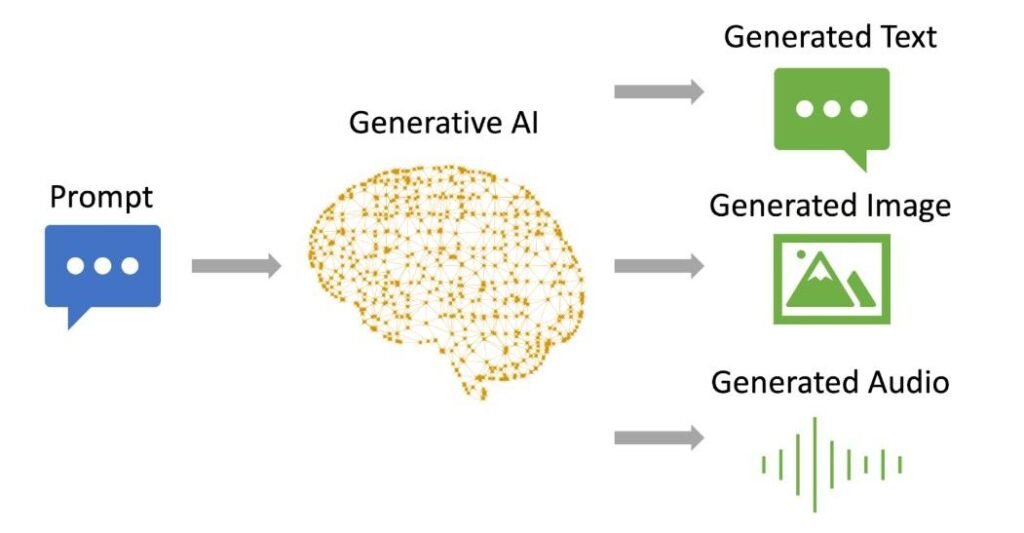
Generative AI focuses on producing an output such as:
- Text
- Images
- Audio
- Video
- Code
- Synthetic data
- Other forms of content
The model learns patterns from its training data and uses those learned patterns to produce an output that fits the requested context.
Common Types of Generative AI Tasks
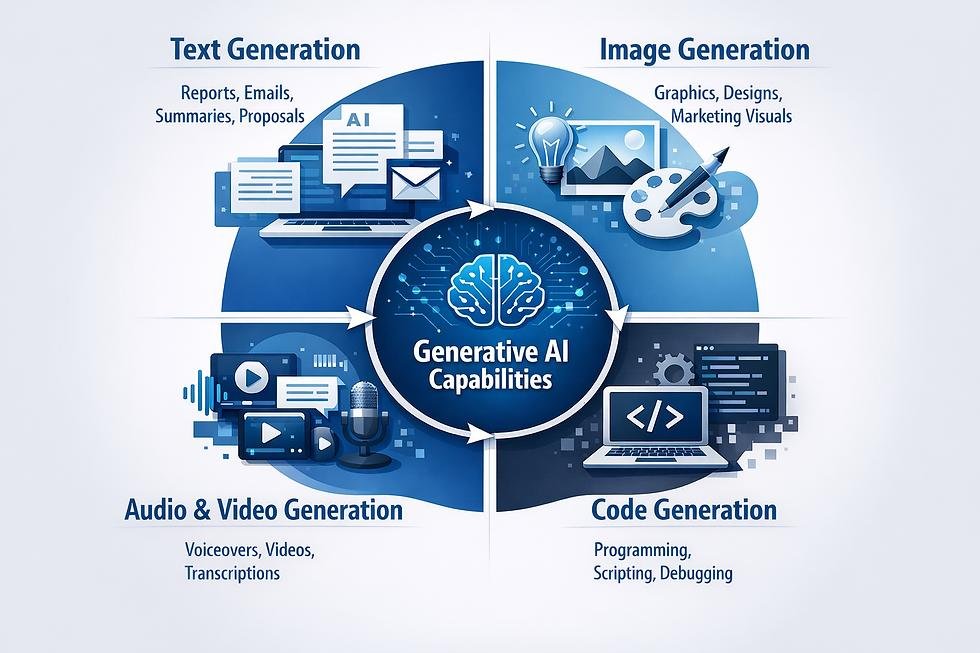
Generative AI is not limited to chatbots. The same basic concept appears across several types of content.
Text Generation
Text generation is one of the most familiar generative AI tasks.
A user might ask a model to:
- Draft an article
- Write an email
- Create a product description
- Generate a story
- Rewrite a paragraph
- Create a list of ideas
- Explain a technical concept
For example:
Input:
“Write a professional email asking for a meeting next week.”
Output:
A newly generated email based on that instruction.
That is clearly a generative AI task.
Image Generation
Image generation systems create images based on prompts or other inputs.
For example:
Input:
“Create an illustration of a futuristic city at sunset.”
Output:
A newly generated image matching the requested description.
This is another straightforward example of a generative AI task.
Code Generation
Generative AI can also produce computer programs.
A developer might ask:
“Write a JavaScript function that checks whether a number is prime.”
The AI generates code that attempts to satisfy the request.
Code generation is therefore a generative AI task because the system is producing a new code output.
Audio and Speech Generation
Generative AI can create or transform audio content.
Examples include:
- Generating synthetic speech
- Creating a voiceover
- Producing music
- Generating sound effects
The exact capabilities vary between models and tools, but the underlying task is generative when the system produces new audio content.
Video Generation
Video generation uses AI to produce video from prompts, images, or other inputs.
For example, a user might describe a short scene and ask an AI system to create a video representing it.
Again, the defining characteristic is that the system produces new content.
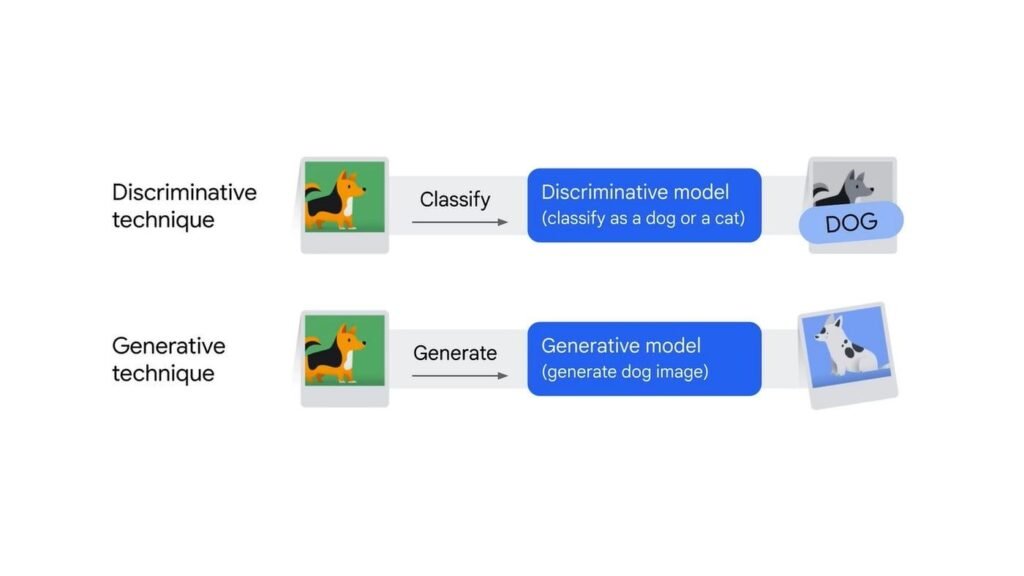
Generative AI vs. Classification
One of the most important distinctions to understand is generation versus classification.
A classification system receives information and assigns it to a category.
For example:
“Determine whether this email is spam or legitimate.”
The possible output might simply be:
Spam
The system has classified the input.
Now compare that with:
“Write a reply to this email.”
The system must produce new text. That is generative.
Simple comparison
Classification:
Input → Category
Generation:
Input → Newly created content
This distinction is useful in AI exams, certification questions, technical interviews, and general discussions about artificial intelligence.
Generative AI vs. Prediction
Prediction and generation can sometimes appear similar because both involve producing an output.
A predictive AI system might estimate:
- Whether a customer will cancel a subscription
- The expected demand for a product
- The likelihood of a transaction being fraudulent
- A future numerical value
These are prediction tasks.
Generative AI, on the other hand, is generally used to create content such as text, images, audio, video, or code.
For example:
Predictive task:
“Estimate next month’s sales.”
Generative task:
“Write a sales report explaining the factors that could affect next month’s sales.”
The first primarily produces a prediction. The second produces new text.
Generative AI vs. Search and Retrieval
Retrieving information from a database is another task that should not automatically be confused with generation.
Suppose an employee asks a company system:
“Find the company’s vacation policy.”
A retrieval system may locate the relevant document and return it.
That is primarily an information-retrieval task.
If a generative AI system instead receives the company’s policy and produces:
“Explain the vacation policy in simple language for a new employee.”
the system is generating a new explanation.
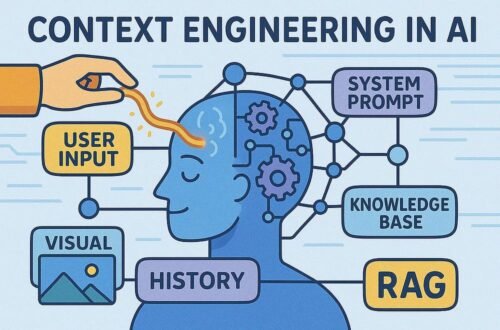
Modern AI applications can combine retrieval and generation. This is often called retrieval-augmented generation (RAG). In such systems, information retrieval and generative processing can work together.
Generative AI Can Transform Existing Content Too
A common misconception is that generative AI only counts when it creates something completely from nothing.
That’s not correct.
Generative AI can also take existing material and create a transformed version.
For example:
- Summarizing a report
- Rewriting an email
- Turning notes into an article
- Converting a document into bullet points
- Changing the tone of text
- Creating a caption from an image
- Turning a transcript into meeting notes
Consider this task:
“Rewrite this technical explanation so a beginner can understand it.”
The original text already exists, but the AI generates a new version. Therefore, the task can still be considered generative.
Real-World Examples of Generative AI Tasks
Example 1: Creating a Customer Email
A customer-service employee provides:
“Write a polite response explaining that the customer’s order has been delayed.”
The AI creates an email draft.
Why it is generative:
The model is producing new text based on the instruction.
Example 2: Creating Product Descriptions
An online retailer provides product information and asks AI to create a description.
The model may turn specifications into readable marketing copy.
Why it is generative:
The output is newly generated text.
Example 3: Creating Software Code
A developer describes a feature and asks an AI coding assistant to produce the initial implementation.
Why it is generative:
The system creates code based on the developer’s instructions.
The generated code should still be reviewed and tested because generative models can produce incorrect or insecure implementations.
Example 4: Generating an Image
A designer enters a prompt describing a scene, object, or illustration.
The system creates an image based on the prompt.
Why it is generative:
The AI produces visual content rather than merely recognizing something in an existing image.
Example 5: Summarizing a Meeting
A transcript is supplied to an AI system with the instruction:
“Create five bullet points summarizing the key decisions.”
The AI produces a shorter version of the information.
Why it is generative:
It creates a new textual representation of the source material.
A Useful Test for Multiple-Choice Questions
If you encounter a question asking “which task is a generative AI task?”, look at the verbs in each option.
Words that often indicate generation include:
- Create
- Generate
- Write
- Compose
- Produce
- Draft
- Design
- Summarize
- Rewrite
- Transform
- Generate an image
- Generate code
Words that often indicate other AI tasks include:
- Classify
- Detect
- Predict
- Identify
- Rank
- Retrieve
- Measure
- Calculate
- Categorize
These words are not absolute rules. For example, summarization can involve sophisticated processing of existing information, and whether something is called “generative AI” depends partly on the underlying model. But the vocabulary can provide a useful first clue.
Also Read: Droven io Best AI Jobs in USA
How a Generative AI Task Works
Although different models use different architectures, a simplified workflow looks like this:
1. The user provides an input
The input might be a:
- Text prompt
- Image
- Document
- Audio recording
- Code snippet
- Combination of inputs
2. The model interprets the input
The system processes the request and determines what kind of response is appropriate.
For a text-generation model, this involves processing the relationships between words, tokens, and the surrounding context.
3. The model generates an output
The system produces content that matches the request.
Depending on the application, that might be:
- A paragraph
- A complete document
- An image
- Code
- Audio
- Video
4. The output is reviewed
This step is particularly important for professional use.
Generated content can contain:
- Incorrect information
- Missing context
- Misinterpretations
- Calculation errors
- Poorly written code
- Unwanted bias
Human review may therefore be necessary, especially when the output affects important decisions.
Benefits of Generative AI Tasks
Generative AI can be useful because it can assist with many content-heavy activities.
Faster content creation
Instead of starting with a blank page, users can generate an initial draft and refine it.
Easier communication
AI can transform complex material into summaries, explanations, or different writing styles.
Support for developers
Code-generation tools can help developers create boilerplate code, explain unfamiliar code, or explore implementation approaches.
Creative assistance
Generative systems can help users brainstorm stories, visual concepts, designs, and other creative material.
Personalization
The same underlying information can be transformed for different audiences, such as beginners, technical professionals, customers, or employees.
Limitations and Risks
Generative AI is useful, but generation does not guarantee correctness.
Generated information can be wrong
A model can produce an answer that sounds convincing but contains factual errors. Users should verify important claims against reliable sources.
Outputs can reflect biases
Models learn patterns from data and can reproduce undesirable biases or stereotypes.
Privacy matters
Sensitive or confidential information should not be entered into an AI service unless the organization’s policies and the service’s data-handling practices allow it.
Generated code requires testing
Code that looks reasonable can still contain bugs, security vulnerabilities, or incorrect assumptions.
Copyright and ownership can be complicated
The legal treatment of AI-generated material can vary by jurisdiction and circumstance. For commercial or high-stakes use, current legal guidance should be checked rather than assuming that all AI-generated content has the same legal status.
Common Misconceptions About Generative AI
“Any AI output is generative AI.”
Not necessarily.
An AI system can output a prediction, classification, score, or retrieved record without performing a generative task.
“Generative AI must create something completely original.”
Not necessarily.
It can transform existing information into a new form, such as a summary or rewritten explanation.
“Only chatbots are generative AI.”
No.
Generative AI can work with text, images, audio, video, code, and other data types.
“If AI generates the answer, it must be correct.”
Definitely not.
Generation describes how the system produces an output, not whether that output is accurate.
Frequently Asked Questions
Which task is a generative AI task?
A task such as writing an email from instructions, generating an image from a prompt, creating computer code, or producing a summary is a generative AI task because the system creates new content.
Is classifying an email as spam a generative AI task?
Generally, no. Spam detection is primarily a classification task because the system assigns an existing email to a category.
Is predicting future sales a generative AI task?
Not by itself. Predicting future sales is primarily a predictive analytics or forecasting task. A generative model could, however, generate a written sales forecast or explanation.
Is summarizing a document generative AI?
It can be. When a generative AI model creates a new summary from an existing document, the task involves generation. The model is producing a new textual representation rather than simply returning the original document.
Is writing computer code a generative AI task?
Yes. When an AI model produces new code based on a prompt or specification, it is performing a code-generation task.
Is translating text generative AI?
Translation can be performed using different types of technology and models. When a generative model produces the translated text, the task uses generative AI. The important distinction is between the task itself and the specific technology used to perform it.
What is the easiest way to recognize generative AI?
Ask whether the system is being asked to create, write, generate, compose, or transform content. If it is, the task is likely generative. If it is mainly classifying, detecting, retrieving, or predicting, it may belong to another AI category.
Conclusion
The best way to understand which task is a generative AI task is to focus on the output. Generative AI is designed to produce new content or transform existing information into a newly generated form.
Writing an email, generating an image, producing code, creating a voice recording, drafting a story, and summarizing a document can all involve generative AI. By contrast, tasks such as spam classification, object detection, data retrieval, and numerical forecasting are generally associated with classification, detection, retrieval, or prediction.
The distinction is useful because it prevents a common mistake: treating every AI-powered task as generative AI. If the central job is to generate content, you are looking at a generative AI task.