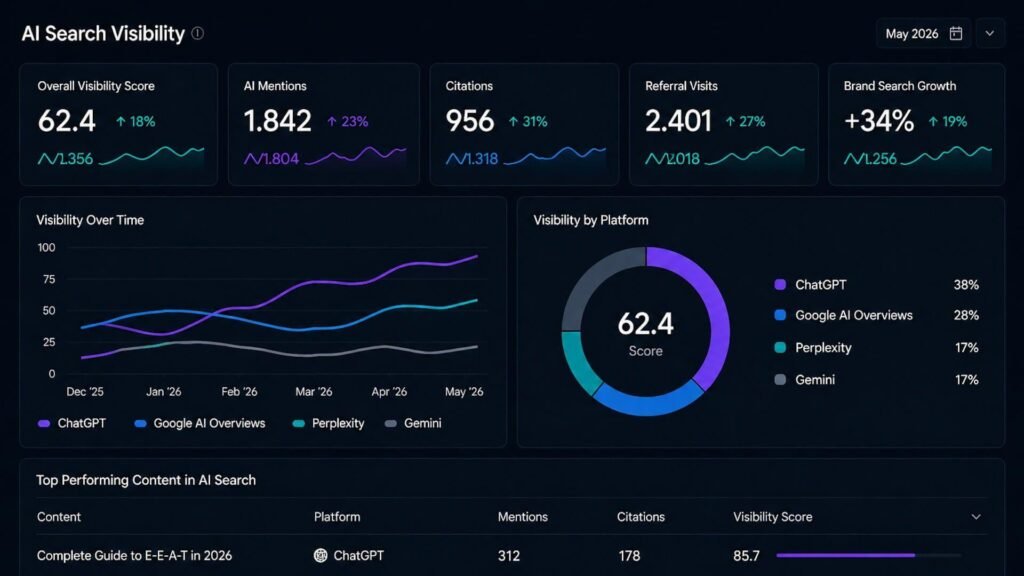
Getting traffic from traditional search and being visible inside AI-generated answers are increasingly different challenges. A website can rank well for a keyword yet still be missing when someone asks ChatGPT, Gemini, Perplexity, or another AI system to recommend the best sources, products, or services in that category. That is where LLM optimization tools for AI visibility become useful.
These tools help you measure whether your brand or website is mentioned, cited, or recommended in AI-generated answers. Depending on the platform, they can also show which competitors appear instead, which pages are being cited, what prompts trigger mentions, and where your content has gaps.
This guide explains what LLM optimization actually means, how AI visibility differs from traditional SEO, which tools are worth considering in 2026, and how to choose one without paying for features you do not need. Because tool features and pricing change frequently, verify current pricing and availability on the vendor’s website before purchasing.
What Is LLM Optimization for AI Visibility?
LLM optimization is the process of improving a website, brand, and its supporting web presence so that AI systems can more easily discover, understand, and potentially cite or mention it in their answers.
You may also see related terms such as:
- Generative Engine Optimization (GEO)
- Answer Engine Optimization (AEO)
- AI search optimization
- AI visibility optimization
- LLM visibility
The terminology is still evolving, and these terms are not always used in exactly the same way. In practical terms, they all address a similar problem: how does your business or content appear when people use AI systems to find information?
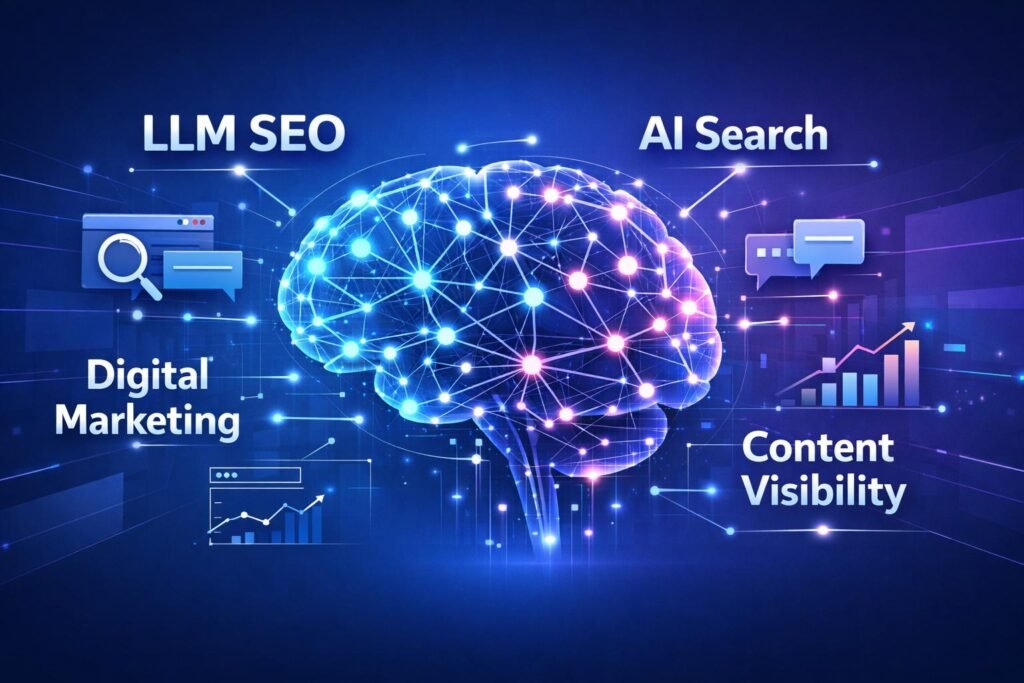
Traditional SEO commonly focuses on rankings, clicks, impressions, backlinks, and organic traffic. AI visibility adds different questions:
- Does an AI system mention my brand?
- Is my website cited as a source?
- Which competitors are mentioned instead?
- Which pages are being cited?
- How does the AI describe my company?
- For which questions am I visible?
- Does my visibility differ between AI platforms?
That distinction is important because an AI-generated answer does not behave like a conventional search-results page. A user may receive a small set of recommendations rather than dozens of blue links.
How AI Visibility Tools Work
Most dedicated AI visibility platforms follow a relatively simple process.
1. Define the questions that matter
Instead of tracking only individual keywords, you create or discover natural-language prompts.
For example, a cybersecurity company might monitor questions such as:
What are the best cybersecurity platforms for small businesses?
Which cybersecurity tools offer automated threat detection?
What should a small company look for in endpoint security software?
These questions represent the conversations in which the company wants to be discovered.
2. Run those prompts through AI platforms
The tool checks selected AI systems and records their responses.
Depending on the platform, this can include ChatGPT, Gemini, Perplexity, Google AI Overviews or AI Mode, Microsoft Copilot, Claude, and other supported surfaces. Coverage varies considerably between products.
3. Analyze the answers
The platform determines things such as:
- Whether your brand was mentioned
- Whether your website was cited
- Where your brand appeared in a recommendation
- Which competitors appeared
- Which URLs were cited
- How frequently your brand appeared
- How the brand was described
Some tools also analyze sentiment or the broader narrative surrounding a brand.
4. Turn observations into optimization opportunities
The most useful platforms go beyond telling you that your visibility is low.
They can help identify:
- Missing topics
- Citation opportunities
- Competitor gaps
- Frequently cited third-party sources
- Technical issues affecting discoverability
- Content that should be improved
This creates a practical loop:
Measure → Understand → Improve → Recheck
That is much more useful than simply watching an AI visibility score.
Best LLM Optimization Tools for AI Visibility
There is no single best platform for every website. The right choice depends on whether you need enterprise monitoring, SEO integration, prompt tracking, competitor research, content optimization, or an inexpensive way to start.
The following tools stand out for different use cases in 2026.
| Tool | Best suited for | Notable capabilities |
|---|---|---|
| Ahrefs Brand Radar | SEO teams and established brands | AI visibility, citations, share of voice, custom prompts, competitor research |
| Semrush AI Visibility Toolkit | Existing Semrush users | AI visibility, competitor analysis, prompt tracking, technical auditing |
| Peec AI | Dedicated AI visibility monitoring | Visibility, position, sentiment, share of voice, citation analysis |
| OtterlyAI | Smaller teams and focused monitoring | Prompt tracking, brand monitoring, citations, competitor comparisons |
| Scrunch AI | AI-ready websites and broader optimization | Monitoring, citations, site diagnostics, AI-agent traffic |
| Profound | Enterprise AI visibility programs | Large-scale AI search monitoring and enterprise-focused analysis |
1. Ahrefs Brand Radar
Ahrefs Brand Radar is particularly interesting for organizations that already use SEO data and want to connect it with AI visibility.
It tracks brand visibility across AI surfaces and provides metrics including mentions, citations, estimated impressions, and AI Share of Voice. Ahrefs also supports custom prompts, allowing businesses to track specific questions rather than relying entirely on a pre-built database.
One useful feature is its attempt to connect AI visibility with the wider web. Ahrefs says Brand Radar can examine sources such as SEO results, YouTube, Reddit, and other channels that may influence discoverability.
Best for: SEO professionals, established brands, agencies, and teams that want AI visibility alongside traditional search intelligence.
Potential drawback: Its broader data and feature set may be more than a small website needs.
2. Semrush AI Visibility Toolkit
Semrush has integrated AI visibility into its broader marketing platform.
Its AI Visibility Toolkit is designed to track brand mentions, compare competitors, research prompts, monitor changes, and identify technical problems that could prevent AI systems from accessing or citing a site. Semrush also connects AI visibility data with its existing SEO ecosystem.
This makes it attractive if your workflow already includes keyword research, site auditing, competitor analysis, and content optimization.
Semrush also provides an AI Search Optimizer that can analyze content and provide recommendations intended to improve visibility in both Google and LLM-driven search environments.
Best for: SEO teams that want traditional SEO and AI visibility in one platform.
Potential drawback: You may be paying for a broad marketing suite when you only need basic AI monitoring.
3. Peec AI
Peec AI takes a more specialized approach to AI visibility.
Its platform focuses on measurements such as visibility, position, sentiment, and share of voice. It also provides competitor comparisons and information about the sources most frequently cited for tracked prompts.
That makes it useful for a marketing team asking a straightforward question:
“When customers ask AI about our category, how often are we actually being considered?”
The ability to compare visibility with competitors is particularly useful because an absolute visibility number does not tell you whether your position is improving relative to the market.
Best for: Teams primarily interested in AI search monitoring and competitive visibility.
Potential drawback: If you need a complete traditional SEO platform as well, a broader suite may make more sense.
4. OtterlyAI
OtterlyAI focuses on monitoring and optimizing visibility across major AI search environments.
Its current platform tracks brand mentions, citations, sentiment, and share of voice. It supports prompt-based monitoring across platforms including ChatGPT, Google AI Overviews, Google AI Mode, Gemini, Perplexity, Copilot, and Claude, although exact coverage and implementation can change over time.
A practical advantage is that you can define the questions your customers are likely to ask and then repeatedly monitor those questions.
For example, an AI software company might track:
- Best AI writing tools for businesses
- Best AI tools for technical documentation
- AI software for small marketing teams
- Alternatives to a particular competitor
Over time, you can see whether your brand starts appearing more frequently and whether the pages cited by AI systems change.
Best for: Small and mid-sized marketing teams that want focused AI search monitoring.
Potential drawback: You still need a broader SEO and content strategy outside the platform.
5. Scrunch AI
Scrunch AI takes a broader approach than simple mention tracking.
Its platform combines AI search visibility monitoring with content delivery, site diagnostics, AI-agent traffic analysis, citation monitoring, and optimization insights.
That distinction matters because visibility is not purely a content-writing problem. If important pages are difficult for automated systems to access, understand, or process, publishing more articles may not solve the underlying issue.
Best for: Businesses that want to improve the technical and content side of AI discoverability.
Potential drawback: Some organizations may find the broader platform unnecessary if they only want a simple visibility tracker.
6. Profound
Profound is another prominent platform in the AI visibility and generative-search category, particularly for larger organizations.
It is designed around monitoring how brands appear across AI search experiences and analyzing the sources and prompts behind those appearances. Current third-party comparisons frequently position Profound toward enterprise use, but capabilities, packaging, and pricing should be verified directly with the provider before making a purchasing decision.
Best for: Larger organizations with dedicated search, content, and marketing teams.
Potential drawback: Enterprise-oriented platforms can be excessive for a new website or individual publisher.
What Should You Measure?
Buying an AI visibility tool is only useful if you understand what its numbers mean.
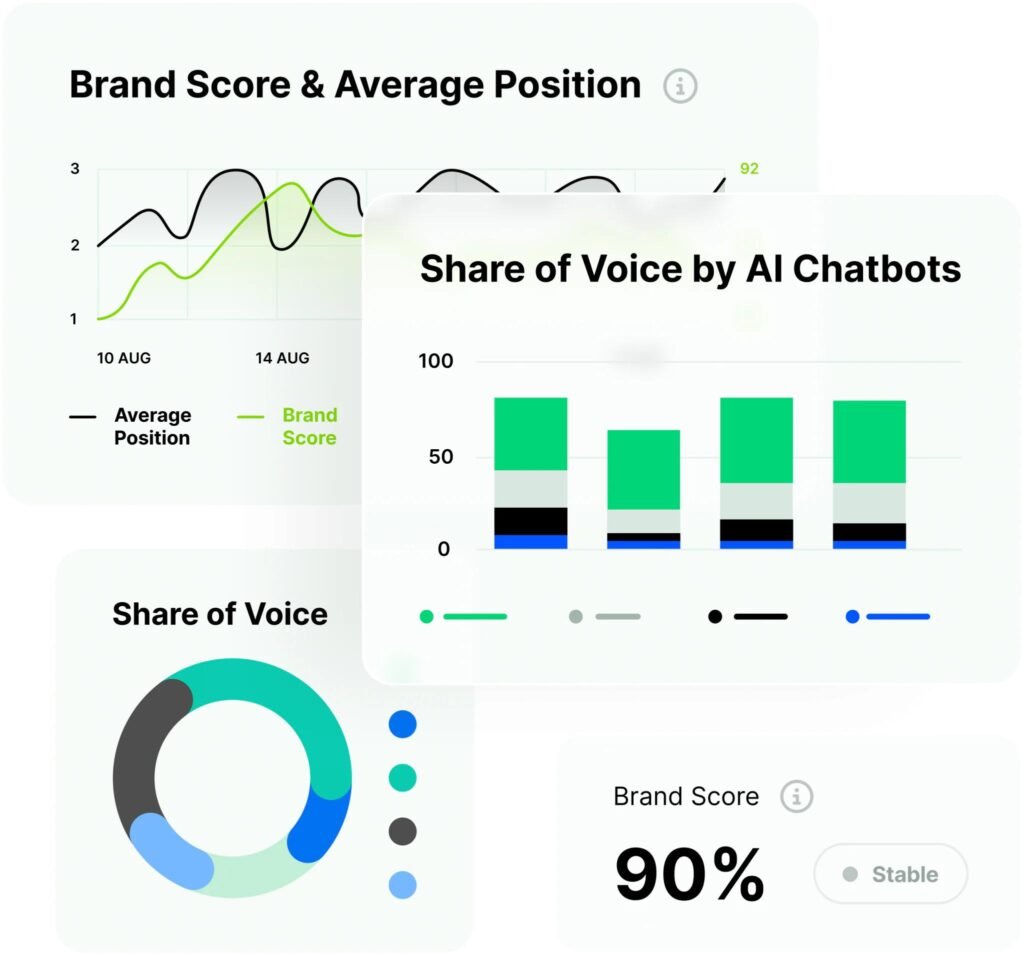
Mentions
A mention indicates that your brand appears in an AI-generated answer.
This is useful for measuring basic visibility, but it does not necessarily mean the mention is positive or prominent.
Citations
A citation indicates that the AI response references a source, often through a link or cited webpage.
Citations can be especially valuable because they reveal which pages or external sources are influencing AI answers.
Share of Voice
Share of Voice compares your visibility with competitors within a defined set of prompts.
For example, if an AI system repeatedly recommends five companies for a particular category, you want to know not just whether your company appears, but how often it appears compared with competing companies.
Position
Some platforms track where your brand appears in an AI-generated list.
Being the first recommendation and being mentioned near the bottom of a long answer are not equivalent.
Sentiment and narrative
Some tools analyze how an AI system describes your brand.
This can uncover problems that a simple mention count misses.
A company could be mentioned frequently but repeatedly described as expensive, difficult to use, or suitable only for large organizations. That is a very different problem from not being mentioned at all.
Why Traditional SEO Tools Are Not Enough
Traditional SEO tools remain valuable. They help with:
- Keyword research
- Backlinks
- Organic rankings
- Technical SEO
- Search traffic
- Content gaps
- Competitor analysis
But AI visibility introduces another measurement layer.
Consider a simple example.
A website ranks #2 on Google for:
best project management software for remote teams
However, when users ask an AI assistant the same question, the answer may recommend four competitors and never mention that website.
Traditional rank tracking would show excellent performance.
AI visibility monitoring would reveal the missing opportunity.
The two measurements are not contradictory. They are measuring different discovery systems.
How to Choose an LLM Optimization Tool
Do not choose a platform simply because its dashboard contains the words “AI,” “GEO,” or “LLM.”
Evaluate it against your actual workflow.
1. Check AI platform coverage
Make sure the tool monitors the AI surfaces your audience actually uses.
Look for coverage of platforms such as:
- ChatGPT
- Google AI Overviews
- Google AI Mode
- Gemini
- Perplexity
- Claude
- Microsoft Copilot
Coverage changes, so verify current support before subscribing.
2. Look for custom prompt tracking
Generic databases are useful, but your business may depend on very specific questions.
Custom prompts let you track the questions that matter directly to your customers.
3. Examine citation data
A good visibility platform should help answer:
Why did this answer cite my competitor instead of me?
Knowing which pages and domains are repeatedly cited can guide your content and authority strategy.
4. Compare competitors
AI visibility makes competitive research especially important.
You should be able to determine:
- Which competitors are mentioned?
- For which prompts?
- Which sources are cited for them?
- Where do they appear but you do not?
- Are they receiving more citations?
5. Check reporting frequency
Some businesses need daily monitoring. Others may only need weekly or monthly trend analysis.
Do not pay for high-frequency monitoring if your content strategy changes only occasionally.
6. Consider your existing tools
If you already use Ahrefs or Semrush, adding another platform may create unnecessary overlap.
On the other hand, a specialized AI visibility platform may offer deeper prompt-level monitoring than your existing SEO software.
Also Read: Candy AI Review 2026
A Practical AI Visibility Workflow
You do not need to optimize everything at once.
Use this process instead.
Step 1: Create a list of important questions
Start with 20–50 questions that potential customers might ask AI.
Include:
- Informational questions
- Comparison questions
- “Best” queries
- Alternative queries
- Product-selection questions
- Problem-solving questions
Step 2: Establish your baseline
Record:
- Brand mentions
- Citations
- Competitor mentions
- Position
- Share of voice
- Important cited URLs
This gives you a starting point.
Step 3: Find the gaps
Suppose competitors appear for 15 questions while your company appears for only four.
Do not immediately create 11 new articles.
First investigate why.
Look at the sources AI systems cite for those answers.
Step 4: Improve the underlying content
Create or improve genuinely useful resources.
Depending on the gap, that could mean:
- A detailed comparison
- An original tutorial
- A technical explanation
- A product documentation page
- A case study
- An FAQ
- A research-backed guide
The goal is not to manipulate an AI model into saying your brand name. The goal is to make your information easier to discover, understand, verify, and cite.
Step 5: Improve technical accessibility
Make sure important pages are accessible to search crawlers and AI systems where appropriate.
Pay attention to:
- Indexability
- Robots directives
- Internal linking
- Clear page structure
- Descriptive headings
- Structured data where appropriate
- Canonical URLs
- Page accessibility
- Accurate, consistent business information
Step 6: Recheck the same prompts
Use the same prompt set after meaningful changes.
This makes it easier to determine whether your strategy actually changed visibility rather than simply reacting to random variations in AI responses.
Common Mistakes in AI Visibility Optimization
Mistake 1: Treating an AI visibility score as a Google ranking
An AI visibility score is a platform-specific measurement. It is not an official Google ranking factor or universal measure of online authority.
Different tools can produce different scores because they use different prompts, models, data sets, and methodologies.
Mistake 2: Checking one AI response and drawing conclusions
AI-generated answers can vary.
One response is not enough to establish a reliable trend.
That is why prompt tracking over time is more useful than manually asking one question once.
Mistake 3: Publishing pages just to get cited
Creating shallow pages stuffed with keywords or brand mentions is unlikely to produce a sustainable advantage.
Useful, accurate, well-structured information remains the stronger foundation.
Mistake 4: Ignoring third-party sources
AI systems can use information from sources beyond your own website.
If competitors are consistently cited from industry publications, review sites, forums, documentation, or other authoritative sources, improving only your own website may not close the gap.
Mistake 5: Assuming AI visibility replaces SEO
It does not.
Search optimization, technical SEO, useful content, digital authority, and AI visibility overlap in important ways but are not identical.
A strong strategy should treat AI visibility as an additional discovery channel rather than a replacement for everything that came before it.
Real-World Examples
Example 1: SaaS company
A project-management SaaS company discovers that AI assistants frequently recommend three competitors for questions about remote-team collaboration.
Its own website is rarely cited.
The company examines the cited sources and discovers that competitors have detailed comparison pages, documentation, integrations pages, and independent reviews.
Instead of simply adding the phrase “best project management software,” the company improves its documentation and creates a detailed guide explaining remote-team workflows.
It then monitors the same prompt set to see whether its visibility changes.
Example 2: Technology publication
A technology website wants its articles to become sources in AI-generated answers.
It tracks questions related to AI tools and discovers that AI systems frequently cite pages containing:
- Clear definitions
- Specific comparisons
- Original explanations
- Direct answers
- Structured sections
- Supporting evidence
The publisher then restructures its content around actual reader questions rather than writing articles primarily around isolated keywords.
Example 3: B2B software company
A B2B company appears frequently in AI answers but is usually listed below competitors.
Its visibility percentage looks healthy, but its average position is weak.
The marketing team therefore does not simply publish more content. It investigates competitor positioning, citations, product descriptions, reviews, and the information AI systems use when deciding how to describe the companies.
This illustrates why visibility alone is not enough.
Advantages of LLM Optimization Tools
The strongest benefits are practical.
They make AI visibility measurable.
Instead of guessing what AI systems say about your business, you can track defined prompts.
They expose competitor gaps.
You can see where competing brands appear while yours does not.
They reveal citation sources.
Knowing which pages influence AI answers can inform your content and authority strategy.
They help identify changes over time.
Repeated monitoring can show whether your efforts correspond with changes in visibility.
They complement traditional SEO.
Many platforms connect AI visibility with search, content, and technical SEO data.
Limitations and Risks
AI visibility measurement is still an evolving field.
Different tools may use different prompt sets, models, sampling methods, and definitions of metrics. As a result, you should not assume that a score from one platform is directly comparable with a score from another.
AI responses can also change because models, search systems, indexes, and retrieval processes change. A visibility improvement today does not guarantee permanent visibility.
There are also privacy and cost considerations. AI visibility platforms may run large numbers of prompts, and more frequent monitoring can consume more credits or increase subscription costs. Before choosing a plan, understand exactly how prompts, checks, models, and additional usage are counted.
Most importantly, no legitimate tool can guarantee that an AI system will recommend your brand. These platforms measure and help optimize discoverability; they do not control the answers generated by independent AI systems.
Frequently Asked Questions
What are the best LLM optimization tools for AI visibility?
There is no universal winner. Ahrefs Brand Radar and Semrush are strong choices for teams already invested in broader SEO platforms, while Peec AI and OtterlyAI are more focused on AI visibility monitoring. Scrunch AI is useful for teams interested in AI-ready websites and agent interactions, while enterprise teams may consider platforms such as Profound. Features and pricing change, so verify current details before choosing.
Is LLM optimization the same as GEO?
Not exactly in every usage, but the terms overlap heavily. GEO, or Generative Engine Optimization, generally refers to improving visibility in generative AI answers. LLM optimization can be used more broadly to describe efforts to make information easier for language-model-based systems to understand and surface.
Can these tools improve my ChatGPT rankings?
They can help you understand and improve the factors associated with AI visibility, but there is no guaranteed “ChatGPT ranking” that a tool can directly manipulate. AI answers can vary by prompt, model, retrieval system, location, freshness, and other factors.
Do I need an AI visibility tool if I already use Google Search Console?
Google Search Console remains valuable for Google Search performance, but it does not provide the same type of cross-platform AI visibility monitoring offered by dedicated tools. Using both can therefore make sense if AI-generated discovery is important to your website.
How often should I check AI visibility?
There is no universal schedule. For most organizations, regular monitoring of a consistent prompt set is more useful than repeatedly checking random questions. A practical schedule might be weekly or monthly depending on how quickly your market and content change. Some platforms support daily tracking for teams that need more frequent monitoring.
Can small websites benefit from LLM optimization?
Yes, but they usually do not need an expensive enterprise platform immediately. A small publisher can begin with a focused set of important questions, manually inspect AI answers, analyze cited sources, and use an affordable or free visibility tool where available.
Does ranking on Google guarantee AI visibility?
No. Strong Google rankings can help discoverability, but they do not guarantee that an AI system will mention or cite the same page. AI visibility should therefore be monitored separately.
What should I optimize first for AI visibility?
Start with the information that matters most to your audience. Identify important questions, measure your current visibility, study the sources AI systems cite, and improve the pages that can provide the clearest and most authoritative answers. Technical accessibility should be checked at the same time.
Conclusion
The best LLM optimization tools for AI visibility are not necessarily the platforms with the biggest feature lists. The best tool is the one that helps you answer practical questions: where is my brand appearing, where is it missing, which competitors are winning those conversations, and what sources are influencing the answers?
Ahrefs Brand Radar and Semrush are particularly useful when AI visibility needs to fit into an established SEO workflow. Peec AI and OtterlyAI provide more specialized monitoring, while Scrunch AI takes a broader approach to making websites and content accessible to AI-driven discovery. Enterprise organizations may need a platform designed for larger-scale monitoring and reporting.
Whichever tool you choose, treat AI visibility as a measurement and optimization discipline—not a shortcut around good content. Track meaningful questions, study citations, improve the underlying information, maintain strong technical SEO, and measure the same prompts over time.
The real objective is not simply to make an AI mention your brand. It is to become a useful, trustworthy source that AI systems have a reason to discover and cite.