
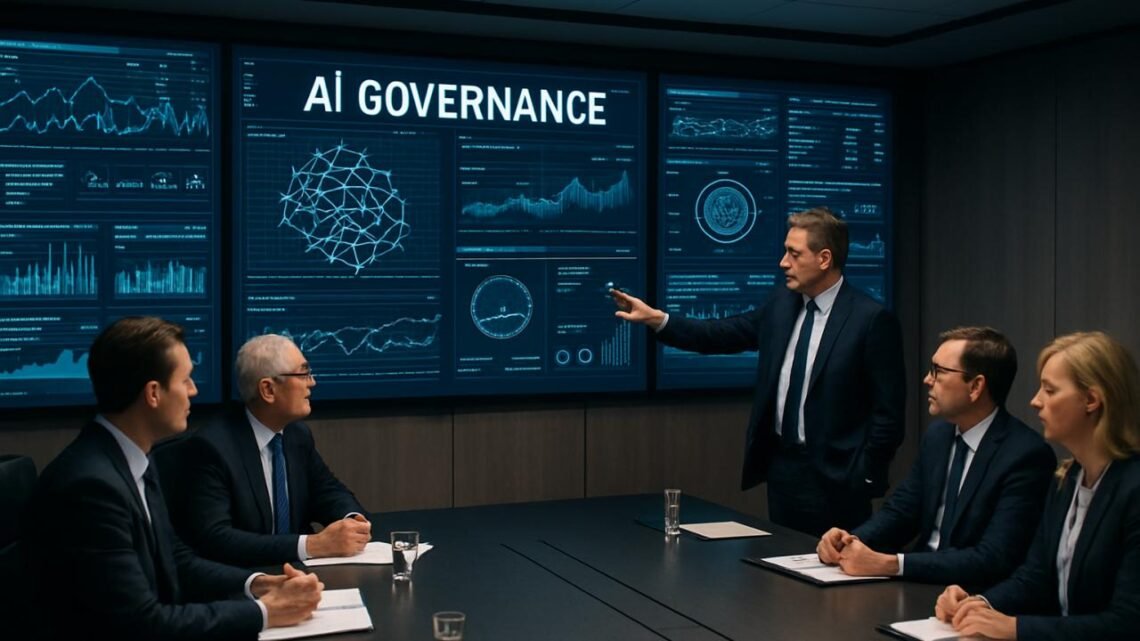
AI transformation is often presented as a technology challenge. Organizations are told to choose the right models, hire AI specialists, build better data pipelines, and automate more processes.
Those things matter. But they do not answer the harder questions: Who decides where AI should be used? Who is accountable when it produces a harmful or incorrect result? What data is acceptable to use? When should a human override an AI system? How do leaders decide whether an AI project is actually creating value?
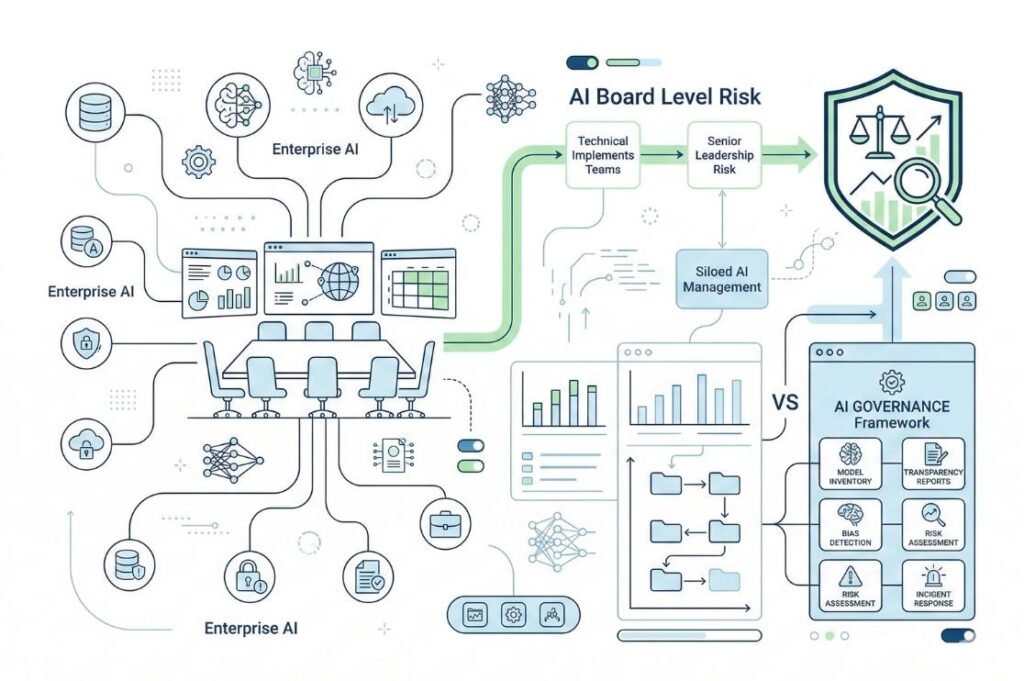
This is why AI transformation is a problem of governance as much as it is a problem of technology. Successful adoption requires a system for making decisions, assigning responsibility, managing risk, measuring outcomes, and changing organizational processes. Without that system, even technically impressive AI projects can create confusion instead of transformation.
This article explains what AI governance means in the context of organizational transformation, why governance problems often appear before technical problems, how governance should work in practice, and what organizations can do to build a more responsible and effective approach to AI.
What Does It Mean to Say AI Transformation Is a Problem of Governance?
At its simplest, governance is the system an organization uses to make decisions and assign accountability.
AI governance applies that idea to artificial intelligence. It defines how an organization decides:
- Which AI use cases should be approved
- Who owns an AI system and its outcomes
- What data the system can access
- What level of human oversight is required
- How risks are identified and managed
- How performance is monitored after deployment
- When an AI system should be changed, restricted, or retired
The important point is that governance is not just a compliance checklist.
A company can have a written AI policy and still have poor AI governance. If employees do not know who can approve an AI tool, who is responsible for its outputs, or what information can be entered into it, the organization has a governance problem regardless of how many policies exist.
AI transformation changes how decisions and work are performed. Once AI begins influencing customer interactions, hiring, financial analysis, healthcare workflows, software development, or other important processes, the organization must decide how much authority to give the system and who remains accountable.
That is fundamentally a governance question.
Why AI Projects Often Fail for Organizational Reasons
An AI model can perform well in testing and still fail to create value in the real world.
Imagine a company builds an AI system that summarizes customer support conversations. The technology works accurately enough, but several questions remain unanswered:
- Should agents trust the summary without checking the original conversation?
- Who is responsible if important information is omitted?
- Can the summaries be stored permanently?
- Are customers told how their information is processed?
- Who monitors whether accuracy changes over time?
- Which team is responsible for fixing problems?
If nobody has clear answers, the problem is not simply model quality. The organization has failed to establish ownership and decision-making processes.
The same issue appears across many AI initiatives.
| Technical question | Governance question |
|---|---|
| Which model should we use? | Who approves the model for this use case? |
| Can the model access this data? | Who has authority to approve that data use? |
| How accurate is the system? | What level of error is acceptable for this decision? |
| Can we automate this task? | Who remains accountable for the outcome? |
| How can we deploy faster? | What controls must exist before deployment? |
| Can the AI make recommendations? | When must a human review or override them? |
Technology answers the first type of question. Governance creates a framework for answering the second.
Both are necessary, but organizations frequently focus heavily on the technical side because it is easier to see. A new model, chatbot, or automation can be demonstrated quickly. Building clear accountability across departments is slower and often requires changes in management.
AI Transformation Is Not the Same as Deploying AI Tools
One common misconception is that buying or building AI tools automatically creates AI transformation.
It does not.
An organization might give employees access to generative AI and see some individuals become more productive. That can be useful, but it is not necessarily organizational transformation.
Transformation occurs when AI meaningfully changes how the organization operates, makes decisions, delivers services, or creates value.
For example, consider two approaches to customer support.
Approach One: Individual AI Adoption
Support agents independently use AI to help write responses.
This may improve productivity, but each employee may use the technology differently. There may be inconsistent quality, unclear rules about customer data, and no shared way to measure results.
Approach Two: Governed AI Transformation
The organization identifies specific support tasks where AI can help. It defines approved data sources, establishes quality requirements, assigns ownership, creates escalation procedures, and monitors outcomes.
AI becomes part of a managed operating process rather than an informal collection of individual tools.
The second approach requires more effort. However, it is also more likely to produce consistent, measurable, and sustainable results.
The Core Governance Problems Organizations Must Solve
AI governance can sound broad and abstract, so it helps to break it into practical problems.
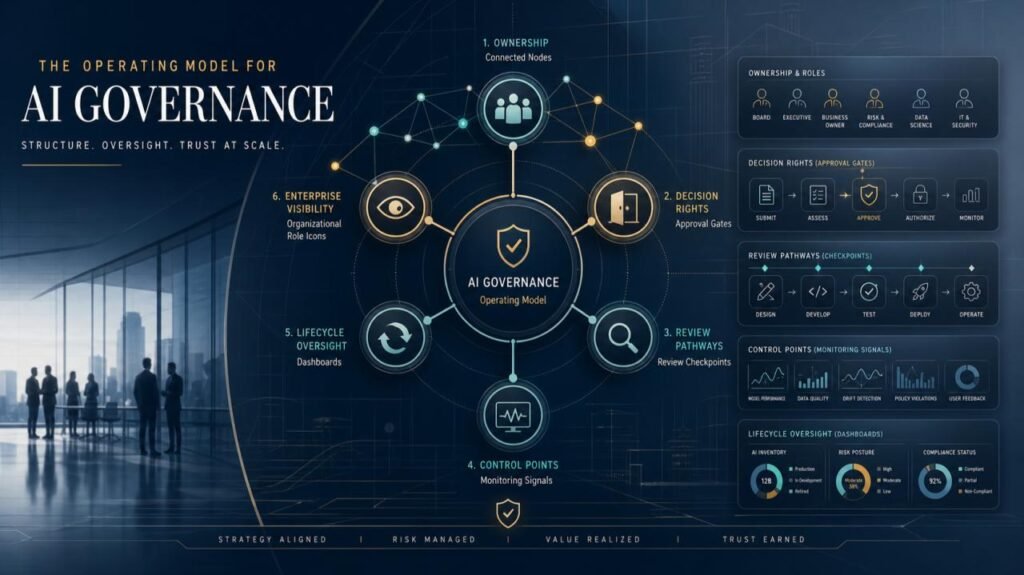
1. Decision Rights
Organizations need to decide who has the authority to make different AI-related decisions.
Not every decision should go through the same committee. Choosing a prompt template does not require the same approval process as deploying an AI system that influences high-impact decisions.
Clear governance defines which decisions belong to:
- Business teams
- Technical teams
- Data and security teams
- Legal or compliance functions
- Senior leadership
- Dedicated AI governance groups, where appropriate
The goal is not to create bureaucracy around every experiment. The goal is to make important decisions visible and accountable.
2. Accountability
AI can make accountability confusing.
Suppose an AI system recommends that a transaction should be flagged for investigation. An employee accepts the recommendation, but it later turns out to be wrong.
Who is responsible?
The software vendor? The data team? The manager who approved the system? The employee who accepted the recommendation?
Governance should establish accountability before these situations occur.
A useful principle is that introducing AI does not eliminate organizational responsibility. People and organizations remain responsible for the decisions they make about how AI is designed, deployed, and used.
3. Data Governance
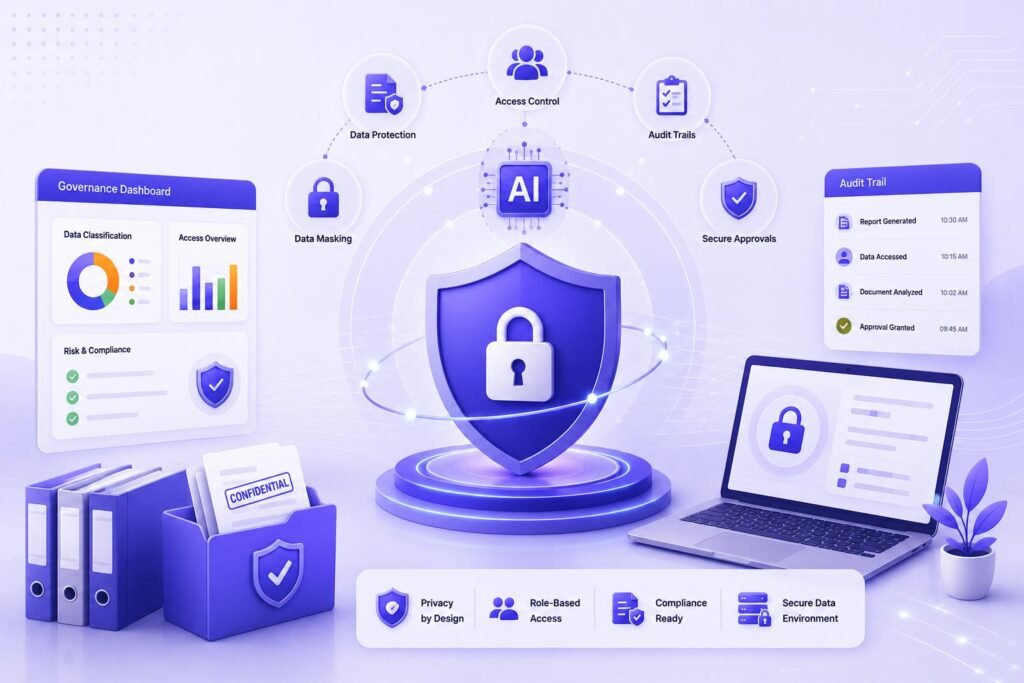
AI systems depend on data, which means AI transformation often exposes existing weaknesses in data management.
Organizations may discover that:
- Important data is scattered across disconnected systems
- Ownership of data is unclear
- Data quality varies significantly
- Sensitive information is accessible too broadly
- Historical data contains errors or outdated assumptions
An AI project cannot solve all of these problems automatically.
Governance should establish rules around data access, quality, retention, security, and appropriate use. The exact requirements depend on the organization, the data involved, and applicable laws or regulations.
Because legal and regulatory requirements can change, organizations should verify current obligations with qualified and up-to-date sources rather than relying on a generic AI policy.
4. Risk Management
Not every AI use case carries the same level of risk.
An AI tool that suggests alternative wording for an internal document is different from a system that helps make decisions affecting customers, employees, finances, safety, or access to important services.
A practical governance approach evaluates the use case, not just the technology.
Questions might include:
- What happens if the AI is wrong?
- Who could be affected?
- Can a human detect and correct errors?
- What data does the system use?
- Could the system create privacy or security concerns?
- How easily can the decision be explained or reviewed?
- What monitoring is required after deployment?
This allows organizations to apply stronger controls where the consequences of failure are greater.
Also Read: Droven.io New Gadgets 2026
How AI Governance Should Work in Practice
Good governance should enable useful AI adoption rather than simply slow it down.
A practical approach can follow five steps.
Step 1: Define the Business Problem
Start with the problem, not the model.
Instead of saying, “We need to use AI in customer service,” define a specific objective.
For example:
Reduce the time agents spend searching internal documentation while maintaining the accuracy of customer responses.
This makes it easier to evaluate whether AI is actually helping.
Step 2: Classify the Use Case
Assess the potential impact and risk.
A simple internal productivity assistant may require lightweight controls. A system influencing significant decisions may require stronger review, testing, documentation, and ongoing oversight.
The classification process should be understandable enough that teams can use it consistently.
Step 3: Assign Clear Ownership
Every significant AI system should have identifiable owners.
Ownership may include:
- A business owner responsible for the intended outcome
- A technical owner responsible for implementation and maintenance
- A data owner responsible for relevant data
- Risk, security, privacy, or compliance stakeholders when necessary
These roles do not need to create a large new department. The important thing is that responsibility does not disappear between teams.
Step 4: Establish Controls Before Deployment
Controls should match the use case.
They might include:
- Data access restrictions
- Security testing
- Accuracy or quality evaluation
- Human review requirements
- Clear user instructions
- Logging and monitoring
- Incident reporting procedures
- Limits on what the AI is allowed to do
The objective is not perfection. AI systems can still make mistakes. Governance helps ensure that mistakes are anticipated and managed rather than ignored.
Step 5: Monitor the System After Launch
Deployment is not the end of governance.
Models, data, user behavior, and business conditions can change over time. A system that performed well during initial testing may later produce different results.
Organizations should therefore monitor relevant indicators and have a process for responding when problems appear.
Real-World Examples of AI Governance in Action
Example 1: An Internal Knowledge Assistant
A company creates an AI assistant that answers employee questions using internal policies and documentation.
The technical task is relatively straightforward: connect a language model to approved knowledge sources.
The governance challenge is deciding:
- Which documents are authoritative
- Who updates outdated information
- Whether employees can upload confidential files
- How incorrect answers are reported
- When users should verify information with a human expert
Without these rules, the assistant may confidently distribute outdated or unauthorized information.
Example 2: AI-Assisted Recruitment
An organization uses AI to help summarize job applications and identify relevant qualifications.
Governance questions include:
- What information is provided to the system?
- Is sensitive information appropriately protected?
- Does the AI make decisions or only assist human reviewers?
- How are errors identified?
- Who reviews complaints or unusual outcomes?
- How is the system evaluated over time?
The key issue is not whether AI can summarize a résumé. It is how that capability fits into a decision process affecting real people.
Example 3: AI in Financial Operations
A finance team uses AI to identify unusual transactions for human review.
The AI does not automatically block transactions. Instead, it prioritizes cases that may deserve attention.
This design choice is itself a governance decision. By keeping a human review step for higher-consequence actions, the organization can use AI for speed while maintaining defined accountability.
The system still requires monitoring. If it begins generating too many irrelevant alerts or missing important cases, someone must have responsibility for investigating and adjusting the process.
Example 4: Generative AI for Software Development
Developers use AI to generate code suggestions.
The organization must decide whether generated code can be merged without review, what types of proprietary code can be shared with external services, and how security vulnerabilities are tested.
Here, governance does not mean banning AI coding tools. It means defining how they fit into existing engineering, security, and review processes.
The Advantages of Treating AI Transformation as a Governance Challenge
A governance-first perspective can provide several benefits.
Better alignment with business goals
AI projects are evaluated according to the problems they solve rather than the novelty of the technology.
Clearer accountability
Teams know who owns decisions and who is responsible for monitoring outcomes.
More appropriate risk controls
High-impact systems can receive greater scrutiny while lower-risk experiments can move faster.
Improved trust
Employees and users are more likely to understand how AI is expected to be used when rules and responsibilities are clear.
More sustainable adoption
AI becomes part of organizational processes instead of remaining a collection of disconnected experiments.
Limitations and Risks of AI Governance
Governance is not automatically good simply because it exists.
Poorly designed governance can create its own problems.
Too much centralization can slow useful work
If every experiment requires approval from a large committee, teams may avoid the official process or move too slowly to learn anything useful.
Rules can become outdated
AI technology and organizational use cases change. Governance frameworks need regular review rather than permanent assumptions.
Policies do not guarantee good behavior
Employees may misunderstand policies or use unapproved tools. Training, communication, and practical enforcement matter.
Governance cannot eliminate AI errors
Even well-governed systems can produce inaccurate, biased, insecure, or unexpected outputs. Governance reduces and manages risk; it does not guarantee perfect results.
Measurement can be difficult
Organizations may struggle to determine whether an AI project is genuinely creating value. Increased usage alone does not prove business benefit.
A useful governance system therefore needs both controls and measurement. It should ask not only, “Is this allowed?” but also, “Is this working?”
Common Mistakes in AI Transformation
Mistake 1: Starting with the tool
Organizations sometimes adopt a technology first and search for a problem afterward.
A better approach is to identify meaningful problems and then determine whether AI is an appropriate solution.
Mistake 2: Treating governance as only a legal issue
Legal and compliance teams can play important roles, but AI governance also involves operations, technology, data, security, leadership, and business strategy.
Mistake 3: Creating policies without operational processes
A policy saying “use AI responsibly” does not tell an employee what to do when an AI tool produces a questionable result.
Governance must translate principles into practical decisions and workflows.
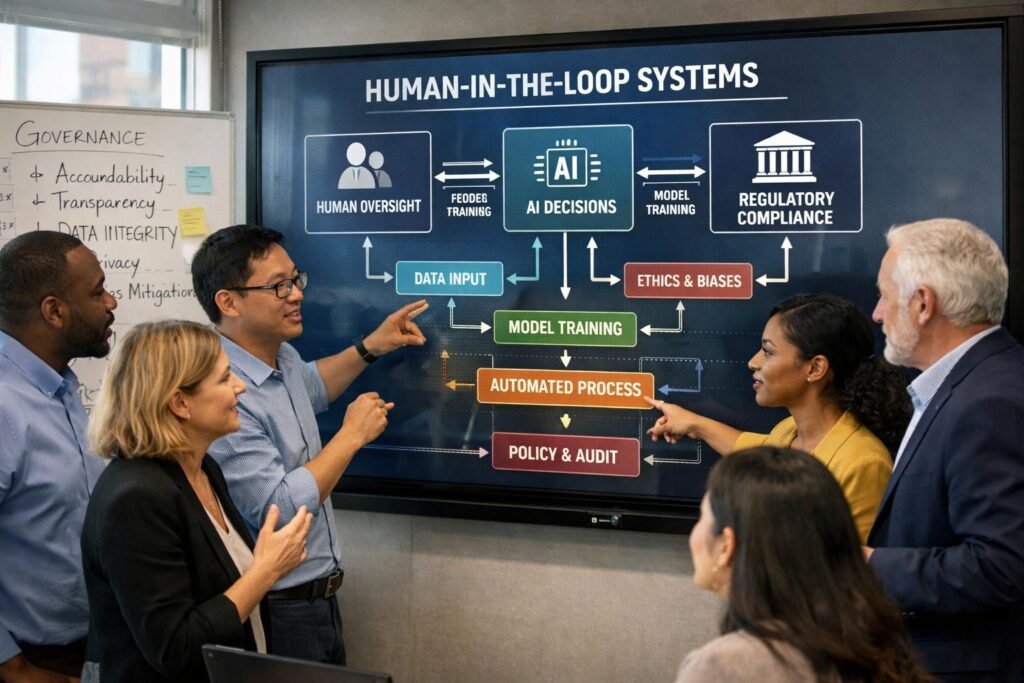
Mistake 4: Assuming human oversight automatically solves everything
A human reviewer can be valuable, but simply placing a person at the end of an automated process is not enough. The reviewer must have sufficient information, authority, time, and ability to challenge the AI.
Mistake 5: Governing every use case the same way
A low-risk writing assistant and an AI system involved in consequential decisions should not necessarily face identical requirements.
Risk-based governance is usually more practical.
Frequently Asked Questions
Is AI transformation really a problem of governance?
Yes, in the sense that successful AI transformation requires decisions about authority, accountability, risk, data, and organizational processes. Technology is essential, but technology alone does not determine how AI should be used responsibly or effectively.
What is the difference between AI governance and AI compliance?
AI governance is broader. It includes decision-making, accountability, oversight, risk management, and operational processes. Compliance focuses more specifically on meeting applicable laws, regulations, standards, or internal requirements.
Does every organization need an AI governance committee?
No. The right structure depends on the organization and its AI use cases. Smaller organizations may assign responsibilities to existing leaders and teams, while larger or higher-risk environments may need more formal governance structures.
Does AI governance slow down innovation?
Poor governance can. Well-designed governance can do the opposite by giving teams clear rules for experimentation and stronger processes for higher-risk deployments.
Who should own AI governance?
There is rarely one person who can manage every aspect. Effective governance usually involves shared responsibilities across business leadership, technical teams, data owners, security, privacy, risk, and other relevant functions.
What is the first step in building an AI governance framework?
Start by identifying current and planned AI use cases. Understand what each system does, what data it uses, who is affected, who owns it, and what could happen if it fails.
Can an organization use AI responsibly without a formal framework?
Small-scale AI use may begin informally, but as adoption expands, unclear responsibilities and inconsistent practices become more difficult to manage. A framework does not have to be complicated, but responsibilities and decision processes should be clear.
Why is the keyword “AI transformation is a problem of governance” important?
The phrase highlights a central lesson: organizations cannot achieve meaningful AI transformation simply by acquiring powerful technology. They must also govern how that technology is selected, deployed, monitored, and connected to real business decisions.
Conclusion
AI transformation is a problem of governance because AI changes more than technology. It changes workflows, decision-making, accountability, data use, and the relationship between human judgment and automated systems.
The organizations most likely to benefit from AI will not necessarily be those with access to the most impressive tools. They will be the ones that can clearly define what problems AI should solve, who owns the outcomes, what risks are acceptable, and how performance will be monitored over time.
Good AI governance should not become a barrier placed between employees and innovation. Its purpose is to create enough structure for useful experimentation while ensuring that important systems have clear accountability and appropriate oversight.
The real challenge of AI transformation is therefore not just learning how to build or buy AI. It is learning how to govern its use well.