Organizations rarely suffer from a complete lack of information. The harder problem is that useful knowledge is scattered across documents, emails, project systems, customer records, policies, meeting notes, code repositories, and the experience of individual employees. Finding the right information—and understanding which information applies to a particular situation—can be surprisingly difficult.
AI contextual organizational knowledge refers to the use of AI to make an organization’s own knowledge available in the right context. Instead of producing an answer based mainly on general information, an AI system can retrieve relevant internal material and use it to answer questions, support decisions, and assist with work.
This article explains what the concept means, how these systems work, where technologies such as retrieval-augmented generation (RAG) and knowledge graphs fit in, and what organizations need to consider before relying on AI for internal knowledge.
What Is AI Contextual Organizational Knowledge?
At its simplest, AI contextual organizational knowledge means giving an AI system access to an organization’s knowledge and enough context to use that knowledge appropriately.
Consider two questions:
“How should a company handle a customer requesting a refund?”
A general AI model can provide a reasonable answer based on general business practices.
Now consider:
“How should our company handle this customer’s refund request?”
That question may depend on the company’s refund policy, the customer’s contract, previous exceptions, the product involved, the employee’s role, and decisions made in similar cases.
The second question requires organizational context.
Organizational knowledge can include:
- Policies and procedures
- Product documentation
- Contracts and agreements
- Customer-support records
- Project documentation
- Internal research
- Meeting notes
- Engineering documentation
- Past decisions
- Incident reports
- Training materials
- Frequently asked questions
- Employee expertise and operational experience
Knowledge-management research commonly distinguishes between explicit knowledge, which can be documented, and tacit knowledge, which is embedded in people’s experience, judgment, and ways of working. AI can help connect these forms of knowledge, but it does not automatically capture everything employees know.
The important word is contextual.
A document repository can tell you what information exists. Contextual AI aims to help determine which information matters for this particular question, user, task, and situation.
Why Context Matters for Organizational AI
A language model may be excellent at explaining concepts while knowing nothing about a particular organization’s internal rules.
For example, suppose an engineering team has dealt with a recurring production problem three times.
The relevant knowledge might be distributed across:
- An incident report explaining what happened.
- A ticket describing the eventual fix.
- A code review discussing why another solution was rejected.
- A runbook documenting the approved procedure.
- A later project document that changed part of the procedure.
A simple keyword search may return all five documents without explaining how they relate.
A contextual AI system can potentially retrieve the relevant material and synthesize it into an answer such as:
- what happened previously,
- what solution was approved,
- which solution was rejected,
- whether the procedure has since changed,
- and where the evidence came from.
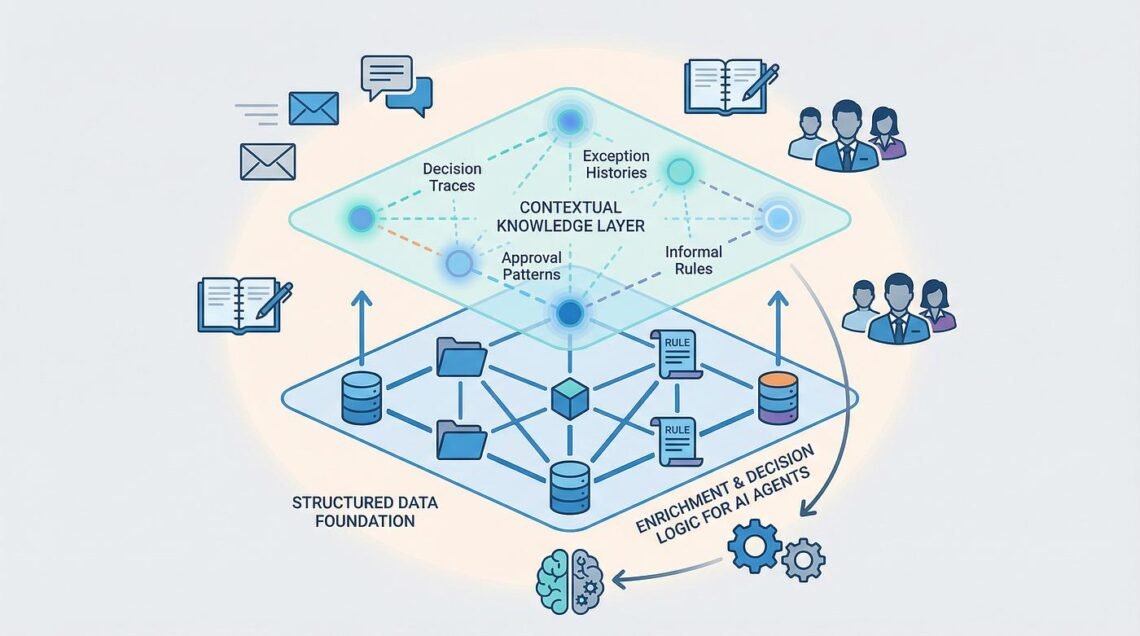
That distinction is important because organizational knowledge is not simply a collection of documents. It includes relationships between information, people, decisions, processes, and historical events.
Recent research on AI and knowledge management similarly emphasizes that organizational knowledge is distributed across systems and people and that AI can support its discovery, sharing, creation, and application.
How AI Contextual Organizational Knowledge Works
There is no single architecture for building contextual organizational knowledge. However, a typical system contains several connected layers.
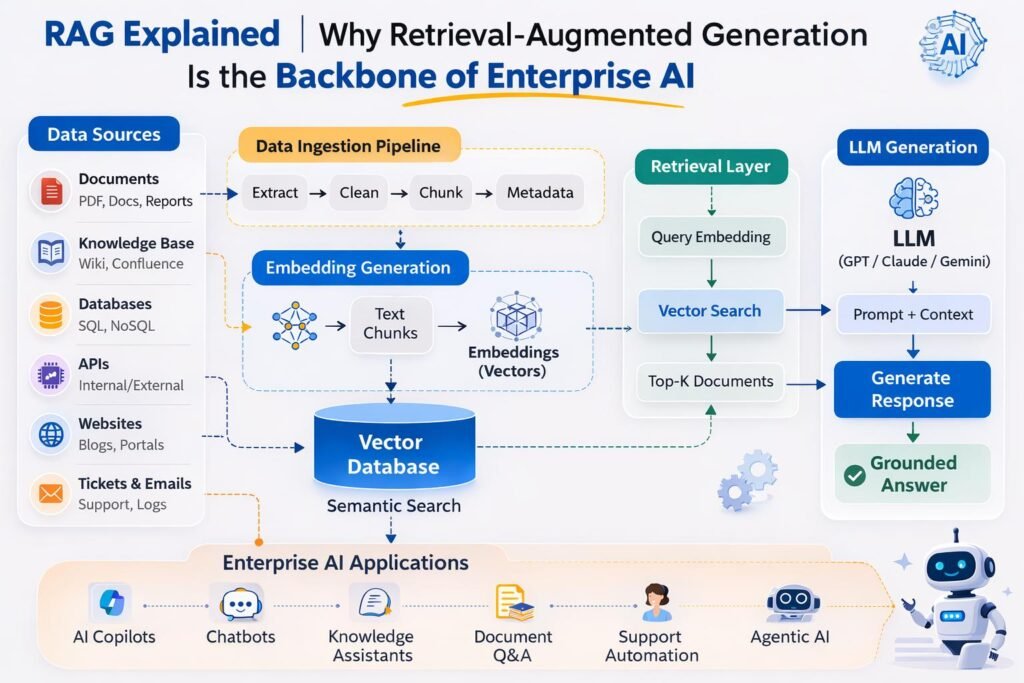
1. Collect organizational information
The system first needs access to relevant sources.
Depending on the organization, these might include:
- Document management systems
- Wikis
- Databases
- Customer-support platforms
- Project-management tools
- Code repositories
- Internal communications
- CRM systems
- Policy libraries
The objective is not necessarily to copy everything into one database. A well-designed system can connect to different sources while respecting their permissions.
2. Process and organize the information
Raw organizational information is often messy.
Documents may contain outdated policies, duplicated material, conflicting instructions, or information intended only for a particular department.
Before AI can use this information effectively, organizations may need to:
- Remove duplicates
- Identify outdated documents
- Preserve document versions
- Extract useful metadata
- Divide large documents into searchable sections
- Record ownership
- Track dates and revisions
- Apply access permissions
This stage is easy to underestimate. Better retrieval cannot compensate for fundamentally unreliable source material.
Research on generative AI in knowledge management highlights data quality, security, transparency, and up-to-date knowledge as important design considerations.
3. Retrieve relevant knowledge
When someone asks a question, the system searches the organization’s information for material relevant to that question.
This is where retrieval-augmented generation (RAG) is commonly used.
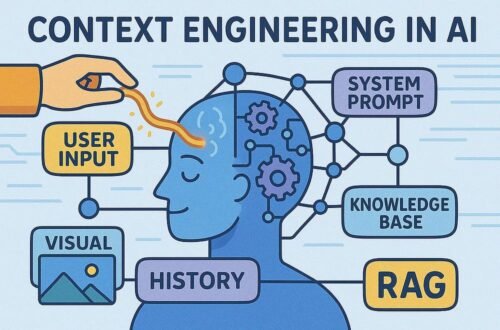
Rather than expecting a language model to memorize an organization’s entire knowledge base, RAG retrieves relevant information at query time and supplies it to the model as context.
For example:
Question:
“Can this customer receive a refund?”
Retrieval might find:
- The current refund policy
- The customer’s contract
- The relevant product terms
- A previous exception
- A support ticket containing additional context
The language model can then formulate an answer using those retrieved sources.
4. Apply user and task context
Retrieving the right documents is only part of the problem.
The system may also need to understand:
- Who is asking?
- What department are they in?
- What project are they working on?
- What customer or product is involved?
- What information is the user authorized to access?
- Is the question asking for background information or a recommendation?
- Which policy version is currently valid?
This is what makes the system contextual rather than simply searchable.
A finance employee and a software engineer might ask the same broad question but legitimately receive different information because their roles and permissions differ.
5. Generate and support the answer
The AI model uses the retrieved information to generate a response.
A strong enterprise implementation should ideally show the sources behind important claims.
This gives users a way to verify the answer rather than treating generated text as automatically correct. Research into GenAI knowledge-management systems specifically identifies source references, transparency, and acknowledgment of system limitations as important design principles.
AI Contextual Knowledge vs. Traditional Enterprise Search
These approaches are related but not identical.
| Traditional enterprise search | Contextual AI knowledge |
|---|---|
| Returns documents | Can synthesize information |
| Often depends on keywords | Can use semantic meaning |
| User examines search results | AI can explain relevant findings |
| Usually document-focused | Can connect documents, people, processes, and events |
| Context is often supplied manually | Context can be incorporated into retrieval |
| User determines the final answer | AI can assist with interpretation |
This does not mean AI search replaces traditional search.
For many tasks, conventional search is preferable because it lets users inspect the original material directly. Contextual AI is most useful when the user needs help connecting information and applying it to a specific question.
The Role of RAG and Knowledge Graphs
Two concepts frequently appear in discussions about contextual enterprise AI: RAG and knowledge graphs.
Retrieval-Augmented Generation
RAG connects a generative AI model to an external knowledge source.
A simplified flow looks like this:
User question → retrieval → relevant organizational information → AI model → answer
This approach has an important advantage: organizations can update their information sources without necessarily retraining the underlying language model every time a document changes.
RAG is particularly useful when information changes regularly, such as:
- Internal policies
- Product specifications
- Support documentation
- Procedures
- Project information
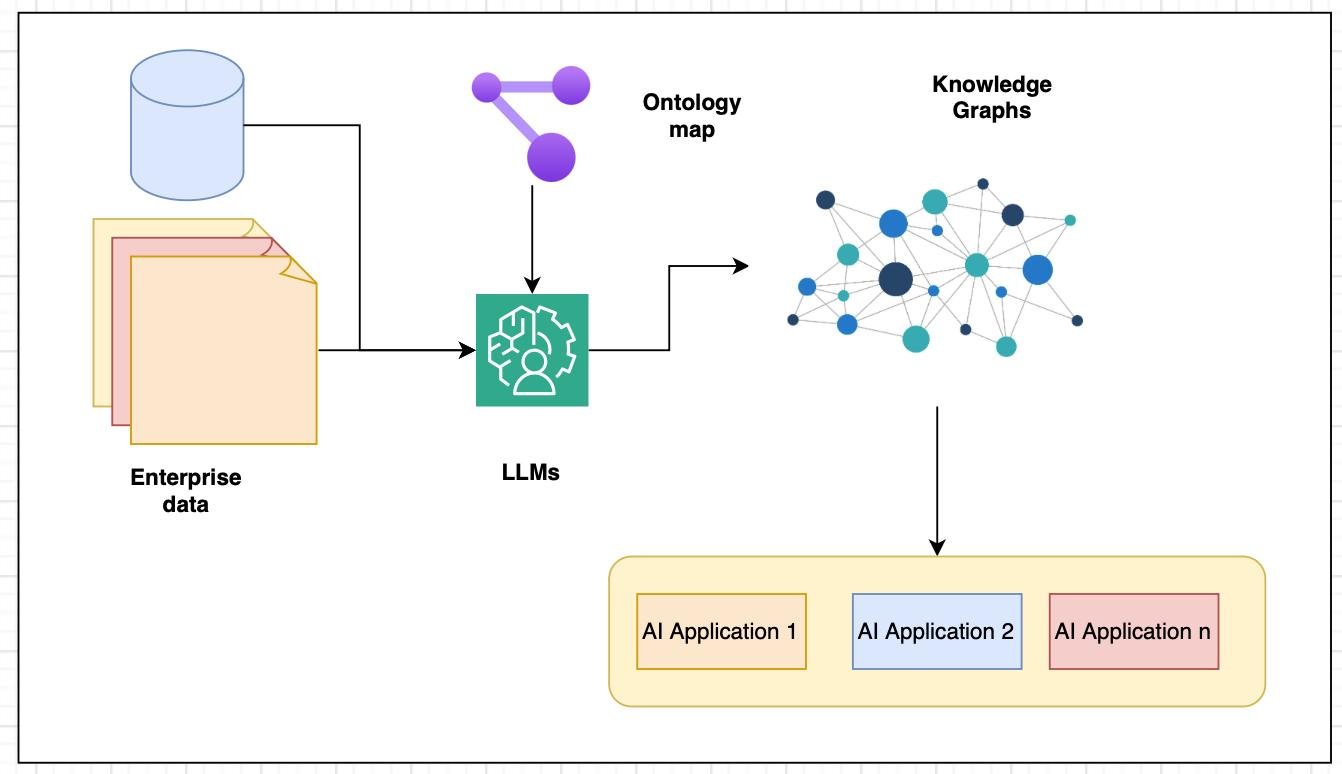
Knowledge graphs
A knowledge graph represents entities and relationships.
For example:
Customer → signed → Contract
Contract → applies to → Product
Product → owned by → Business Unit
Business Unit → follows → Policy
This can help an AI system reason across relationships that may be difficult to identify from isolated text passages.
RAG and knowledge graphs are not competing ideas. They can complement each other. RAG can retrieve relevant text, while a graph can help represent relationships between entities and events.
However, there is no universal “best” architecture. The appropriate design depends on the organization’s data, use case, security requirements, and technical environment.
Real-World Examples of Contextual Organizational Knowledge
Customer support
Imagine a support employee receives a complicated enterprise customer’s question.
Instead of searching several systems manually, an AI assistant could retrieve:
- The customer’s contract
- Current product documentation
- Previous support cases
- Applicable service policies
- Relevant internal troubleshooting steps
The assistant could then produce a draft response and identify the sources it used.
The employee still reviews the response, but the time spent searching across systems can be reduced.
Software engineering
An engineering assistant can be connected to technical documentation, issue trackers, code repositories, and incident reports.
A developer might ask:
“Why does this service use this particular authentication method?”
A useful contextual answer could connect the implementation to an earlier security decision, a relevant design document, and the current deployment procedure.
The value is not merely explaining authentication. It is explaining why this organization implemented it this way.
Employee onboarding
New employees often need information that experienced employees already know.
An internal AI assistant could answer questions such as:
- Where is the approved process for this task?
- Who owns this system?
- Which document contains the current procedure?
- What should I do when this exception occurs?
This can make organizational knowledge easier to access without requiring every question to be answered by a senior employee.
Incident response
During a technical incident, teams may need information quickly.
A contextual system could help retrieve:
- Previous incident reports
- System architecture documents
- Relevant runbooks
- Recent configuration changes
- Known failure modes
The AI can organize the information, while qualified engineers remain responsible for decisions and actions.
Sales and account management
A sales employee preparing for a customer meeting could ask an internal AI system to summarize the organization’s history with that customer.
The system might retrieve:
- Previous proposals
- Contracts
- Support history
- Meeting notes
- Product usage information
- Open issues
Instead of producing a generic sales summary, it can provide context specific to that account.

Benefits of Contextual Organizational Knowledge
When implemented properly, this approach can provide several practical benefits.
Faster access to internal information
Employees spend less time determining where information is stored and more time using it.
Better knowledge sharing
Useful knowledge does not have to remain confined to the employees who happen to know where it is located.
More consistent answers
A shared, controlled knowledge source can help employees work from the same policies and procedures.
Improved decision support
AI can connect information from multiple sources and present relevant evidence alongside a question.
Preservation of organizational memory
Organizations accumulate knowledge through projects, failures, decisions, and accumulated experience. AI can help make parts of that history easier to retrieve and reuse.
Academic research increasingly examines AI’s role in organizational knowledge creation and the conversion between tacit and explicit knowledge. However, human expertise remains important, particularly where judgment and contextual interpretation are required.
Limitations and Risks
Contextual AI is not automatically reliable simply because it has access to internal data.
Poor source data produces poor answers
If an organization’s knowledge base contains outdated or contradictory information, the AI may retrieve and present the wrong material.
This is one reason knowledge governance matters as much as model selection.
Retrieval can miss important information
A relevant document may not be retrieved because of poor indexing, ambiguous terminology, missing metadata, or an incomplete query.
RAG reduces some problems associated with relying exclusively on a model’s internal knowledge, but it does not eliminate retrieval failures.
Conflicting documents are difficult
Suppose one policy says something different from a later policy.
The system needs to know which document is authoritative and current. Simply retrieving both does not solve the problem.
Privacy and access control matter
An internal AI system can become a serious information-security problem if it gives employees access to information they are not authorized to see.
Permissions should therefore be enforced at the retrieval layer rather than assuming users will ignore information they should not have received.
AI can still make mistakes
Even when supplied with correct organizational information, a language model can misunderstand it, combine unrelated facts, or produce an overly confident answer.
For high-impact decisions, human review remains important.
Tacit knowledge is difficult to capture
Some expertise exists in people’s experience rather than in documents.
An experienced engineer may know that a particular warning usually indicates a deeper problem even though that reasoning was never formally documented.
AI can help capture and organize some of this expertise, but it cannot assume that every undocumented judgment can be reconstructed automatically.
Cost and complexity
A serious enterprise implementation may require:
- Data integration
- Identity and access management
- Search infrastructure
- Document processing
- Model infrastructure
- Monitoring
- Security controls
- Governance
- Ongoing maintenance
The challenge is therefore organizational as much as technical.
How to Build a Useful Contextual AI System
Organizations considering this approach can start with a focused use case rather than trying to connect every system at once.
Step 1: Choose a specific problem
Start with a question employees repeatedly struggle to answer.
For example:
“How do support agents find the correct procedure for unusual billing cases?”
This is more actionable than a goal such as “make all company knowledge available to AI.”
Step 2: Identify authoritative sources
Determine which sources should be trusted.
If five documents describe the same procedure, establish which one is authoritative and how outdated versions are handled.
Step 3: Map permissions
Decide who can access each type of information.
The AI should respect the organization’s existing security model wherever possible.
Step 4: Add retrieval and generation
Connect the relevant sources to a retrieval system and then provide retrieved information to an appropriate language model.
Step 5: Require evidence for important answers
Where practical, have the system show supporting documents or passages.
This makes verification easier and helps users identify when the AI has misunderstood the available evidence.
Step 6: Test difficult cases
Do not evaluate the system only with straightforward questions.
Test:
- Ambiguous questions
- Outdated information
- Conflicting policies
- Missing information
- Similar terminology
- Permission boundaries
- Questions with no reliable answer
A useful system should be capable of saying “I don’t have enough reliable information to answer this” rather than confidently inventing an answer.
Common Misconceptions
“It’s just a company chatbot.”
Not necessarily. A chatbot is an interface. Contextual organizational knowledge describes the broader capability of connecting AI with organizational information, context, permissions, relationships, and workflows.
“The AI needs to be trained on every company document.”
Not always.
A retrieval-based architecture can provide relevant organizational information to a language model when the question is asked. Whether fine-tuning, RAG, direct database access, knowledge graphs, or another architecture is appropriate depends on the use case.
“More data automatically means better answers.”
No.
Relevant, accurate, current, well-governed information is usually more useful than an enormous collection of poorly maintained documents.
“RAG solves hallucinations.”
RAG can ground an answer in retrieved information, but it does not guarantee correctness. Retrieval itself can fail, and the model can still misinterpret the material.
“AI can replace organizational expertise.”
That is a much stronger claim than the technology supports.
AI can make expertise easier to discover and reuse, but important decisions may still require people with domain knowledge, accountability, and judgment.
Frequently Asked Questions
What is AI contextual organizational knowledge?
AI contextual organizational knowledge is the use of AI to retrieve, interpret, and apply an organization’s own information in the context of a particular question, user, task, or decision.
How is it different from ordinary AI?
Ordinary general-purpose AI can answer using its trained knowledge and whatever information the user provides. Contextual organizational AI is connected to relevant internal information so its answers can reflect the organization’s own policies, history, processes, and decisions.
Is RAG required for contextual organizational knowledge?
No. RAG is one important architecture for connecting AI models to external knowledge, but organizations can use other approaches or combine multiple techniques depending on their requirements.
Can contextual AI use private company data?
Yes, technically it can be connected to private organizational data. However, the implementation must address authentication, authorization, data handling, privacy, and security requirements.
Can it understand tacit knowledge?
Only to a limited extent. Tacit knowledge is difficult to capture because it often exists as experience and judgment rather than explicit documentation. AI can help extract patterns from interactions and work artifacts, but human expertise remains important.
Does contextual AI always give accurate answers?
No. Its accuracy depends on the quality and relevance of retrieved information, system design, model behavior, and how well the organization maintains its knowledge sources.
What is the biggest mistake when implementing contextual AI?
Treating the project as only an AI-model problem. The quality of organizational knowledge, permissions, governance, retrieval, workflows, and human oversight can be just as important as the language model itself.
Conclusion
AI contextual organizational knowledge is fundamentally about making AI useful within the reality of a particular organization.
The goal is not simply to give a language model more information. It is to connect the model with the right organizational knowledge, retrieve relevant evidence, understand the surrounding context, respect access boundaries, and help people apply that information to real work.
Technologies such as RAG, enterprise search, knowledge graphs, and generative AI can provide important building blocks. But successful systems also depend on clean and current information, strong governance, appropriate permissions, transparent sources, and human judgment.
The most useful question for an organization is therefore not “Which AI model should we use?” It is “What knowledge does our organization need AI to understand, in what context, and how will we know when its answer is trustworthy?”