Searching for droven io ai automation tools can be confusing because the phrase can sound as though Droven.io itself is an automation software platform. It is important to make that distinction first: Droven.io presents itself as an informational technology platform covering artificial intelligence, robotic process automation (RPA), AI in business, digital transformation, and related technology topics. It does not present itself as a software vendor that sells or runs automation products.
That makes the topic more useful than a simple list of tools. Droven.io can be understood as a source for learning about AI and automation concepts, while the actual automation work is performed by separate software platforms, AI services, RPA systems, or custom-built workflows.
This guide explains what the term droven io ai automation tools means in practice, how AI automation works, which types of tools are relevant, where they can be useful, and what you should check before adopting an automation system.
What Does “Droven IO AI Automation Tools” Mean?
The phrase droven io ai automation tools is best treated as a search topic rather than the name of one specific software product.
Droven.io describes itself as an educational and informational platform. Its published material covers AI tools and applications, AI automation work, AI in business and marketing, RPA, digital transformation, and other technology subjects.
The distinction matters:
- Droven.io provides technology information and educational content.
- AI automation tools are the actual software systems businesses use to automate processes.
- RPA tools automate repetitive, rule-based interactions with digital systems.
- AI systems can add capabilities such as classification, summarization, prediction, language understanding, and decision support.
- Workflow platforms connect different applications and move information between them.
So, if you arrive at Droven.io looking for a button that will automatically process your company’s emails or update your CRM, that is not what the site claims to provide.
Instead, its value is in helping readers understand concepts and technologies before selecting or implementing separate tools.
What Is AI Automation?
Traditional automation follows predefined instructions.
For example:
When a customer completes a form → add the information to a spreadsheet → send a confirmation email.
AI automation can add an interpretation or decision-making layer.
For example:
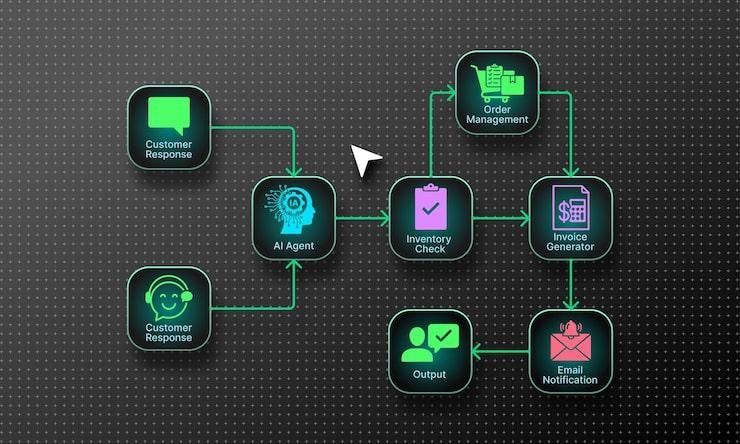
When a customer submits a message → AI identifies the customer’s intent → classify the request → send it to the appropriate workflow → draft a response → ask a human to approve it when confidence is low.
The difference is important.
Traditional automation is generally strongest when the rules are predictable. AI automation becomes useful when the workflow contains information that is difficult to handle with simple rules alone.
That could include:
- Emails written in different ways
- Customer questions
- Long documents
- Unstructured text
- Images or scanned documents
- Product descriptions
- Support requests
- Sales leads requiring classification
AI does not necessarily replace the entire workflow. Often, the most practical design is a combination of conventional automation and AI.
How AI Automation Workflows Usually Work
A typical intelligent automation workflow contains several stages.
1. A trigger starts the workflow
Something happens that tells the system to begin.
Examples include:
- A new email arrives
- A customer submits a form
- A file is uploaded
- An order is placed
- A calendar event is created
- A database record changes
2. The workflow collects information
The automation retrieves the data needed to complete the task.
For example, a sales workflow might collect a customer’s name, company, email address, message, previous interactions, and CRM record.
3. AI processes the information
An AI model may then classify, summarize, extract, generate, or analyze the information.
For example, it might determine whether an incoming message is:
- A sales inquiry
- A support request
- A billing question
- Spam
- A request requiring human attention
4. The workflow takes an action
The result is passed to another system.
For example:
- Update a CRM
- Create a support ticket
- Send an email
- Notify a team member
- Store information in a database
- Generate a report
5. Humans monitor important decisions
Good automation does not mean removing humans from every process.
For sensitive, expensive, or ambiguous decisions, a workflow can require human approval before taking action.
That approach is especially useful when AI output could cause financial, legal, customer-service, or reputational problems.
The Main Types of AI Automation Tools
There is no single category called “AI automation.” Several types of technology can be combined to create an automated system.
Workflow Automation Platforms
These platforms connect applications and automate sequences of actions.
A basic workflow might look like:
Form submission → database → CRM → email → team notification
They are particularly useful when a company already uses several applications that need to exchange information.
The main advantage is that many common workflows can be created without developing a complete custom application.
Robotic Process Automation
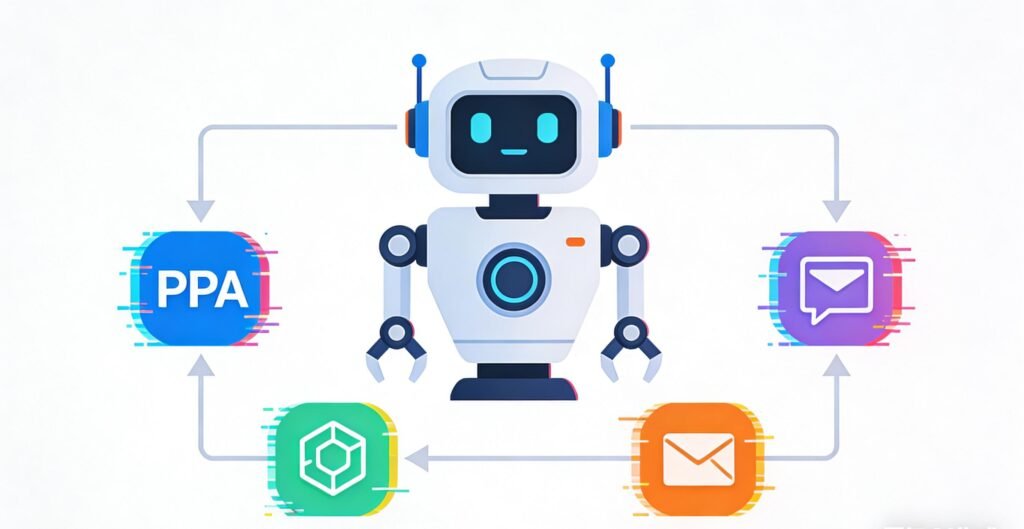
Robotic Process Automation, or RPA, uses software bots to perform repetitive, rule-based computer tasks.
Examples include:
- Entering data
- Moving information between systems
- Updating spreadsheets
- Processing invoices
- Generating reports
- Transferring information between applications
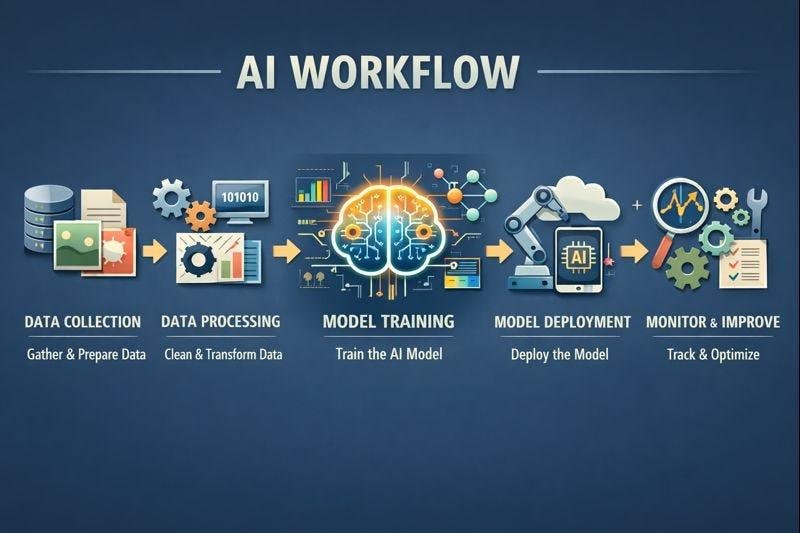
Droven.io specifically discusses RPA as a way to automate repetitive digital tasks and describes a workflow involving task identification, workflow creation, bot training, and execution or monitoring.
RPA is especially useful when employees repeatedly perform the same digital procedure.
AI Assistants and Generative AI
Generative AI can handle tasks that depend on language or other unstructured information.
For example, a company could use AI to:
- Summarize customer conversations
- Draft responses
- Extract information from documents
- Categorize incoming requests
- Create first drafts of reports
- Convert meeting notes into action items
The AI component becomes more useful when combined with an automation platform that can actually perform the next step.
AI Agents
An AI agent is a more autonomous system that can interpret a goal, choose actions, use tools, and continue through multiple steps.
For example, a lead-management agent might:
- Receive a new inquiry.
- Read the message.
- Identify the customer’s requirements.
- Search approved company information.
- Determine whether the lead meets predefined criteria.
- Update the CRM.
- Draft a response.
- Escalate unusual cases to a salesperson.
This is more flexible than a simple fixed sequence, but it also introduces additional risks because the system has greater freedom to make decisions.
Custom AI Automation
Some businesses eventually need custom software.
A custom system may combine:
- An AI model
- APIs
- Databases
- Webhooks
- Authentication
- Business rules
- Monitoring
- Human approval
- Existing company software
This approach can be powerful, but it normally requires more development and maintenance than a simple no-code workflow.
What AI Automation Can Actually Do
The most useful automation opportunities are usually repetitive processes with clearly defined inputs and outputs.
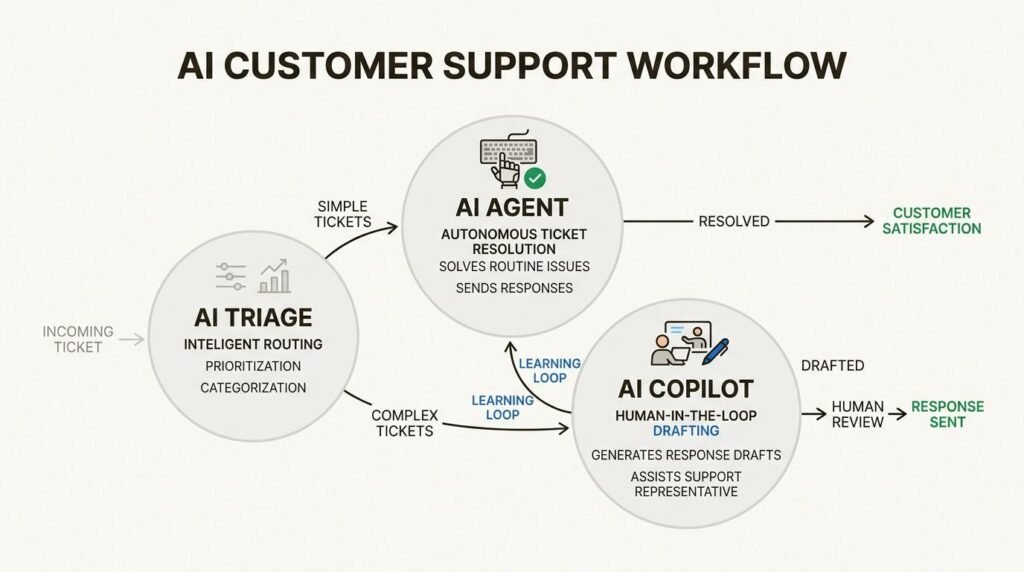
Example 1: Customer Support
Imagine an online store receiving hundreds of customer emails.
Instead of manually reading every message, an automated workflow could:
- Receive the email.
- Identify the subject.
- Classify the request.
- Extract the order number.
- Retrieve approved order information.
- Draft an appropriate response.
- Send straightforward cases automatically.
- Escalate unusual cases to a human.
The benefit is not simply “using AI.” The real benefit comes from connecting AI classification with the systems that execute the rest of the process.
Example 2: Lead Qualification
A business might receive inquiries through its website.
An automation could:
- Capture the form submission.
- Check whether required information is present.
- Use AI to categorize the inquiry.
- Add the lead to a CRM.
- Assign the appropriate sales representative.
- Send a personalized acknowledgement.
- Schedule a follow-up task.
A human salesperson can then concentrate on qualified opportunities rather than copying information between systems.
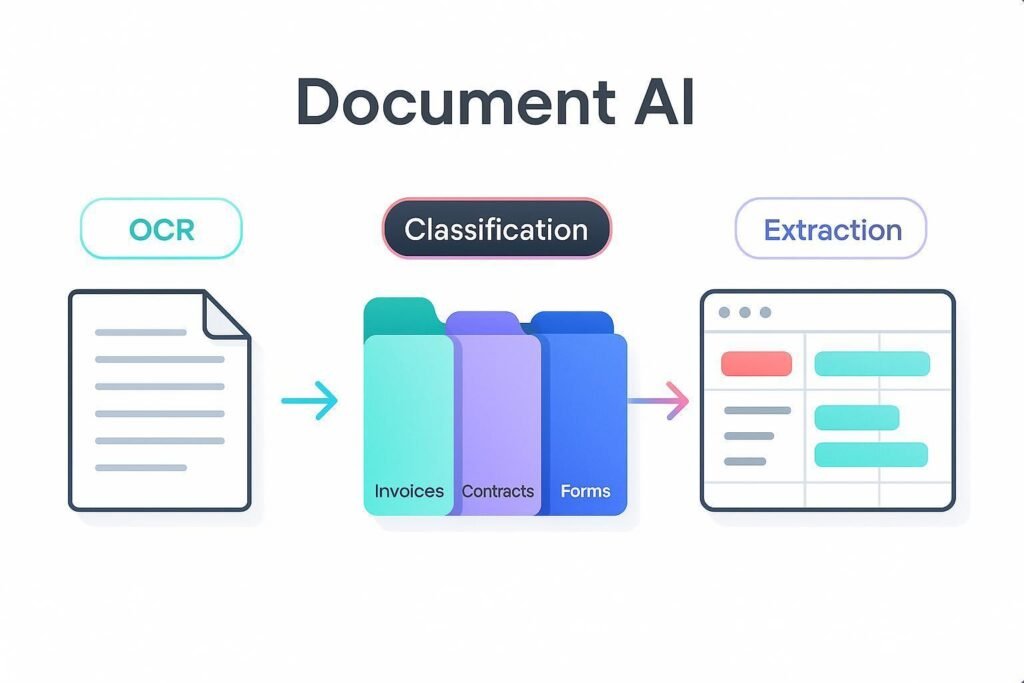
Example 3: Document Processing
Consider a business that receives supplier invoices as PDFs.
A workflow could:
- Detect a new invoice.
- Extract the supplier, invoice number, date, and amount.
- Check the information against existing records.
- Flag missing or suspicious information.
- Store the document.
- Send approved invoices into an accounting workflow.
The important point is that document processing often combines several technologies rather than relying on AI alone.
Example 4: Marketing Operations
A marketing team might receive customer or campaign data from multiple sources.
Automation can help:
- Collect campaign information
- Organize leads
- Segment audiences
- Summarize performance
- Generate internal reports
- Notify team members about important changes
Droven.io’s business-focused AI material discusses applications including marketing, customer experience, decision-making, cybersecurity, and operational efficiency.
Benefits of AI Automation
When implemented appropriately, automation can provide several practical benefits.
Less repetitive manual work
Employees spend less time copying information, updating records, sorting messages, or performing predictable administrative tasks.
Faster processing
Software can process many routine operations without waiting for someone to perform each step manually.
More consistent workflows
A well-designed automation follows the same defined procedure each time.
Better use of employee time
Automation can move routine work away from employees so they can concentrate on activities that require judgment, communication, creativity, or expertise.
Better integration between systems
Instead of maintaining isolated spreadsheets and applications, automation can connect systems so information flows between them.
Limitations and Risks
AI automation is not automatically accurate, inexpensive, or safe.
AI can make mistakes
An AI model may misunderstand a request, extract incorrect information, or produce an answer that sounds convincing but is wrong.
For this reason, high-impact workflows should include validation and human review where appropriate.
Automation can amplify bad processes
If a business process is poorly designed, automating it can simply make the poor process run faster.
Before automating, ask:
Is this process actually worth keeping?
Sometimes the correct solution is to simplify the process first.
Integration can become complicated
Connecting several systems introduces dependencies.
An automation may fail because:
- An API changes
- Authentication expires
- A service becomes unavailable
- Data arrives in an unexpected format
- A workflow exceeds a service limit
- A third-party application changes its behavior
Monitoring is therefore part of automation—not an optional extra.
Privacy and security matter
AI automation may handle customer information, financial documents, employee records, or other sensitive business data.
Before connecting a tool to company systems, check:
- What data it receives
- Where the data is processed
- How long data is retained
- Who can access it
- What security controls exist
- Whether the service meets relevant regulatory requirements
Do not assume that a tool is safe simply because it uses AI.
Costs can be difficult to predict
Automation expenses may come from several places:
- Software subscriptions
- AI model usage
- API calls
- Cloud infrastructure
- Storage
- Development
- Maintenance
- Monitoring
A workflow that looks inexpensive at small scale may become more costly as usage grows.
Also Read: AI Contextual Organizational Knowledge
How to Choose an AI Automation Tool
Rather than starting with the question, “Which AI tool is best?”, start with the process.
Step 1: Identify the repetitive task
Write down exactly what employees currently do.
For example:
“Every morning, an employee reads new website inquiries, copies contact information into the CRM, categorizes the lead, and sends an acknowledgement.”
That is much more useful than saying:
“We need AI for sales.”
Step 2: Determine how predictable the task is
If the process follows strict rules, conventional automation or RPA may be enough.
If it requires understanding text, documents, or context, AI may add value.
Step 3: Identify the systems involved
List the applications that need to communicate.
For example:
Website → CRM → Email → Calendar
Then check whether the automation platform supports the required integrations or APIs.
Step 4: Decide where humans should remain involved
Not every decision should be automated.
Define which cases can happen automatically and which require approval.
Step 5: Test a small workflow
Do not automate an entire department on the first attempt.
Start with one measurable process.
Track:
- Time saved
- Error rates
- Workflow failures
- AI accuracy
- Human intervention
- Operating costs
Step 6: Expand only after testing
Once the first workflow works reliably, extend the approach to related processes.
This reduces the risk of building a large automation system around assumptions that have not been tested.
Droven.io vs. AI Automation Software
The simplest way to understand the distinction is to separate learning from execution.
| Category | Main purpose |
|---|---|
| Droven.io | Learn about AI, RPA, automation, and technology |
| Workflow automation software | Connect applications and automate processes |
| RPA software | Automate repetitive, rule-based computer tasks |
| Generative AI | Understand or generate unstructured content |
| AI agents | Perform multi-step tasks with greater autonomy |
| Custom AI systems | Solve specialized automation requirements |
Droven.io itself states that it is an informational platform rather than a provider of automation software or enterprise solutions.
That distinction is one of the most important things to understand when researching droven io ai automation tools.
Common Mistakes to Avoid
Assuming Droven.io is an automation product
This is the biggest misconception.
Droven.io provides educational material about technology; it does not claim to be the automation engine running your business workflows.
Choosing a tool before defining the problem
A long list of features does not mean a platform is suitable for your workflow.
Start with the business process.
Automating everything
Some tasks require human judgment and should remain partly manual.
Ignoring failure handling
Every serious automation should answer:
What happens if the AI is wrong?
and:
What happens if the connected application is unavailable?
Treating AI output as automatically trustworthy
AI-generated information should be validated according to the risk of the task.
A mistake in an internal draft is very different from a mistake involving a payment, customer account, or compliance process.
Frequently Asked Questions
What are Droven IO AI automation tools?
The phrase droven io ai automation tools refers to the AI and automation technologies discussed or researched in relation to Droven.io. Droven.io itself describes its role as an informational technology platform rather than an automation software provider.
Does Droven.io provide automation software?
Based on its publicly available description, no. Droven.io says it is an informational and educational platform and does not sell automation tools or enterprise solutions.
What does Droven.io cover?
Its technology content includes artificial intelligence, AI tools and applications, AI automation, RPA, AI in business and marketing, digital transformation, cybersecurity, cloud computing, software development, and future technology.
What is the difference between AI automation and RPA?
RPA generally automates predictable, rule-based digital actions, such as transferring data between systems. AI automation can add capabilities such as language understanding, classification, summarization, and contextual decision support. The two technologies can also be combined.
Can AI automation replace employees?
Not necessarily. In many practical deployments, automation removes repetitive work while people remain responsible for judgment, exceptions, supervision, and higher-value activities.
Is AI automation suitable for a small business?
It can be, especially when the business has repetitive processes involving email, forms, customer information, scheduling, reporting, or data transfer. The best starting point is usually a small workflow with a clear benefit rather than a broad attempt to automate everything.
Is AI automation always accurate?
No. AI systems can make errors, misunderstand information, or produce incorrect outputs. Important workflows should therefore include validation, monitoring, and human review where appropriate.
How should I start learning about AI automation?
Start by learning the difference between workflow automation, RPA, generative AI, and AI agents. Then identify one repetitive process in your own work and investigate which technology fits that process.
Conclusion
The most important thing to understand about droven io ai automation tools is that Droven.io and automation software serve different purposes. Droven.io is positioned as an educational technology platform covering AI, RPA, business automation, digital transformation, and related subjects. It is not itself the software that executes business workflows.
Actual AI automation usually combines several components: workflow software, APIs, AI models, business rules, databases, RPA, or custom code. The right combination depends on the task being automated, the systems involved, the level of human oversight required, and the sensitivity of the data.
For beginners, the best approach is simple: define the problem first, choose the technology second, and automate gradually. A small workflow that reliably saves time is far more valuable than a complicated AI system that looks impressive but is difficult to control.
If you use Droven.io as a learning resource and then verify specific software capabilities, pricing, security policies, and integrations directly with the relevant vendors, you can make much more informed automation decisions.