
Artificial intelligence can have a significant environmental footprint, but the answer to “is AI bad for the environment” is more complicated than a simple yes or no. AI systems require electricity to train and operate, data centers need cooling, and the hardware behind AI depends on energy- and resource-intensive manufacturing.
At the same time, AI is not an environmental impact category by itself. Its footprint depends on what kind of AI is being used, how much computing it requires, where the data center is located, what electricity powers it, how efficiently the hardware is operated, and what the technology is being used to accomplish.
This article explains where AI’s environmental impact comes from, including electricity consumption, carbon emissions, water use, hardware production, and electronic waste. It also looks at an important part of the discussion that is sometimes overlooked: AI can potentially help reduce environmental impacts in other industries.
Is AI Bad for the Environment?
AI can be harmful to the environment when its growing computational demand leads to additional electricity consumption, water use, greenhouse gas emissions, resource extraction, and electronic waste.
However, it would be misleading to treat every AI application as having the same environmental impact.
A short text-generation request and a large-scale AI model processing video, images, or complex reasoning tasks can require very different amounts of computing. The environmental impact also changes depending on the efficiency of the data center and the electricity sources supplying it.
The International Energy Agency (IEA) reported that data centers consumed about 1.5% of global electricity in 2024, although data centers support many workloads besides AI. The agency expects global data-center electricity consumption to more than double by 2030 in its base case, reaching around 950 TWh.
That does not mean AI alone will consume that amount. Rather, AI is one of the major forces contributing to increasing demand for data-center computing.
Why Does AI Use So Much Energy?
AI models run on computers located primarily in data centers. These facilities contain servers equipped with CPUs, GPUs, and other specialized hardware.
Training a large model can involve processing enormous amounts of data repeatedly. Once a model has been trained, it still requires computing resources whenever people use it. This second stage is often called inference.
The basic process looks like this:
- AI developers prepare and process large datasets.
- Specialized computers train the model using those datasets.
- The trained model is stored on servers.
- Users send requests to the model.
- Servers perform calculations to generate responses.
- Cooling and other infrastructure keep the equipment operating.
Every step involving computation requires electricity.
Modern data centers also consume electricity for networking, storage, cooling, power management, and other supporting infrastructure. According to the IEA, servers account for around 60% of electricity demand in modern data centers on average, although the proportion varies by facility.
Training is only part of the picture
A common misconception is that most of AI’s environmental impact happens when a model is trained.
Training can certainly require substantial computing resources, but popular AI systems may also perform millions or billions of inference operations over their lifetimes.
This creates an important distinction:
- Training: building or updating an AI model.
- Inference: running the trained model to answer requests or perform tasks.
- Infrastructure: operating the servers, networking equipment, storage, and cooling systems needed for both.
The environmental footprint therefore depends on the entire lifecycle rather than one training run.
AI Does Not Use the Same Amount of Energy for Every Task
It is tempting to ask how much electricity “one AI query” uses, but there is no universal number.
Energy consumption can vary with:
- Model size
- Hardware type
- Data-center efficiency
- Request length
- Output length
- Type of AI task
- Cooling requirements
- Server utilization
- Electricity source
A simple text request can be considerably less computationally demanding than certain image, video, reasoning, or agentic tasks.
The IEA’s latest analysis notes that newer AI applications such as video generation, reasoning, and agentic tasks can consume dramatically more energy per task than simple text generation.
This is one reason why viral claims about the environmental cost of “one AI prompt” should be treated carefully. A number calculated for one model, data center, or workload should not automatically be applied to every AI system.
How AI Contributes to Carbon Emissions
Electricity consumption does not automatically equal a particular amount of carbon emissions.
The key question is where the electricity comes from.
A data center powered primarily by a low-carbon electricity mix can have a different operational carbon footprint from an otherwise similar facility supplied by a grid with a high share of fossil fuels.
The IEA estimates that renewables currently provide a significant share of electricity consumed by data centers globally, while natural gas, coal, nuclear power, and other sources also contribute. The exact mix varies substantially by region.
This means two AI systems performing similar amounts of computation can have different carbon footprints simply because they operate in different locations.
Efficiency matters too
Hardware and software efficiency can reduce the amount of computing required for a particular task.
Improvements can come from:
- More efficient AI chips
- Better model architectures
- Smaller specialized models
- Improved software optimization
- Higher server utilization
- More efficient cooling
- Better data-center design
There is an important complication, however: making AI more efficient does not necessarily guarantee lower total environmental impact.
If computing becomes cheaper and easier, people and organizations may simply use much more of it. This is sometimes discussed in terms of rebound effects.
AI Also Uses Water
Electricity receives most of the attention in discussions about AI’s environmental footprint, but water is another important consideration.
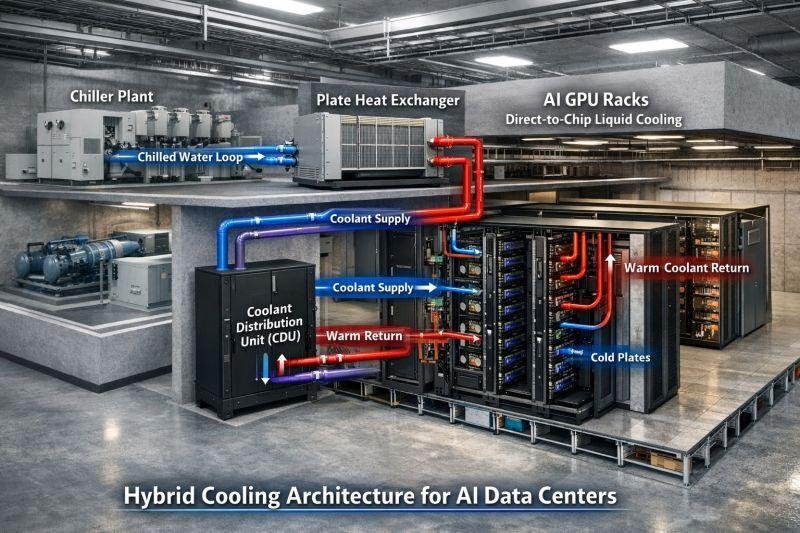
Data centers generate substantial heat. Depending on the facility, cooling systems can use water to remove that heat and maintain suitable operating temperatures.
There is also an indirect water footprint associated with electricity generation. Power plants can consume or withdraw water depending on their technology and location.
The OECD identifies direct cooling and water use associated with electricity generation as two major sources of water consumption connected to AI computing. Semiconductor manufacturing can also require significant quantities of water.
Why location matters
Water use is not equally important everywhere.
A data center located in an area with abundant water resources faces a different environmental challenge from one operating in a region experiencing drought or water stress.
This is why a single global estimate of “AI’s water consumption” can be misleading without information about:
- Where the computing occurs
- Which cooling technology is used
- Local climate
- Local water availability
- Electricity generation methods
- Whether water is withdrawn, consumed, treated, or returned
A 2025 study in Nature Sustainability modeled the combined energy, water, and carbon impacts of AI servers in the United States and found substantial uncertainty depending on server deployment, grid conditions, efficiency, and location.
AI Hardware Has an Environmental Footprint Too
AI does not exist only as software.
Running AI requires physical infrastructure such as:
- GPUs and other accelerators
- CPUs
- Memory
- Storage
- Networking equipment
- Servers
- Data-center buildings
- Cooling equipment
- Power infrastructure
Manufacturing this equipment requires raw materials, energy, water, transportation, and industrial processes.
The environmental impact associated with manufacturing is sometimes called embodied environmental impact.
This matters because looking only at electricity consumed during AI operation does not capture the entire lifecycle.
The OECD notes that AI’s environmental footprint can include energy and water consumption, greenhouse gas emissions, electronic waste, and resource extraction associated with hardware and infrastructure.
What About Electronic Waste?
AI hardware does not last forever.
Servers and accelerators eventually become obsolete, are replaced, or are moved to less demanding workloads. Disposing of or recycling this equipment creates another environmental consideration.
Electronic waste can contain valuable materials that can potentially be recovered, but improper disposal can create environmental problems.
The rapid development of AI hardware also raises a broader question: how often should computing equipment be replaced to achieve better performance?
A newer, more efficient chip could reduce the energy required for certain workloads, but manufacturing the replacement also has an environmental cost.
There is therefore no simple rule that newer hardware is always environmentally better.

Real-World Examples of AI’s Environmental Impact
AI chatbots
When someone asks an AI chatbot to generate text, the request is processed on computing infrastructure in a data center.
The model performs calculations, uses electricity, and produces heat that must be managed by the facility.
For an individual user, the environmental effect of one request may be relatively small compared with many ordinary activities. The larger issue is what happens when millions of people use AI repeatedly at large scale.
AI image and video generation
Generating images requires more than simply retrieving existing text.
The model performs substantial mathematical operations to construct the requested image. Video generation can require even more computation because the system needs to generate or process information across many frames.
This is one reason the environmental cost of AI should not be reduced to a single “AI query” figure.
Large AI data centers
The environmental effects become particularly important when AI infrastructure is deployed at enormous scale.
The IEA notes that AI-focused data centers can have power demands comparable to energy-intensive industrial facilities, while their geographic concentration can create significant local effects on electricity systems.
A region may therefore experience a noticeable increase in electricity demand even though data centers remain a relatively small share of global electricity consumption.
Also Read: Droven.io Enterprise Tech Innovation
Can AI Actually Help the Environment?
Yes. AI can create environmental benefits as well as environmental costs.
The important question is whether those benefits are large enough to outweigh the resources required to develop and operate the AI system.
Potential applications include:
Improving electricity grids
AI can help analyze electricity demand, forecast renewable generation, detect equipment problems, and optimize energy systems.
The IEA identifies AI-enabled optimization and innovation as an important potential benefit for the energy sector.
Reducing energy waste
AI systems can analyze patterns in buildings, factories, transportation networks, and other systems to identify opportunities for more efficient energy use.
For example, a system could analyze building conditions and adjust heating or cooling based on changing demand.
Environmental monitoring
AI can process large quantities of satellite imagery, sensor data, and other environmental information.
This can support applications such as:
- Monitoring forests
- Tracking changes in land use
- Detecting environmental changes
- Improving weather and climate modeling
- Monitoring infrastructure
- Supporting agricultural decision-making
The OECD highlights environmental monitoring, climate-related modeling, smart systems, and resource optimization as areas where AI can potentially support environmental objectives.
Improving industrial efficiency
Factories can use AI to identify patterns in equipment performance, predict maintenance requirements, and optimize production processes.
If an AI system helps an industrial operation use substantially less energy or material, the environmental benefit could potentially exceed the footprint of running the AI system.
But that outcome should be demonstrated rather than assumed.
The Biggest Misconceptions About AI and the Environment
“AI is destroying the environment.”
This is too broad to be useful.
AI has real environmental costs, particularly through electricity consumption, cooling, hardware manufacturing, and infrastructure expansion. But its overall environmental effect depends on how the technology is produced and used.
“AI has no environmental impact because it is digital.”
Digital services still depend on physical infrastructure.
Every AI model ultimately runs on physical computers that require electricity, cooling systems, buildings, networking equipment, and manufactured components.
“Every AI question uses the same amount of energy.”
It does not.
Different models and tasks can have very different computational requirements.
“Renewable energy makes AI environmentally harmless.”
Renewable electricity can reduce operational carbon emissions, but it does not eliminate all environmental impacts.
AI infrastructure still involves hardware manufacturing, land and infrastructure requirements, water considerations, resource extraction, and electronic waste.
“AI will automatically solve climate change.”
AI may help with environmental problems, but its benefits depend on how it is deployed and whether the resulting applications actually reduce resource consumption or emissions.
Potential benefits should be measured rather than assumed.
How Can the Environmental Impact of AI Be Reduced?
Reducing AI’s footprint requires action at several levels.
1. Use the smallest suitable model
A complex model is not necessary for every task.
If a smaller model can perform a job adequately, using it may reduce computational requirements.
2. Improve hardware efficiency
More efficient chips can perform more computation with less electricity, although their manufacturing footprint must also be considered.
3. Improve data-center efficiency
Better cooling, power management, server utilization, and facility design can reduce the resources required to operate AI infrastructure.
4. Use lower-carbon electricity
The electricity mix supplying a data center can significantly affect its operational carbon footprint.
5. Measure water consumption
AI companies and data-center operators can improve environmental decision-making by measuring and reporting water use more consistently.
The OECD has pointed out that water-related data remains less developed than some energy and emissions metrics.
6. Avoid unnecessary AI workloads
Organizations can also consider whether AI is actually necessary for a particular task.
Running a computationally expensive system for a problem that could be solved with a simpler method may provide little benefit relative to its resource use.
So, Is AI Bad for the Environment?
AI has an environmental cost, but whether a particular AI application is environmentally harmful depends on the entire system around it.
The biggest concerns are electricity demand, carbon emissions, water use, hardware manufacturing, resource extraction, and electronic waste. These impacts are becoming more important as AI adoption and data-center capacity grow.
At the same time, AI can potentially reduce environmental impacts elsewhere by improving energy systems, industrial efficiency, environmental monitoring, transportation, agriculture, and other applications.
The most useful way to think about AI and sustainability is therefore not simply “AI is bad” or “AI is green.” The better question is: How much environmental resource does an AI system require, and what does society get in return?
As AI technology develops, reliable measurement will become increasingly important. Current estimates can vary substantially depending on the model, workload, hardware, data-center location, electricity mix, cooling system, and assumptions used. For current figures, readers should verify the latest information from organizations such as the IEA, OECD, and peer-reviewed research.
Frequently Asked Questions
Is AI bad for the environment?
AI can have negative environmental effects because it requires electricity, cooling, physical hardware, and data-center infrastructure. However, the size of the impact varies considerably between AI systems and applications.
Does AI use a lot of electricity?
AI can require substantial electricity, particularly at large scale. Data centers as a whole accounted for about 1.5% of global electricity consumption in 2024, according to the IEA, with AI contributing to the sector’s growing demand.
Does AI consume water?
Yes. Water can be used directly in some data-center cooling systems and indirectly through electricity generation. Semiconductor manufacturing also has significant water requirements.
Is AI worse for the environment than traditional computing?
There is no universal answer. Some AI workloads require considerably more computation than conventional software tasks, while other AI applications can be relatively lightweight. The comparison depends on the specific workloads, infrastructure, and intended outcome.
Does using ChatGPT or another AI chatbot harm the environment?
Using an AI chatbot requires computing resources and therefore has an environmental footprint. However, the impact of an individual request depends on the model, workload, hardware, data center, and electricity source. It is more meaningful to consider aggregate usage and infrastructure than to treat every individual prompt as having an identical environmental cost.
Can AI help fight climate change?
Potentially. AI can be used for energy-system optimization, environmental monitoring, forecasting, industrial efficiency, and other applications. Whether a particular application produces a net environmental benefit depends on its actual resource requirements and the environmental savings it creates.
Will AI’s environmental impact get worse?
AI-related computing demand is expected to grow, but the future environmental impact is uncertain. Efficiency improvements, cleaner electricity, improved cooling, hardware development, and changes in AI usage could reduce impacts per unit of computation, while rapidly increasing demand could increase total resource consumption. The IEA’s projections should therefore be treated as scenarios rather than guaranteed outcomes.
What is the biggest environmental problem caused by AI?
There is no single issue that applies everywhere. Electricity demand and associated emissions receive significant attention, while water use, hardware manufacturing, mineral extraction, and electronic waste are also important parts of the broader AI lifecycle. The relative importance of each depends heavily on location, technology, and how the AI system is operated.