
Learning AI skills does not mean you need to become a mathematician, software engineer, or machine-learning researcher. The field is broad, and the right skills depend heavily on what you want to do with artificial intelligence.
If you are starting from scratch, the biggest challenge is often knowing where to begin. There are programming skills, AI concepts, data skills, prompting techniques, automation, machine learning, generative AI, and many specialized areas. Trying to learn everything at once can quickly become overwhelming.
This guide explains how to learn AI skills in a structured way. You will learn which fundamentals matter, when to learn programming, how to practice with real projects, which AI skills are useful for different careers, and how to avoid common mistakes that slow beginners down.
What Are AI Skills?
AI skills are the knowledge and practical abilities used to understand, build, operate, evaluate, or apply artificial intelligence systems.
They range from basic skills, such as using AI tools effectively, to advanced technical abilities such as training machine-learning models.
Common AI-related skills include:
- AI and machine-learning fundamentals
- Prompt engineering
- Data analysis
- Python programming
- Machine learning
- Generative AI
- AI automation
- Working with APIs
- Model evaluation
- Data preparation
- AI application development
- Responsible and safe use of AI
You do not need all of these skills. Your learning path should match your goal.
For example, someone who wants to use AI to automate business tasks may need strong prompting, workflow automation, and API knowledge without becoming an expert in neural-network architecture.
Someone who wants to build machine-learning systems will need a much deeper technical foundation.
How to Learn AI Skills Step by Step
A useful AI learning path is to move from understanding → using → building → evaluating.

1. Start With AI Fundamentals
Before learning complicated tools or writing machine-learning code, understand what artificial intelligence actually does.
Start with concepts such as:
- Artificial intelligence
- Machine learning
- Deep learning
- Neural networks
- Generative AI
- Large language models
- Computer vision
- Natural language processing
- Training and inference
- AI models and datasets
You do not need to understand every mathematical detail initially.
For example, understand the basic difference between machine learning and traditional programming.
In traditional programming, a developer generally provides rules and data to produce an output.
In machine learning, a model can learn patterns from examples and use those learned patterns to produce predictions or other outputs.
The goal at this stage is not memorization. You should be able to explain the concepts in your own words.
2. Learn to Use AI Tools Properly
One of the fastest ways to understand AI is to use it for real tasks.
Experiment with AI systems for:
- Summarizing information
- Generating and improving text
- Brainstorming
- Explaining technical concepts
- Analyzing structured information
- Creating outlines
- Writing or debugging code
- Transforming information from one format to another
But do not treat an AI tool as an unquestionable source of truth.
AI systems can produce incorrect information, misunderstand instructions, omit important context, or present uncertain information confidently.
A useful habit is to ask:
What did the AI produce, and how can I verify it?
That question is an important AI skill in itself.
3. Develop Prompting Skills
Prompting is the practice of giving an AI system instructions and context that help it produce a useful response.
Good prompting is more than simply writing longer questions.
A strong prompt often provides:
- The task — what you want done.
- Context — information the system needs.
- Constraints — what it should or should not do.
- Output format — how the result should be presented.
- Quality criteria — what makes the answer useful.
For example, instead of asking:
“Explain AI automation.”
You could specify the audience, purpose, length, examples, and desired structure.
The important lesson is not to memorize a collection of “magic prompts.” Instead, learn how to communicate requirements clearly and evaluate whether the resulting output actually solves the problem.
4. Learn Basic Python
Python is worth learning if you want to move beyond simply using AI tools.
You do not have to master the entire language before touching AI.
Start with:
- Variables
- Strings and numbers
- Lists and dictionaries
- Conditions
- Loops
- Functions
- Modules
- Error handling
- Reading and writing files
- Basic data structures
Then learn how Python interacts with data and external services.
For example, you might eventually build a small program that:
- Reads information from a file.
- Processes the information.
- Sends selected data to an AI service.
- Receives a response.
- Stores the result.
- Produces a useful report.
That type of project teaches considerably more than reading programming tutorials without building anything.

5. Learn the Basics of Data
AI depends heavily on data, so understanding data is an important part of learning AI skills.
Start with concepts such as:
- Structured vs. unstructured data
- Data cleaning
- Missing values
- Duplicates
- Features
- Labels
- Training data
- Testing data
- Data quality
- Bias in datasets
Consider a simple customer-support example.
Suppose you have thousands of support messages and want an AI system to classify them into categories such as billing, technical problems, and account access.
If the underlying examples are poorly labeled or contain inconsistent information, the resulting system may perform poorly.
This is why AI development is not simply about choosing a powerful model. The quality and suitability of the data matter too.

6. Understand Machine Learning
Once you understand the fundamentals, begin learning how machine learning works.
You should become familiar with concepts such as:
- Supervised learning
- Unsupervised learning
- Classification
- Regression
- Clustering
- Features
- Labels
- Training
- Validation
- Testing
- Overfitting
- Model evaluation
A simple example is predicting whether an email belongs to a particular category.
The model can learn from examples where the correct category is already known. It can then use patterns in new messages to make predictions.
The important part is understanding the complete process rather than focusing only on the model.
A simplified machine-learning workflow looks like this:
Collect data → clean data → prepare data → train model → evaluate model → improve system → test with new data
7. Learn Generative AI
Generative AI deserves its own place in an AI learning roadmap because it introduces a different set of practical skills.
Learn the basics of:
- Large language models
- Text generation
- Image generation
- Embeddings
- Context windows
- Retrieval-augmented generation
- AI agents
- Model limitations
- Evaluation
You should also understand the difference between an AI model and an AI application.
A model is the underlying system that performs tasks such as generating text or analyzing inputs.
An application can combine a model with instructions, data, software, databases, tools, user interfaces, and business rules.
This distinction becomes important when you start building real AI applications.
8. Learn APIs and Automation
If your goal is to use AI professionally, learning how AI connects to other software can be extremely useful.
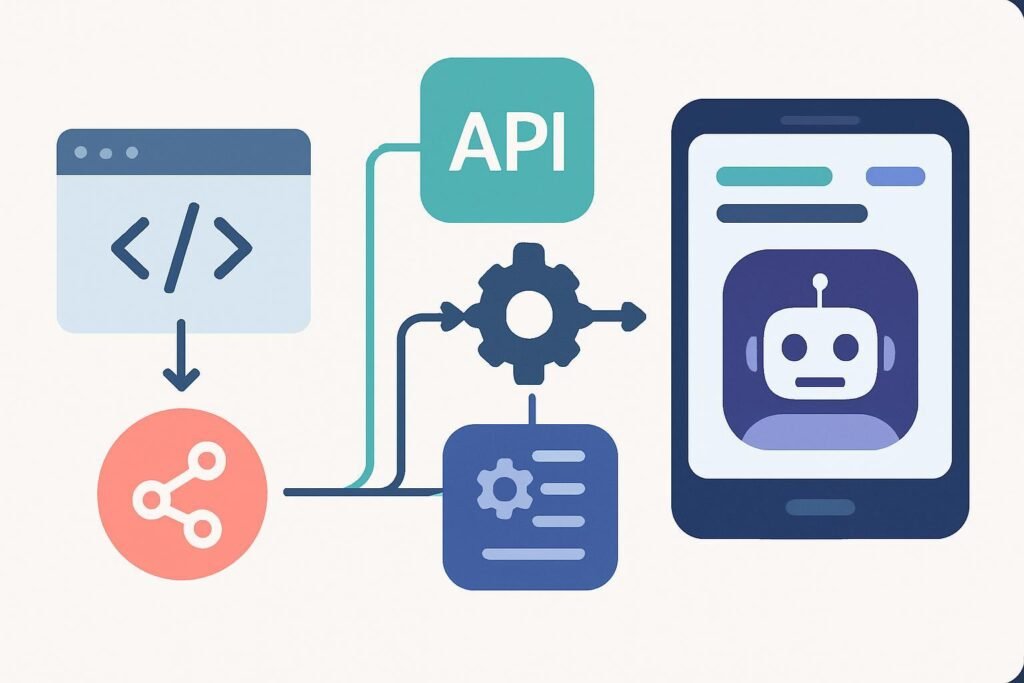
An API allows one software system to communicate with another.
For example, an automated workflow might:
Receive a customer request → extract information → send relevant information to an AI model → classify the request → save the result → notify an employee.
This combines AI with ordinary software automation.
You can start with simple workflows before attempting complicated AI agents.
Learn concepts such as:
- API requests
- Authentication
- JSON
- Webhooks
- Inputs and outputs
- Error handling
- Rate limits
- Automation workflows
This area is particularly useful for people interested in AI automation, business processes, and AI-powered applications.
9. Build Projects Instead of Only Taking Courses
One of the biggest mistakes beginners make is collecting courses without building anything.
Courses can provide structure, but projects force you to solve problems.
Start small.
Project 1: AI Research Assistant
Create a workflow that takes a research question and organizes relevant information into a structured outline.
Your goal is not to create a perfect research system. The goal is to learn how AI handles instructions, context, and structured outputs.
Project 2: Document Classifier
Build a simple program that receives text documents and categorizes them.
For example:
- Sales
- Support
- Finance
- General
This teaches you about classification, inputs, outputs, and evaluation.
Project 3: Customer Support Assistant
Create a basic assistant that answers questions using a defined collection of company information.
This introduces an important real-world concept: an AI system should use relevant information rather than simply generating answers from general knowledge.
Project 4: AI Automation Workflow
Create a workflow that receives a form submission, uses AI to categorize the request, and stores the result.
This combines automation, APIs, structured data, and AI.
The complexity of your projects should increase gradually.
Choosing the Right AI Skills for Your Goal
You do not need the same AI skills for every career.
| Goal | Useful skills to prioritize |
|---|---|
| AI-powered content work | AI tools, prompting, research, fact-checking |
| AI automation | Prompting, workflows, APIs, webhooks, basic coding |
| Data analysis | Python, statistics, data cleaning, visualization |
| Machine learning | Python, mathematics, statistics, machine learning |
| AI application development | Python, APIs, databases, AI models, software development |
| AI product management | AI fundamentals, product thinking, evaluation, user research |
| AI research | Mathematics, statistics, programming, machine learning, research methods |
| Business AI implementation | AI fundamentals, process analysis, automation, evaluation |
This is why asking “What is the best way to learn AI?” does not have one universal answer.
The best path depends on what you intend to build or accomplish.
How Much Math Do You Need to Learn AI?
This depends on the level of AI work you want to perform.
If your goal is to use AI tools, automate tasks, or build applications with existing models, you can begin without advanced mathematics.
For machine learning, mathematics becomes increasingly useful.
Important areas include:
- Algebra
- Probability
- Statistics
- Functions
- Vectors
- Matrices
- Calculus
You do not necessarily need to learn all of these before starting practical work.
A better approach is to learn mathematics alongside the technical concepts that require it.
For example, when learning how a machine-learning model uses numerical features, learning about vectors becomes much more meaningful because you can see why the concept matters.
Common Mistakes When Learning AI
Trying to Learn Everything
AI is too broad to master all at once.
Choose a direction first and expand later.
Chasing Every New AI Tool
New AI products and features appear frequently. Learning every tool can become a distraction.
Focus on transferable concepts such as prompting, APIs, data, evaluation, automation, and programming.
Specific tools can change. Fundamental skills remain useful for much longer.
Relying Completely on AI-Generated Answers
Using AI to learn can be useful, but accepting every answer without verification can create bad habits.
Ask AI to explain concepts, generate examples, quiz you, or help debug your code. Then verify important information independently.
Building Projects That Are Too Complicated
Your first project does not need to be an autonomous AI agent with multiple integrations.
A small working project teaches more than a huge unfinished idea.
Ignoring Evaluation
An AI application is not successful simply because it produces an answer.
You need to ask:
- Is the answer correct?
- Is it consistent?
- Does it follow the required format?
- What happens when the input is unusual?
- Does it expose private information?
- What happens when the model is uncertain?
Evaluation should be part of the project from the beginning.
Also Read: Perplexity AI Image Generation Capabilities
Real-World Ways AI Skills Are Used
AI skills are increasingly relevant across different types of work.
A marketing professional might use AI to analyze customer feedback and organize recurring themes.
A software developer might integrate a language model into an application through an API.
A business operations employee might automate the classification of incoming requests.
A data analyst might use machine-learning techniques to identify patterns in a dataset.
A researcher might use AI tools to organize large amounts of information while independently checking important sources.
In each case, the valuable skill is not merely knowing that AI exists. It is knowing where AI is appropriate, how to use it, and how to evaluate the result.
Benefits of Learning AI Skills
Learning AI skills can provide several practical benefits.
Better Productivity
AI can help automate repetitive tasks and assist with drafting, analysis, coding, organization, and information processing.
Better Technical Understanding
Learning how AI systems work helps you understand their capabilities and limitations instead of treating them as mysterious tools.
More Career Flexibility
AI skills can complement existing expertise in areas such as programming, marketing, finance, education, design, research, and business operations.
Ability to Build
Once you understand programming, APIs, data, and AI models, you can move from simply consuming AI products to building your own AI-powered workflows and applications.
Limitations and Risks to Understand
AI skills should also include knowing when not to use AI.
AI systems can produce inaccurate or misleading outputs. Some tasks require human judgment, specialized expertise, or independent verification.
Privacy is another consideration. Sensitive information should not automatically be entered into an AI service simply because the service accepts text or files. Before using an AI tool with confidential information, understand the service’s current data-handling and privacy policies.
Costs can also become relevant when building AI applications. Model usage, infrastructure, storage, external APIs, and other services can introduce ongoing expenses.
Finally, AI systems should be evaluated for security, reliability, bias, and unintended behavior when they are used in important workflows.
A Simple AI Learning Plan
If you are starting from zero, you can organize your learning into stages.
Stage 1: Understand
Learn:
- What AI is
- What machine learning is
- What generative AI is
- How AI models differ from applications
- Basic AI limitations
Stage 2: Practice
Use AI tools regularly.
Practice:
- Writing precise instructions
- Providing context
- Getting structured outputs
- Checking answers
- Comparing different approaches
Stage 3: Code
Learn basic Python.
Build small programs that manipulate data and communicate with external services.
Stage 4: Build
Create practical projects involving:
- AI APIs
- Automation
- Data
- Documents
- Classification
- AI-powered assistants
Stage 5: Specialize
Choose an area such as:
- Machine learning
- Generative AI
- AI automation
- AI engineering
- Data science
- Computer vision
- Natural language processing
- AI product development
Stage 6: Evaluate
Learn how to test AI systems rather than assuming that they work.
Create test cases, measure results where appropriate, inspect failures, and improve the system.
How Long Does It Take to Learn AI Skills?
There is no single timeframe because “learning AI” can mean very different things.
You can learn basic AI concepts and practical AI-tool usage relatively quickly.
Becoming comfortable with Python and AI APIs takes more sustained practice.
Developing strong machine-learning or AI-engineering skills requires substantially more study and hands-on experience.
Instead of setting a goal such as “I will master AI in three months,” use measurable milestones:
- Explain core AI concepts without notes.
- Build a small AI-powered application.
- Work with an API.
- Clean and analyze a dataset.
- Evaluate an AI system.
- Explain why an AI output may be unreliable.
- Complete a project without following a tutorial step by step.
These milestones give you evidence that you are actually developing skills.
Frequently Asked Questions
How to learn AI skills as a beginner?
Start with AI fundamentals, then learn to use AI tools effectively, practice prompting, learn basic Python, and build small projects. You do not need to begin with advanced mathematics or machine-learning theory.
Do I need coding to learn AI skills?
No. Coding is not required for every AI-related role. However, Python and basic programming become increasingly valuable if you want to build AI applications, work with APIs, automate workflows, or study machine learning.
Can I learn AI without a computer science degree?
Yes. A formal computer science degree is not a prerequisite for learning AI concepts or developing many practical AI skills. What you need depends on the level of work you want to perform.
What programming language should I learn for AI?
Python is a strong starting point because it is widely used in data science and machine learning. Start with the fundamentals rather than immediately trying to learn specialized AI libraries.
Is prompt engineering enough to learn AI?
Prompting is useful, particularly when working with generative AI, but it is only one part of the broader AI skill set. Understanding AI limitations, data, evaluation, automation, programming, and APIs can make your skills much more transferable.
How to learn AI skills without getting overwhelmed?
Choose one practical goal and learn only the concepts needed to reach it. For example, if your goal is AI automation, start with prompting, workflows, APIs, and basic Python rather than studying every area of machine learning simultaneously.
Should I learn machine learning before generative AI?
Not necessarily. You can learn generative AI concepts and practical applications without first becoming an expert in traditional machine learning. If you later want to understand how models are developed in greater depth, machine-learning fundamentals become increasingly important.
What is the best way to practice AI skills?
Build small projects that solve actual problems. A working document classifier, research assistant, or automation workflow gives you opportunities to practice prompting, data handling, APIs, programming, testing, and troubleshooting.
Conclusion
The most effective way to learn AI skills is not to chase every new tool or attempt to master the entire field at once. Start by understanding the fundamentals, become a thoughtful user of AI, develop practical technical skills, and gradually build increasingly useful projects.
If you are a beginner, a sensible starting point is AI fundamentals → prompting → basic Python → data → APIs and automation → practical projects → specialization.
Most importantly, learn to evaluate AI rather than simply use it. Knowing what a system can do is useful; knowing when its output can be trusted, when it needs verification, and when AI is the wrong tool is an even more valuable skill.
The goal is not to know every AI technology. The goal is to develop enough understanding and practical ability to solve real problems with AI responsibly and effectively.