
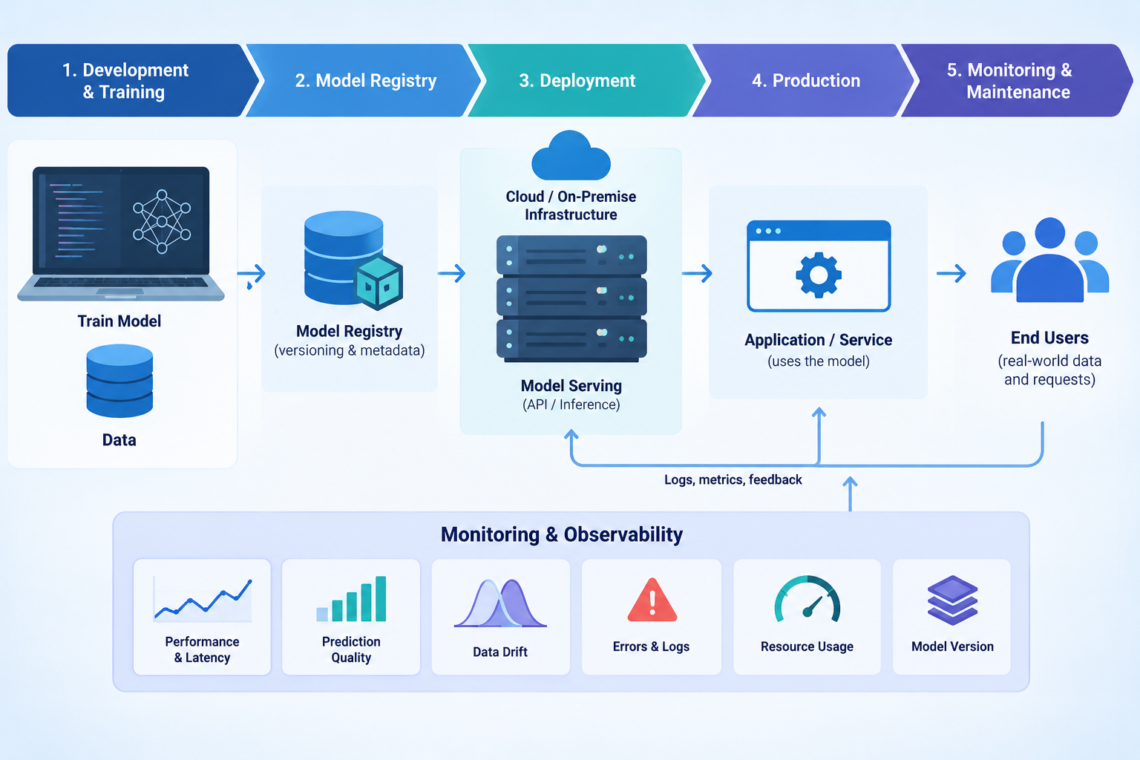
Deploying an AI model into production is very different from training one in a notebook. A model can achieve impressive results during development and still become difficult to operate once real users, live data, security requirements, and business expectations enter the picture. This gap is at the heart of many AI model deployment challenges production.
Production deployment means making a trained model available inside a real application or business workflow and keeping it reliable over time. That involves much more than uploading a model file to a server. Teams have to think about infrastructure, latency, model versions, data quality, monitoring, security, costs, and what happens when the model makes an unexpected prediction.
This guide explains the major challenges involved in deploying AI models, why they occur, how teams can reduce them, and what a practical production deployment process looks like.
What Does AI Model Deployment Mean?
AI model deployment is the process of taking a trained machine learning or AI model and integrating it into an environment where it can generate predictions for real applications.
During development, a data scientist might train a model using a relatively controlled dataset. In production, that same model could receive thousands or millions of requests, encounter unfamiliar inputs, interact with other software systems, and operate under strict response-time requirements.
A typical production AI system has several components:
- A trained model
- An inference environment
- An API or application interface
- Input and output validation
- Data pipelines
- Monitoring and logging
- Security controls
- Model and configuration management
- Infrastructure for scaling
- A process for updating or replacing models
The model itself is only one part of the system.
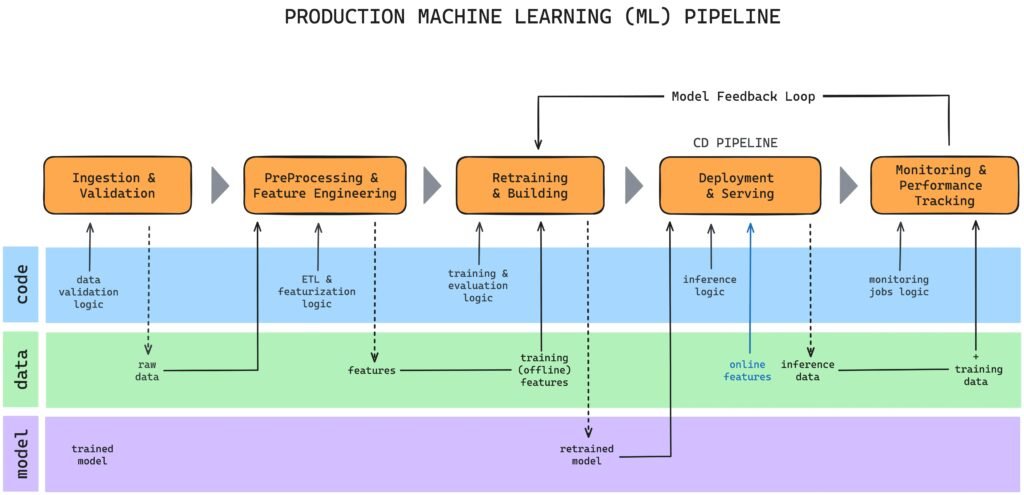
Why Is Production Deployment Harder Than Model Training?
Training primarily answers a question such as: Can this model learn useful patterns from the available data?
Production deployment asks much broader questions:
- Can the model respond quickly enough?
- Can the system handle traffic spikes?
- What happens if an input is malformed?
- Is the model using the same preprocessing logic used during training?
- Can engineers identify why predictions suddenly become worse?
- How can a new model version be introduced safely?
- What happens if the model service goes offline?
- Is sensitive information being logged?
- Can the infrastructure cost remain manageable?
A model can therefore be technically successful while the production system around it fails.
For example, an image classification model might perform well on a test dataset. But if production images arrive at a much higher resolution than expected, inference may become slow and memory consumption may increase. The problem is no longer model accuracy alone; it is a deployment and system-design problem.
The Major AI Model Deployment Challenges Production
1. Infrastructure and Environment Differences
One of the most common problems is the difference between the environment used for development and the environment used for production.
A model may depend on a particular Python version, machine learning framework, library, operating system, GPU configuration, or preprocessing package. If the production environment differs, the model may fail to load or behave differently.
This is especially important when a model depends on a collection of libraries rather than a single framework.
Teams can reduce environment-related problems by:
- Pinning important dependencies
- Using reproducible build processes
- Packaging applications consistently
- Testing models in production-like environments
- Recording model and dependency versions
- Separating development, staging, and production environments
Containerization can also help make deployment environments more consistent, although containers do not eliminate every infrastructure problem.
2. Latency and Response Time
A model may be accurate but too slow for the application that uses it.
Consider an AI recommendation system on an ecommerce website. If generating a recommendation takes several seconds when the page expects a quick response, the model can negatively affect the user experience.
Latency can come from several sources:
- Sending data to the inference service
- Preprocessing the input
- Loading or accessing the model
- Running inference
- Post-processing the result
- Returning the response to the application
Large models can make this more challenging because inference may require substantial computational resources.
Possible solutions include:
- Model optimization
- Smaller or specialized models
- Batching requests where appropriate
- Caching
- Faster hardware
- Asynchronous processing for tasks that do not require immediate results
- Keeping frequently used models loaded in memory
The correct solution depends on the application’s requirements. A fraud-detection system may tolerate a different latency profile from an offline document-processing pipeline.
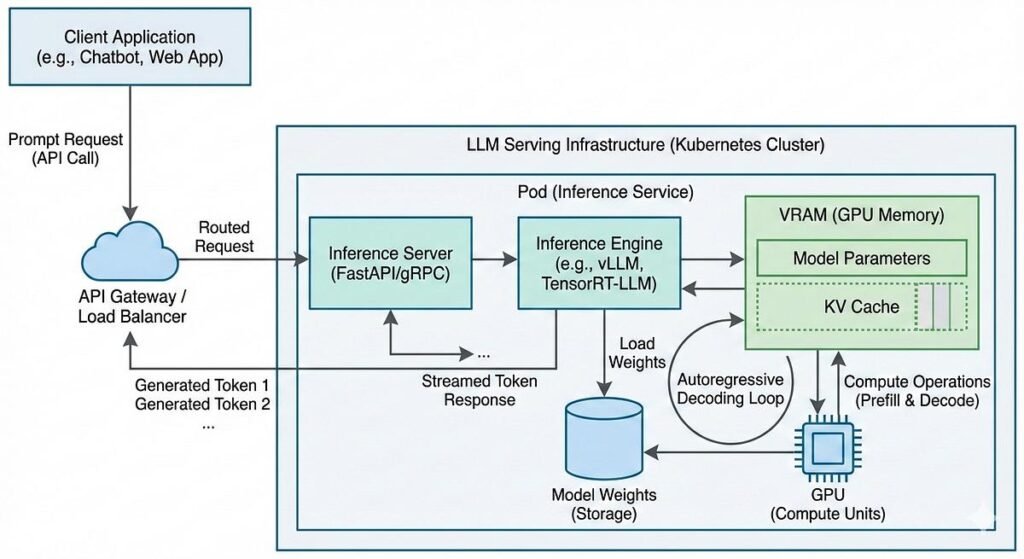
3. Scaling AI Inference
A model that works for ten requests per minute may not behave the same way under thousands of simultaneous requests.
Scaling AI workloads can be particularly difficult because inference may consume significant CPU, GPU, memory, or other resources.
There are two broad scaling problems.
Traffic scaling occurs when the number of requests increases.
Resource scaling occurs when individual requests become more computationally expensive.
For example, a text-generation application may need substantially more compute for long inputs and outputs than for short requests.
A production architecture may need mechanisms that automatically add or remove inference capacity according to demand. However, simply adding more servers can increase costs quickly.
Effective scaling therefore requires balancing:
- Performance
- Availability
- Hardware utilization
- Response time
- Infrastructure cost
4. Model Versioning and Updates
AI models are not usually deployed once and forgotten.
A team may retrain a model after collecting new data, correcting errors, changing features, or improving its architecture. This creates a model-versioning problem.
Suppose version 1.4 is serving customers successfully and a new version 1.5 is ready. Replacing the old model immediately creates risk. If the new version behaves unexpectedly, rolling back must be possible.
A production workflow should keep track of:
- Model version
- Training data or data snapshot
- Model configuration
- Code version
- Dependency versions
- Evaluation results
- Deployment date
- Relevant configuration changes
A model registry or another version-control mechanism can help organize these artifacts.
Canary and Gradual Deployments
Instead of sending all traffic to a new model immediately, teams can gradually expose it to production traffic.
For example:
- Deploy the new model without serving general traffic.
- Test it using controlled requests.
- Send a small portion of traffic to it.
- Compare its behavior with the existing model.
- Increase traffic if the results remain acceptable.
- Roll back if important metrics deteriorate.
This reduces the risk associated with model updates.
5. Data Drift and Changing Real-World Inputs
A model learns from historical data, but production data can change.
This is known as data drift when the distribution or characteristics of input data change over time.
Imagine a model trained to classify customer support requests. If the products, terminology, customer behavior, or support process changes significantly, the incoming requests may no longer resemble the training data.
The model may continue running normally while its usefulness declines.
This is one of the most dangerous deployment problems because nothing necessarily crashes.
The API can return successful responses while the predictions become less reliable.
Teams should therefore monitor relevant input characteristics and establish procedures for investigating significant changes.
6. Model Performance Can Change Without a Technical Failure
Traditional software often provides relatively deterministic behavior. If the same program receives the same valid input under the same conditions, its output is generally predictable.
Machine learning systems are different because their usefulness depends heavily on data.
A deployed model can experience:
- Declining prediction quality
- Unexpected behavior on new input types
- Changes in class distributions
- Increased false positives
- Increased false negatives
- Performance differences across user groups
- Poor handling of rare cases
This means monitoring cannot stop at infrastructure metrics such as CPU utilization and server uptime.
Production AI systems may also need model-quality monitoring.
Depending on the application, useful metrics might include prediction distributions, error rates, feedback signals, business outcomes, or eventually available ground-truth labels.
7. Monitoring and Observability
A production AI system needs enough visibility for engineers to understand what is happening.
Basic infrastructure monitoring might track:
- CPU usage
- GPU usage
- Memory consumption
- Request volume
- Error rates
- Response latency
- Service availability
AI systems may require additional monitoring around:
- Input distributions
- Output distributions
- Confidence scores where applicable
- Model version
- Data quality
- Prediction errors
- Drift indicators
- Human feedback
- Business-specific outcomes
Logging also requires care. A system processing customer documents, financial information, or other sensitive data should not automatically record complete inputs and outputs simply because logs are convenient.
Observability must therefore be designed alongside privacy and security requirements.
8. Security and Privacy
Production AI models can introduce security and privacy concerns that were not obvious during experimentation.
For example, an AI application may process:
- Customer information
- Internal business documents
- Source code
- Financial information
- Personal communications
- Proprietary data
Teams need to determine who can access the model, the data sent to it, and the results it generates.
Security considerations can include:
- Authentication and authorization
- Encryption
- Network controls
- Secret management
- Access logging
- Input validation
- Rate limiting
- Secure dependency management
- Protection of sensitive data in logs
Generative AI applications can introduce additional concerns, including prompt injection and unintended disclosure of information through model outputs or connected tools.
Security testing should therefore consider the complete AI application rather than only the model artifact.
9. Reproducibility and Dependency Management
A production model should be reproducible enough that the team can understand what was actually deployed.
Consider a model that was trained using one version of a library and deployed months later with another. Even if the application starts successfully, changes in dependencies can introduce compatibility or behavioral problems.
Good deployment practices document the relationship between:
Data → preprocessing → code → model → dependencies → infrastructure → deployment configuration
This makes troubleshooting considerably easier.
10. Managing Infrastructure Costs
AI inference can become expensive, particularly when models require GPUs or other specialized hardware.
The cost depends on factors such as:
- Model size
- Number of requests
- Input and output size
- Hardware type
- Inference duration
- Availability requirements
- Whether resources remain running continuously
- Redundancy requirements
A common mistake is optimizing only for model quality while ignoring the economics of serving the model.
A slightly less resource-intensive model may sometimes be more practical if it delivers sufficiently good results at a much lower operating cost.
The important question is not simply:
Which model performs best?
It is:
Which model provides the required quality at an acceptable cost and response time?
11. Integration With Existing Applications
An AI model rarely operates alone.
It may need to interact with:
- Databases
- APIs
- Web applications
- Mobile applications
- Authentication systems
- Data warehouses
- Business workflows
- Monitoring platforms
Integration creates additional failure points.
For example, a model might produce a prediction successfully, but the application could reject the response because the expected API format changed.
Clear interfaces and validation help prevent these problems.
A production AI service should define things such as:
- Accepted input format
- Required fields
- Output format
- Error behavior
- Timeout behavior
- Authentication requirements
- Versioning rules
12. Handling Failures and Unexpected Inputs
Real users do not always provide clean data.
A production system may receive:
- Missing values
- Invalid formats
- Extremely large inputs
- Empty requests
- Duplicate requests
- Unexpected language
- Data outside the model’s training domain
The system should have explicit behavior for these situations.
For example, an AI document-processing service might reject a corrupted file instead of passing it directly into the inference pipeline.
Failure handling can include:
- Validate the input.
- Reject invalid requests safely.
- Set appropriate timeouts.
- Handle service failures.
- Retry only when retrying is safe.
- Return a useful error to the calling application.
- Record enough diagnostic information to investigate the problem.
Real-World Examples of AI Deployment Challenges
Customer Support Classification
A company may use a machine learning model to classify incoming support tickets into categories such as billing, technical problems, and account access.
During testing, the model performs well on historical tickets.
After deployment, the company introduces a new product. Customers begin using new terminology that was not common in the training data.
The model continues returning classifications, but more tickets are assigned incorrectly.
The deployment challenge is not simply that the model needs retraining. The organization also needs a mechanism to detect changing inputs, review incorrect classifications, update training data, and safely deploy a new version.
Fraud Detection
A fraud detection model may evaluate transactions in near real time.
Here, latency is important because delaying the response can interfere with the transaction workflow.
At the same time, incorrectly blocking legitimate transactions can create serious customer problems.
The production system therefore has to balance model accuracy, inference speed, availability, monitoring, and fallback behavior.
Medical Image Analysis
An AI system used to assist with medical image analysis has particularly demanding requirements.
The model must operate in a controlled environment, and its output may require review by qualified professionals rather than being treated as an unquestionable decision.
Deployment therefore involves technical considerations as well as validation, security, privacy, regulatory, and workflow requirements. Exact requirements depend on the intended use and applicable jurisdiction.
Generative AI Applications
A company might deploy a language model to answer questions about internal documents.
The model may perform well in demonstrations, but production introduces different problems.
The system must retrieve the appropriate information, control access to documents, handle unsupported questions, manage inference costs, monitor responses, and prevent users from accessing information they are not authorized to see.
This demonstrates why deploying an AI application is often a systems problem rather than simply a model-hosting problem.
Also Read: AI Contextual Refinement
A Practical AI Model Deployment Process
A reliable deployment process can be organized into several stages.
Step 1: Define Production Requirements
Before deployment, determine:
- Required response time
- Expected traffic
- Availability requirements
- Accuracy requirements
- Data sensitivity
- Infrastructure constraints
- Acceptable operating cost
Without these requirements, it is difficult to decide whether a model is actually production-ready.
Step 2: Validate the Model
Evaluate the model using data that represents realistic production conditions.
Do not rely exclusively on a single overall accuracy number. Depending on the task, examine relevant error types, edge cases, and performance across important segments of the input data.
Step 3: Package the Model
Create a reproducible deployment artifact containing the model and the software required to run inference.
Record the relevant versions and configuration.
Step 4: Test the Complete Inference Pipeline
Test more than the model itself.
Evaluate:
- Input validation
- Preprocessing
- Model inference
- Post-processing
- API behavior
- Error handling
- Performance
- Security
Step 5: Deploy to a Staging Environment
Use an environment that resembles production as closely as practical.
This allows the team to find infrastructure and integration problems before real users depend on the system.
Step 6: Release Gradually
When possible, use controlled deployment methods such as canary releases or other gradual traffic strategies.
Keep the previous model available so that rollback is practical.
Step 7: Monitor Continuously
Monitor both the service and the model.
Infrastructure health tells you whether the system is running. Model and data monitoring help determine whether it is still doing its job effectively.
Step 8: Establish a Retraining and Rollback Process
A production AI system needs a plan for change.
That plan should explain:
- When a model should be reevaluated
- What triggers retraining
- How new versions are tested
- Who approves deployment
- How a failed release is rolled back
- How previous versions are retained
Production Readiness Checklist
Before putting an AI model into production, ask:
| Area | Key question |
|---|---|
| Model quality | Does the model perform adequately on realistic data? |
| Latency | Is inference fast enough for the application? |
| Scaling | Can the service handle expected traffic? |
| Reliability | What happens when a dependency fails? |
| Versioning | Can the exact deployed model be identified? |
| Monitoring | Can the team detect performance or data problems? |
| Security | Are access and sensitive data properly protected? |
| Cost | Is the inference infrastructure financially sustainable? |
| Rollback | Can the previous model be restored safely? |
| Data | Is there a process for detecting changes in production inputs? |
| Integration | Has the complete application workflow been tested? |
Advantages of a Well-Designed Production Deployment
When deployment is handled properly, organizations gain several practical benefits.
More Reliable AI Services
Monitoring, testing, and controlled releases reduce the chance that a model update will unexpectedly disrupt an application.
Better Operational Visibility
Version tracking and observability make it easier to determine which model is running and what may have caused a problem.
Easier Model Improvement
A structured deployment process allows teams to introduce improved models without rebuilding the entire production workflow from scratch.
Better Cost Control
Monitoring resource usage can reveal opportunities to optimize models, hardware, request patterns, and infrastructure.
Limitations and Risks
Even a mature deployment process cannot eliminate every problem.
AI systems remain dependent on the quality and relevance of their data. Some failures may only become visible when unusual real-world cases occur.
There can also be a trade-off between:
- Accuracy and speed
- Model size and operating cost
- Availability and infrastructure expense
- Automation and human oversight
- Performance and privacy
For high-impact applications, organizations may need additional governance, validation, auditability, and human review.
The appropriate controls depend heavily on the application’s purpose and risk level.
Common Misconceptions About AI Deployment
“If the model works in a notebook, it is ready for production.”
Not necessarily. A notebook demonstrates that the model can work under particular conditions. Production requires the surrounding system to operate reliably under real-world conditions.
“Monitoring server uptime is enough.”
It is not. A model can remain online while its predictions become less useful because the incoming data has changed.
“The largest model is always the best choice.”
A larger model may provide stronger capabilities for a particular task, but it can also require more compute, increase latency, and raise operating costs. The appropriate choice depends on the application.
“Retraining automatically fixes deployment problems.”
Retraining can help with model-quality issues, but it does not solve infrastructure failures, security weaknesses, API problems, poor monitoring, or excessive inference costs.
“Deployment is a one-time event.”
Production AI systems generally need ongoing evaluation, monitoring, maintenance, and controlled updates.
Frequently Asked Questions
What are the biggest AI model deployment challenges production?
The major challenges include infrastructure compatibility, latency, scaling, model versioning, changing data, monitoring, security, integration, failure handling, and inference costs.
Why can an AI model perform well in testing but poorly in production?
Production data may differ from the data used during development. Users can also introduce unexpected inputs, and real-world conditions may expose edge cases that were not represented adequately during testing.
What is model drift?
Model drift generally refers to a decline or change in model behavior or performance over time as the relationship between inputs, outputs, and the real-world environment changes. Data drift is a related concept involving changes in the distribution of input data.
How can teams reduce AI deployment failures?
Teams can reduce failures through realistic testing, reproducible environments, version control, gradual releases, monitoring, input validation, clear rollback procedures, and continuous evaluation.
Is cloud deployment required for AI models?
No. AI models can be deployed in cloud environments, on-premises infrastructure, edge devices, or other environments depending on technical, security, cost, and operational requirements.
How do you monitor an AI model after deployment?
Monitoring should cover both the service and the model. Useful signals can include latency, errors, resource usage, input characteristics, output behavior, available ground-truth performance measures, and application-specific outcomes.
Why is model versioning important in production?
Versioning allows teams to identify exactly which model is serving users, compare releases, investigate problems, and roll back to a previous version when necessary.
Does a highly accurate model guarantee a successful production system?
No. Accuracy is only one part of production readiness. A model can be highly accurate but too slow, expensive, insecure, difficult to scale, or poorly integrated with the application.
Conclusion
The hardest part of putting an AI model into production is often not getting the model to make predictions. It is building the surrounding system so those predictions remain useful, secure, affordable, and dependable under real-world conditions.
The most important AI model deployment challenges production include infrastructure compatibility, latency, scaling, version management, data changes, monitoring, security, integration, and cost. Each needs to be considered before the model becomes part of a critical workflow.
A strong production strategy treats the model as one component of a larger system. Test the complete pipeline, release changes gradually, monitor both infrastructure and model behavior, keep versions traceable, and establish clear procedures for retraining and rollback.
The practical goal is not simply to deploy an AI model. It is to create an AI service that can continue working responsibly as the application, data, users, and operating environment change.