
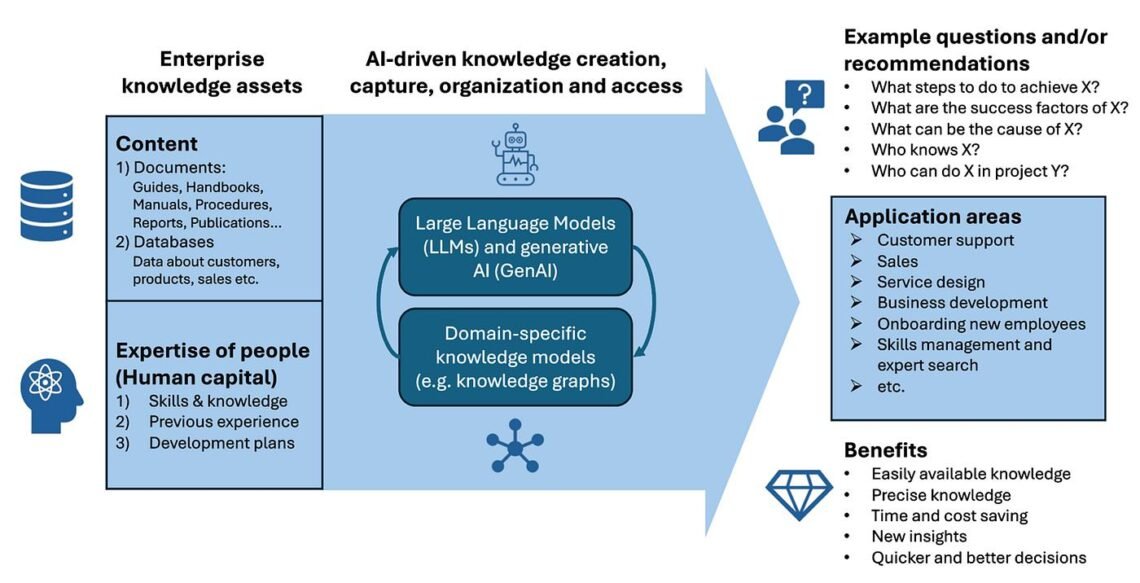
Organizations rarely suffer from a complete lack of information. The bigger problem is often knowing whether the information they already have is accurate, relevant, current, and appropriate for a particular situation. This is where AI contextual organizational knowledge validation becomes useful.
The concept combines several ideas: artificial intelligence, organizational knowledge, contextual understanding, and validation. Instead of simply retrieving information from a company’s documents or databases, an AI system can evaluate that information against the surrounding context and determine whether it is suitable for the task at hand.
This article explains what AI contextual organizational knowledge validation means, how it can work, where it can be applied, and why validation is important when organizations rely on AI for decisions, customer support, internal operations, or knowledge management.
What Is AI Contextual Organizational Knowledge Validation?
At its simplest, AI contextual organizational knowledge validation is the process of using AI to check whether organizational knowledge is accurate, relevant, consistent, and appropriate within a specific context.
Consider a company with thousands of internal documents. These might include:
- Product documentation
- Employee policies
- Customer support procedures
- Technical manuals
- Contracts and guidelines
- Project records
- Internal FAQs
- Security procedures
- Sales information
An AI assistant can retrieve information from these sources. But retrieval alone does not guarantee that the information is correct for the question being asked.
For example, an employee might ask:
“Can customers cancel this type of subscription after the trial period?”
The answer could depend on the product, customer’s location, subscription plan, contract date, or a policy that changed recently.
A document containing an old cancellation policy may still be stored in the company’s knowledge base. A basic retrieval system could find it and produce a confident answer.
Contextual validation adds another layer. The AI attempts to determine whether the information actually applies to the customer’s circumstances and whether it agrees with more authoritative or recent organizational information.
Why Context Matters in Organizational Knowledge
Knowledge does not exist in isolation.
A statement can be correct in one situation and incorrect in another. A company’s internal knowledge therefore needs to be interpreted in relation to factors such as:
- The department involved
- The product or service
- The customer’s situation
- The date or time period
- Geographic or regulatory requirements
- User permissions
- Current company policies
- The source of the information
- The relationship between different documents
This is the reason contextual validation is different from simply searching a database.
Suppose an engineering team has documentation saying that an API accepts a particular parameter. Later, the API is changed and the documentation is updated, but an older project document still contains the previous behavior.
A keyword search might retrieve both documents.
A contextual system should ideally recognize that the newer technical documentation has greater relevance to the current API version and avoid presenting obsolete information as current.
How AI Contextual Organizational Knowledge Validation Works
There is no single technical architecture that defines this concept. Organizations can implement it in different ways depending on their data, AI systems, and validation requirements.
A typical workflow can be understood in several stages.
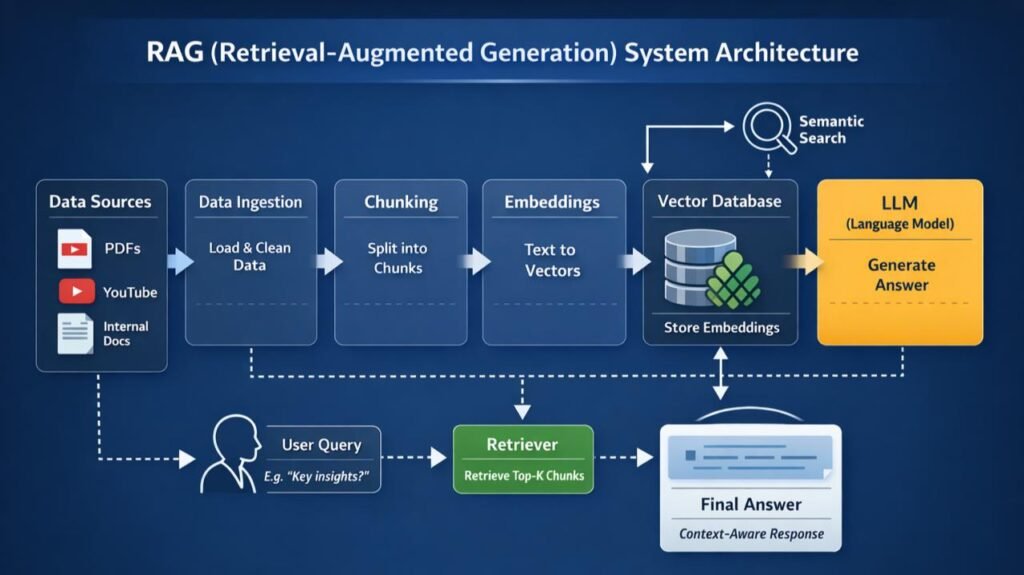
1. Collect Organizational Knowledge
The first step is making relevant organizational information available to the AI system.
Sources can include:
- Internal documents
- Knowledge bases
- Databases
- Wikis
- Product documentation
- Support records
- Approved policies
- Structured business data
The quality of this source material matters. An AI model cannot reliably validate information when the underlying organizational knowledge is incomplete, contradictory, or badly maintained.
2. Retrieve Relevant Information
When someone asks a question, the system identifies information that could help answer it.
Modern AI applications often use retrieval-based architectures, including retrieval-augmented generation (RAG), to provide language models with information from external sources rather than relying only on information contained in the model itself.
For example, a support assistant might retrieve the current refund policy, the relevant product documentation, and an account-specific rule.
3. Interpret the Context
The system then needs to determine what the retrieved information means in relation to the user’s request.
Context might include:
- Who is asking?
- What product is involved?
- What version is being discussed?
- Which policy applies?
- When did the relevant event occur?
- Is the information intended for employees or customers?
- Does the user have permission to access the information?
This step is important because relevant information is not necessarily applicable information.
4. Validate the Knowledge
The AI can then compare information and look for potential problems.
Validation may involve checking for:
- Conflicting statements
- Missing information
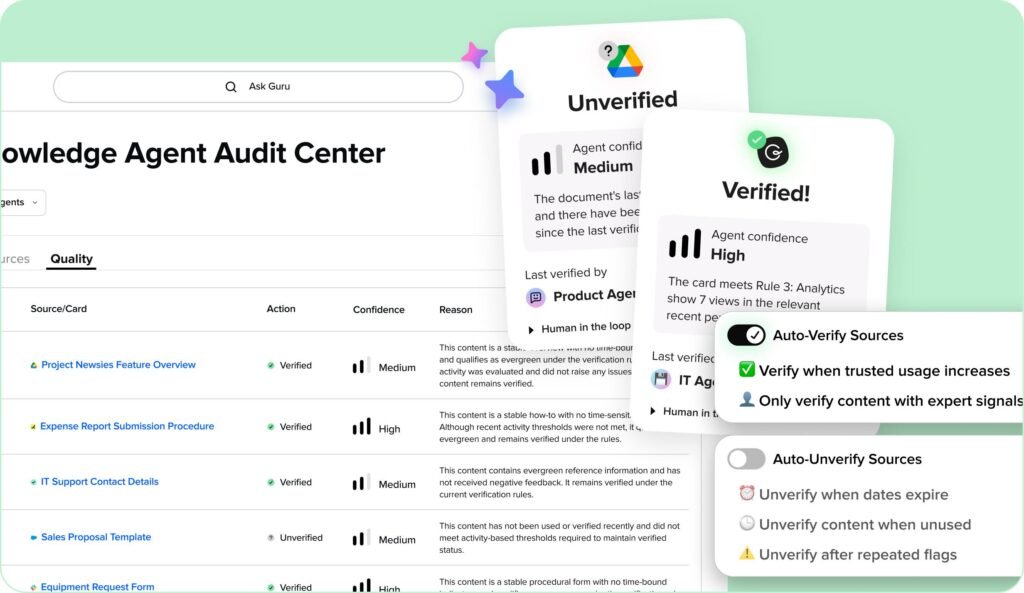
- Outdated material
- Unsupported conclusions
- Incorrect relationships between pieces of information
- Policy exceptions
- Ambiguous instructions
For high-risk applications, validation should not depend solely on an AI model. Rules, structured databases, authoritative sources, human review, or other verification mechanisms may also be required.
5. Produce an Answer With Appropriate Confidence
After validation, the system can generate a response.
If the information is consistent, the AI may provide a direct answer.
If there is a conflict, a safer response might explain that the available sources disagree and identify the relevant documents for review.
That behavior is often more useful than producing a confident but unsupported answer.
Contextual Validation vs. Simple Knowledge Retrieval
These concepts are related but not identical.
| Approach | Main purpose |
|---|---|
| Knowledge retrieval | Find potentially relevant information |
| Semantic search | Find information based on meaning rather than exact keywords |
| RAG | Give retrieved information to a generative AI model as context |
| Knowledge validation | Check whether information meets defined correctness or consistency requirements |
| Contextual validation | Determine whether information is appropriate for a particular situation |
| Organizational knowledge validation | Apply validation to information belonging to an organization |
A system can perform retrieval without performing meaningful validation.
For example, an AI assistant might retrieve five documents that mention a company’s refund policy. That tells the system where relevant information exists, but it does not automatically establish which document represents the current policy.
A Practical Example: Customer Support
Imagine an online software company with several subscription plans.
Its knowledge base contains:
- A general refund policy
- A premium-plan policy
- A regional policy
- A legacy policy from two years ago
- Internal instructions for exceptional cases
A customer asks whether they can receive a refund.
A basic AI assistant may retrieve the general refund policy and answer immediately.
A contextual validation system could instead identify the customer’s plan, region, purchase date, and relevant policy version. It could then compare those details against the applicable organizational rules.
If the available information is contradictory, the system could flag the case rather than treating the first retrieved document as authoritative.
This reduces the risk of turning outdated or incomplete organizational knowledge into an apparently definitive answer.
Also Read: AI Knowledge Base
Another Example: Software Development
Contextual knowledge validation can also be useful for internal engineering assistants.
Suppose developers ask:
“Which authentication method should this service use?”
The organization may have documentation for several systems.
The correct answer could depend on:
- The specific application
- The programming environment
- The current architecture
- Security requirements
- The API version
- Internal engineering standards
An AI system that simply finds the most similar paragraph may return an answer that is technically valid but inappropriate for the particular application.
A context-aware system can use project metadata and current documentation to narrow the relevant knowledge before generating an answer.
Where AI Contextual Organizational Knowledge Validation Can Be Used
The concept has applications across many organizational workflows.
Customer Service
AI can help support teams verify whether an answer matches current product policies, customer circumstances, and approved documentation.
Internal Knowledge Assistants
Employees can ask questions about company processes without manually searching through large collections of documents.
Validation can help identify outdated or conflicting internal information.
Compliance Workflows
Organizations can use structured rules and approved documentation alongside AI to identify whether information or generated responses conform to defined requirements.
Because compliance can involve significant legal and regulatory consequences, AI-generated validation should not automatically be treated as a substitute for qualified human or formal review.
IT and Technical Support
AI assistants can compare technical questions against current documentation, configuration information, and troubleshooting procedures.
This can be particularly useful when organizations have documentation spread across multiple systems.
Enterprise Search
Instead of returning a long list of documents, a knowledge system can attempt to determine which information is relevant to the user’s particular task.
Knowledge Management
Validation can also work in the opposite direction: instead of validating an AI answer, an organization can use AI to identify problems within its knowledge base.
For example, it could help locate documents that appear to:
- Contradict each other
- Refer to outdated processes
- Contain incomplete explanations
- Duplicate information
- Depend on older product versions
Human review can then determine what should actually be changed.
The Role of Source Authority
Not every organizational document should be treated equally.
A company might have an official policy document, an employee-created wiki page, an old support article, and a message in an internal discussion forum that all mention the same subject.
These sources may have very different authority.
A useful validation system therefore needs some understanding of source provenance and authority.
For example, an organization might define a hierarchy such as:
- Approved policy or structured business rule
- Current official product documentation
- Department-maintained documentation
- Internal reference material
- Informal discussions
The exact hierarchy will vary by organization.
The important point is that relevance and authority are different properties. A document can be highly relevant to a question while still being an inappropriate source for establishing the official answer.
Common Problems With Contextual Knowledge Validation
AI can improve knowledge workflows, but it does not eliminate the underlying problems.
Outdated Information
An AI system may retrieve information that was once correct but is no longer applicable.
Document dates, version information, and content ownership can help address this problem.
Conflicting Sources
Two internal documents may provide different instructions.
AI can identify the conflict, but deciding which policy is officially correct may require organizational rules or human review.
Incomplete Context
Sometimes the system does not have enough information to determine which rule applies.
For example, a customer question may omit their subscription type or location.
In such cases, asking for the missing information may be safer than guessing.
Hallucinated Information
Generative AI systems can produce information that is not supported by their available sources.
Grounding responses in authoritative organizational information can reduce this risk, but it does not make hallucinations impossible.
Poor Knowledge Management
AI cannot fully compensate for an organization whose knowledge base is badly maintained.
If important policies are missing, contradictory, or undocumented, the validation system has limited information with which to work.
Privacy and Access Control
Organizational knowledge can contain confidential information.
A system should not expose internal information simply because it was able to retrieve it. Access controls need to be considered separately from relevance.
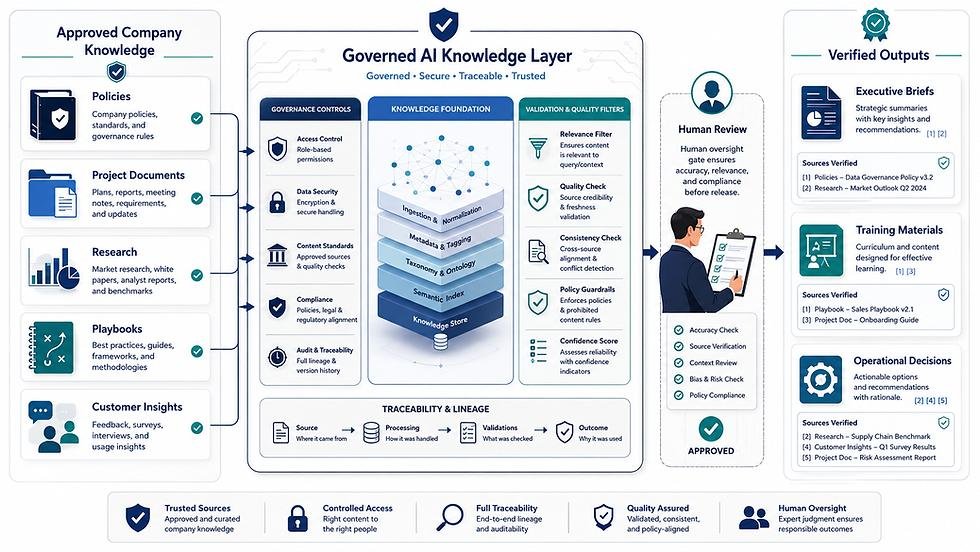
How Organizations Can Build a More Reliable Validation Process
Organizations considering this approach can start with a relatively straightforward process.
Step 1: Identify Important Knowledge Sources
Determine which documents, databases, policies, and systems contain authoritative information.
Step 2: Establish Ownership
Every important knowledge source should ideally have an owner responsible for maintaining it.
Step 3: Add Metadata
Useful metadata can include:
- Creation date
- Last review date
- Version
- Department
- Product
- Geographic scope
- Audience
- Authority level
This information gives an AI system additional context for evaluating retrieved material.
Step 4: Define Validation Rules
Not every piece of knowledge needs the same validation process.
An organization can define rules for questions such as:
- Must the source be current?
- Which source has priority during conflicts?
- When is human approval required?
- What information must be present before an answer can be generated?
- Which types of answers should be refused or escalated?
Step 5: Test With Realistic Cases
Testing should include ordinary questions as well as difficult cases involving outdated documents, conflicting policies, incomplete information, and ambiguous requests.
Step 6: Monitor and Improve
Knowledge validation should be treated as an ongoing process rather than a one-time AI deployment.
As products, policies, systems, and organizational structures change, the underlying knowledge and validation rules may also need to change.
What AI Contextual Organizational Knowledge Validation Does Not Mean
The term can sound more sophisticated than the underlying idea.
It does not mean that an AI system automatically knows everything about an organization.
It also does not mean that every AI-generated answer has been independently verified.
A more accurate interpretation is that AI can help connect organizational knowledge with the context in which that knowledge is being used and can perform checks designed to identify potential inconsistencies or unsupported conclusions.
The quality of the result depends heavily on the quality of the organization’s data, retrieval system, rules, access controls, and review process.
Benefits of AI Contextual Organizational Knowledge Validation
When implemented carefully, the approach can provide several practical benefits.
More relevant answers: The system can consider the circumstances surrounding a question instead of relying only on keyword matches.
Better use of internal knowledge: Employees can access information distributed across multiple organizational sources.
Earlier detection of conflicts: Contradictory documents can be identified for review.
Reduced reliance on outdated information: Dates, versions, and source authority can become part of the validation process.
More transparent uncertainty: Systems can be designed to flag situations where the available knowledge is insufficient rather than forcing an answer.
Improved knowledge maintenance: AI can help organizations discover duplicate, conflicting, or potentially obsolete content.
Limitations and Risks
There are equally important limitations.
AI validation is not the same as factual certainty. A model can misunderstand context, select the wrong source, or incorrectly interpret a policy.
There is also a risk of creating false confidence. A response may appear well-supported because it references internal documents, even when those documents are themselves incomplete or outdated.
Organizations should therefore distinguish between AI-assisted validation and authoritative verification.
For high-impact decisions, AI should generally operate within a broader process involving trusted data, explicit rules, access controls, monitoring, and appropriate human oversight.
Frequently Asked Questions
What is AI contextual organizational knowledge validation?
AI contextual organizational knowledge validation is the use of AI techniques to evaluate organizational information in relation to a specific situation. It can involve checking relevance, consistency, source authority, recency, and whether the available information supports a proposed answer.
Is contextual validation the same as RAG?
No. RAG is a method for retrieving external information and providing it to a generative AI model as context. Contextual validation is a broader concept focused on determining whether information is appropriate, reliable, and applicable to a particular situation. A RAG system can include validation, but retrieval alone does not guarantee validation.
Why is organizational context important for AI?
The same piece of information may apply differently depending on the product, user, location, date, policy, or other circumstances. Organizational context helps an AI system determine which information actually applies to the question being asked.
Can AI automatically determine which company document is correct?
Not reliably in every situation. AI can compare documents and identify signals such as dates, versions, conflicts, or source authority, but organizations should establish explicit rules for determining which sources are authoritative. Some conflicts require human review.
How can organizations reduce incorrect AI answers?
Organizations can improve reliability by using authoritative sources, maintaining current documentation, adding metadata, implementing access controls, establishing validation rules, testing difficult cases, and requiring escalation or human review for high-risk situations.
Does AI contextual organizational knowledge validation prevent hallucinations?
It can help reduce unsupported responses by grounding AI systems in relevant organizational information and validation processes. However, it cannot guarantee that an AI system will never produce an incorrect or unsupported statement.
What is the biggest challenge in organizational knowledge validation?
One major challenge is that organizational knowledge changes over time and may exist across many systems. Keeping sources current, authoritative, accessible, and consistent can be as important as the AI technology used to process them.
Conclusion
AI contextual organizational knowledge validation is fundamentally about making organizational AI more aware of the difference between information that is merely available and information that is actually appropriate for a particular situation.
Retrieving a document is only one part of the problem. A useful system also needs to consider context, source authority, recency, conflicting information, access permissions, and the limits of what can be established from the available evidence.
For organizations building AI assistants, enterprise search systems, support tools, or knowledge-management platforms, this distinction matters. The goal should not be to make AI sound certain. It should be to make the path from organizational knowledge to an answer more relevant, traceable, and appropriately cautious.