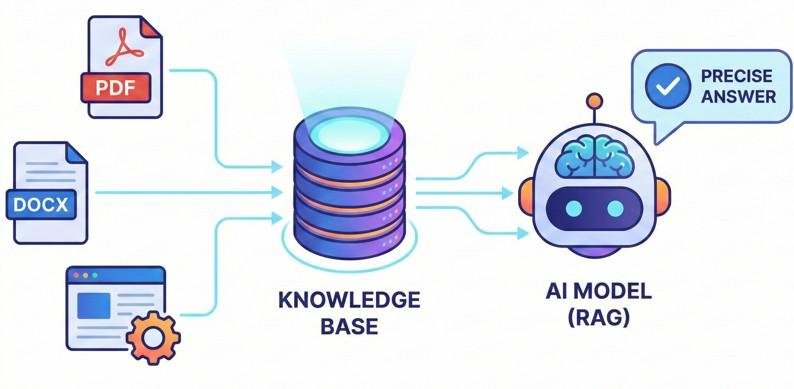
An AI knowledge base is a collection of information that an artificial intelligence system can search and use when answering questions or completing tasks. Instead of relying only on what an AI model learned during training, an AI knowledge base gives it access to specific documents, websites, databases, company information, manuals, policies, or other trusted sources.
This distinction matters because a general-purpose AI model may not know an organization’s private information, may not have access to recently updated documents, or may produce an answer that sounds convincing but is not supported by the available facts. A knowledge base can provide relevant information to the model at the time it needs it. This approach is commonly used with retrieval-augmented generation (RAG).
In this guide, we’ll look at what an AI knowledge base actually contains, how it works, how it differs from AI model training, where businesses use it, and what limitations you need to consider before building one.
What Is an AI Knowledge Base?
At its simplest, an AI knowledge base is a structured or searchable collection of information that an AI application can retrieve when it needs additional context.
For example, imagine a software company has hundreds of documents covering:
- Product documentation
- Installation instructions
- Troubleshooting guides
- Pricing policies
- Internal procedures
- Frequently asked questions
- Customer support information
A normal chatbot might know something about software in general, but it won’t automatically know the contents of these private documents.
An AI system connected to the company’s knowledge base can search those documents when a customer asks a question and use the relevant information to formulate its response.
The knowledge base itself does not necessarily “think.” It primarily provides information. The AI model interprets that information and generates a response.
What Can an AI Knowledge Base Contain?
The contents can vary considerably depending on the application. Common sources include:
- PDFs
- Word documents
- Web pages
- Product manuals
- Help-center articles
- Company policies
- Databases
- Frequently asked questions
- Research documents
- Technical documentation
- Internal wikis
- Structured business data
Modern systems can also work with information beyond ordinary text, depending on the tools and retrieval architecture being used.
The important factor is not simply how much information is stored. The information needs to be relevant, searchable, properly organized, and maintained.
How Does an AI Knowledge Base Work?
Many modern AI knowledge-base systems use retrieval-augmented generation (RAG).
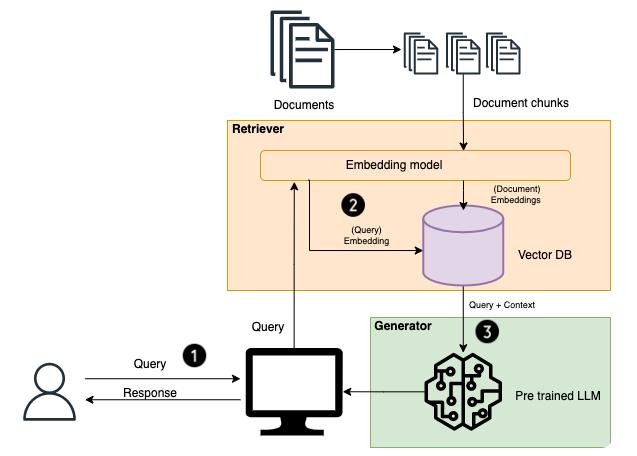
RAG combines information retrieval with a generative AI model. When someone asks a question, the system searches an external knowledge source for relevant information and provides that information to the language model as context before generating the answer.
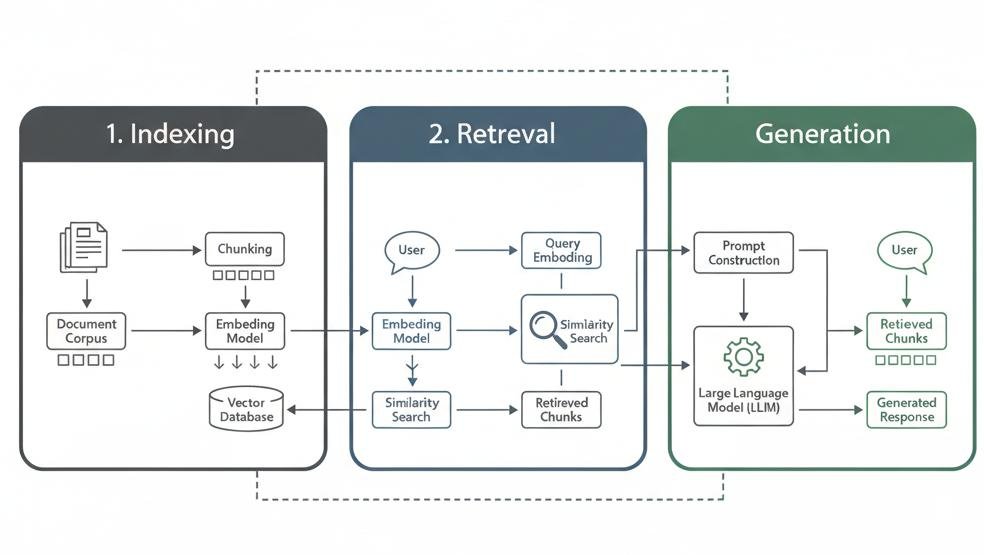
A simplified workflow looks like this:
User question → Search knowledge base → Retrieve relevant information → Give context to AI model → Generate answer
Here’s what happens in more detail.
1. Information is collected
The first step is gathering the material the AI should be able to use.
For a company’s customer-support assistant, this might include product documentation, support articles, return policies, and troubleshooting instructions.
The source material needs to be reviewed carefully. Adding inaccurate or outdated information can create problems later.
2. Documents are processed
Large documents aren’t normally treated as one enormous block of text.
A RAG system may parse documents and divide them into smaller sections, often called chunks. Chunking allows the retrieval system to locate the particular passage that relates to a user’s question rather than passing an entire document to the AI model. Google Cloud’s documentation, for example, describes document parsing and chunking as part of preparing content for retrieval.
3. Information can be converted into embeddings
Many modern retrieval systems use embeddings.
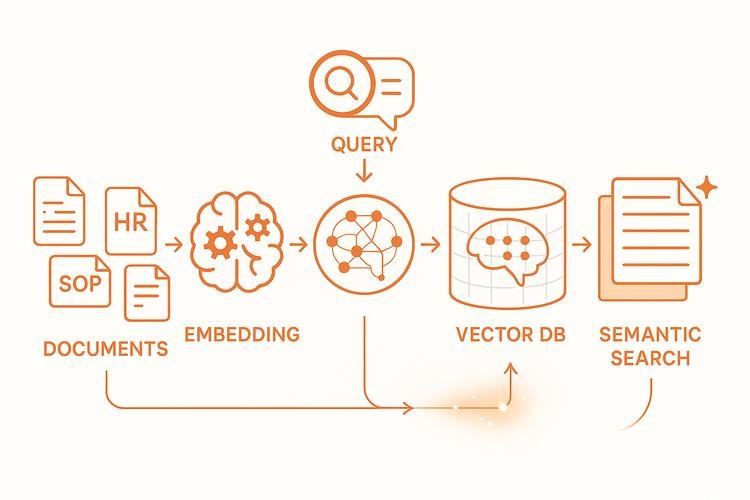
An embedding represents information as a numerical vector that captures aspects of its semantic meaning. Similar concepts can therefore be located near one another in a vector-search system.
For example, a user might ask:
“How can I reset my account password?”
The knowledge base might contain a document titled “Account Recovery Procedure.”
A semantic search system can recognize that these are related even if the user’s wording doesn’t exactly match the document’s wording.
4. The system retrieves relevant information
When the user submits a question, the retrieval component searches the knowledge base.
Depending on the system, retrieval may use:
- Keyword search
- Semantic or vector search
- Metadata filters
- Hybrid search
- Re-ranking
Some modern systems combine keyword and semantic search to improve retrieval quality.
5. The retrieved information is given to the AI model
The relevant passages are added to the model’s context along with the user’s question.
The model can then generate an answer based on both the question and the retrieved material.
This is the central idea behind RAG: the model doesn’t have to rely entirely on its original training knowledge.
6. The answer is generated
Finally, the language model turns the retrieved information into a natural-language response.
A well-designed system can also provide citations or links back to the source material, allowing users to verify where an answer came from. AWS, for example, describes knowledge-base systems where retrieved information can be traced back to its source.
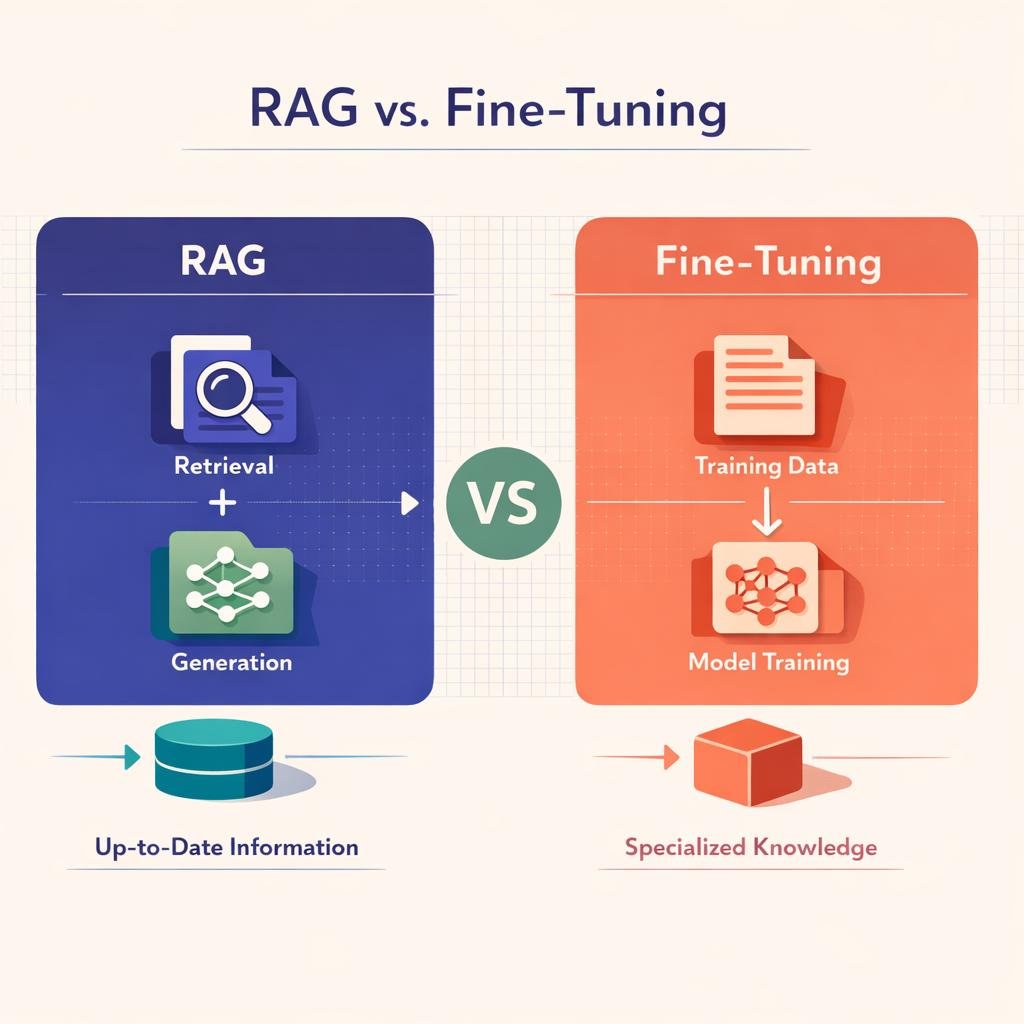
AI Knowledge Base vs. AI Model Training
One of the most common misunderstandings is assuming that adding documents to a knowledge base is the same as training an AI model.
It isn’t.
| AI Knowledge Base | AI Model Training |
|---|---|
| Stores external information for retrieval | Changes or adapts the model through training |
| Information can be updated independently | Training requires a training or tuning process |
| Often used with RAG | Used to change model behavior or capabilities |
| Can work with private company data | Requires appropriate training data and methodology |
| Retrieves relevant information at query time | Learns patterns from training examples |
Suppose a company changes its refund policy.
With a knowledge-base approach, the company can update the relevant source document and re-index the information. The AI application can then retrieve the updated policy.
That is different from retraining the underlying language model.
This is one reason RAG is useful for information that changes frequently or belongs specifically to an organization.
Why Do Businesses Use AI Knowledge Bases?
The main attraction is straightforward: an AI assistant can work with information that is specific to the task.
A general AI model may be capable of explaining a technical concept, but a company might need an assistant that understands its own product documentation.
An AI knowledge base can provide that missing context.
Common applications include:
Customer Support
A customer asks:
“My device won’t connect to Wi-Fi after the firmware update. What should I do?”
Instead of producing a generic troubleshooting response, the assistant can retrieve the company’s specific troubleshooting instructions and provide the relevant steps.
Internal Employee Assistants
Employees may need answers about:
- Vacation policies
- Expense procedures
- IT instructions
- Security policies
- Benefits information
- Internal processes
Rather than searching through dozens of documents manually, an employee can ask a question in natural language.
Technical Documentation
Developers can use an AI assistant connected to product documentation.
For example:
“Which authentication method does this API endpoint support?”
The system can retrieve the relevant section of the documentation and use it to formulate the response.
Product Information
An online retailer could connect an AI assistant to product specifications, return policies, shipping rules, and inventory-related information.
A shopper could then ask questions using ordinary language rather than navigating several pages.
Research and Specialized Knowledge
An AI application can also retrieve information from specialized document collections.
For example, an organization could create a knowledge base containing internal research papers, technical reports, procedures, or other domain-specific material.
The usefulness depends heavily on the quality and relevance of the underlying sources.
A Practical Example of an AI Knowledge Base
Consider a fictional company called Northstar Software.
Northstar sells project-management software and has a support library containing 500 documents.
A customer asks:
“Can I export my project data as a CSV file?”
The system might perform the following process:
- Convert the question into a form suitable for retrieval.
- Search the company’s documentation.
- Find the section describing data exports.
- Retrieve the relevant passage.
- Give that passage to the language model.
- Generate a concise response.
- Include a link to the documentation if the system supports source citations.
The AI model isn’t required to memorize Northstar’s documentation.
Instead, the knowledge base acts as an external reference source.
This distinction becomes especially useful when the documentation changes regularly.
Also Read: BacktoFrontShow Pricing
What Makes a Good AI Knowledge Base?
Simply uploading thousands of documents doesn’t automatically produce a useful AI system.
The quality of retrieval depends heavily on the quality of the underlying information and the retrieval process. Google Cloud specifically notes that irrelevant retrieval can result in responses that are still grounded in the retrieved material but are nevertheless off-topic or incorrect.
A good AI knowledge base should therefore focus on several areas.
Accurate Source Material
If the source documents contain mistakes, the AI may reproduce those mistakes.
Knowledge-base content should be reviewed before it becomes an authoritative source.
Current Information
Old documentation can be just as problematic as missing documentation.
A system answering questions about pricing, policies, software versions, or procedures needs an appropriate process for updating its sources.
AWS guidance also emphasizes validating knowledge freshness rather than allowing systems to rely indefinitely on stale information.
Good Document Structure
Well-organized documents are generally easier to process and retrieve than poorly structured material.
Clear headings, descriptive sections, consistent terminology, and useful metadata can make retrieval easier.
Appropriate Chunking
If chunks are too large, retrieval may return unnecessary information.
If they are too small, important context may be separated.
The right approach depends on the documents and the questions users are expected to ask.
Strong Retrieval
Even a high-quality language model cannot compensate for consistently retrieving the wrong information.
Retrieval quality is therefore one of the most important parts of the entire system.
AI Knowledge Base Limitations
An AI knowledge base can improve an AI application’s access to information, but it does not make the system automatically accurate.
Incorrect Information Can Still Produce Incorrect Answers
If the source material is wrong, incomplete, or outdated, the generated response can inherit those problems.
A knowledge base is not automatically a fact-checking system.
Retrieval Can Fail
The correct document might exist but not be retrieved.
A user’s wording may differ significantly from the wording used in the source material, or the relevant information may be buried in an unsuitable document structure.
This is why retrieval quality needs to be tested rather than assumed.
AI Can Still Misinterpret Retrieved Information
Retrieving the right passage is only part of the process.
The language model still has to interpret the context and formulate the response correctly.
Grounding techniques can reduce unsupported claims, but they don’t eliminate every possible error. Google describes grounding as a way to improve trustworthiness by anchoring responses to verifiable sources, rather than treating it as a guarantee of correctness.
Privacy and Access Control Matter
Company knowledge bases can contain sensitive information.
A system therefore needs appropriate access controls so that users only retrieve information they are authorized to see.
This becomes particularly important when one knowledge base contains information belonging to different teams, customers, or security levels.
Costs and Complexity
A production AI knowledge base may involve several components:
- Document storage
- Parsing
- Embedding generation
- Search infrastructure
- Vector databases or indexes
- Language models
- Monitoring
- Access controls
- Data-update pipelines
The exact architecture and cost depend on the size and requirements of the application.
Common AI Knowledge Base Mistakes
Several mistakes can undermine an otherwise promising system.
Treating the Knowledge Base as a Dumping Ground
Uploading every available document isn’t necessarily a good strategy.
Irrelevant, duplicate, obsolete, or contradictory documents can make retrieval more difficult.
Ignoring Document Updates
A knowledge base should have a process for identifying outdated information.
For example, if a company changes a product feature, its documentation should be updated rather than leaving the old and new instructions together without clarification.
Focusing Only on the AI Model
It’s tempting to spend most of the effort choosing a powerful language model.
But the retrieval layer matters too.
If the system retrieves poor context, a more capable model cannot reliably turn irrelevant information into a correct answer.
Not Testing Real Questions
A knowledge base should be tested using realistic questions users will actually ask.
Testing should examine whether the system:
- Retrieves the right information
- Handles ambiguous questions
- Recognizes when information is missing
- Avoids unsupported claims
- Provides appropriate sources
- Handles outdated information correctly
Is an AI Knowledge Base the Same as a Vector Database?
No.
A vector database is one type of technology that can be used to store and retrieve vector representations of information.
An AI knowledge base is the broader information system and workflow.
A knowledge-base architecture may include document storage, parsing, embeddings, indexes, retrieval logic, metadata, access controls, and a language model.
Vector search can be an important part of that architecture, but the terms should not be treated as interchangeable.
Modern RAG systems can also use hybrid retrieval, combining semantic and traditional keyword-based approaches.
How to Build an AI Knowledge Base
A basic implementation can be approached as a series of steps.
Step 1: Define the purpose
Decide what questions the system needs to answer.
A customer-support knowledge base and a developer documentation assistant may require very different information.
Step 2: Gather reliable sources
Collect the documents, databases, web pages, or other sources the AI should use.
Remove unnecessary or obsolete material.
Step 3: Prepare the content
Parse the documents and divide them into useful sections.
Add metadata where it can help retrieval, such as document type, department, product, version, or date.
Step 4: Create searchable representations
Depending on the architecture, create embeddings and indexes that allow the system to retrieve semantically relevant information.
Step 5: Build the retrieval process
When a user asks a question, the system should search for relevant material and select useful context.
Step 6: Connect retrieval to the AI model
Pass the retrieved information into the model’s context so the response can be grounded in the available sources.
Step 7: Test and monitor
Measure whether the system retrieves useful information and whether its answers are actually supported by that information.
Grounding evaluation can be used to check whether generated statements are supported by reference material.
Frequently Asked Questions
What is an AI knowledge base?
An AI knowledge base is a collection of information that an AI application can search and use to answer questions or perform tasks. It is commonly connected to generative AI through retrieval-augmented generation.
Does an AI knowledge base train the AI?
Usually, no. A knowledge base provides information to the AI at query time. Training or fine-tuning changes how a model behaves, while RAG generally leaves the underlying model unchanged and supplies additional context when needed.
Can an AI knowledge base reduce hallucinations?
It can reduce some unsupported responses by giving the model relevant source material, but it does not guarantee that every answer will be correct. Retrieval quality, source quality, and model behavior all matter.
What information can be stored in an AI knowledge base?
Depending on the system, it can include documents, PDFs, web pages, technical documentation, company policies, databases, FAQs, and other structured or unstructured information.
Do I need a vector database for an AI knowledge base?
Not necessarily. Vector databases are commonly used for semantic retrieval, but AI knowledge-base systems can use different retrieval technologies, including keyword search or hybrid approaches.
Can an AI knowledge base use private company information?
Yes. One major use case for RAG is connecting AI applications to proprietary or private organizational information that isn’t part of the model’s general training knowledge.
How often should an AI knowledge base be updated?
There is no universal schedule. The appropriate frequency depends on how quickly the underlying information changes. Frequently changing information such as policies, prices, product specifications, or procedures should have a process for timely updates.
Is an AI knowledge base always accurate?
No. An AI knowledge base can improve access to relevant information, but inaccurate sources, poor retrieval, missing documents, stale content, or incorrect interpretation can still produce incorrect answers.
Conclusion
An AI knowledge base gives an AI application access to information beyond what the underlying model can provide on its own. In many modern systems, that information is retrieved through RAG and supplied to a language model as context before the model generates an answer.
The most important point is that a knowledge base is more than a collection of files. Its usefulness depends on the quality of its sources, document preparation, retrieval system, freshness, security, and evaluation.
When those pieces are designed carefully, an AI knowledge base can turn a general-purpose language model into a more specialized assistant capable of working with company documentation, technical information, internal policies, product data, and other domain-specific knowledge. The goal isn’t simply to give AI more information; it is to give it the right information at the right time and in a form it can use reliably.