Open source AI models are AI models whose underlying components are made available under terms that give users meaningful freedoms to use, study, modify, and share the system. They are becoming an important alternative to AI services that can only be accessed through a company’s website or API.
But there is an important distinction that is often missed: open source AI is not simply the same thing as an AI model that you can download. Many models described as “open” provide their weights but do not make all of the training data and training code available under open-source terms. The Open Source Initiative (OSI) now has a formal Open Source AI Definition that addresses this distinction.
This guide explains what open source AI models are, how they work, the difference between open-source and open-weight models, where they are useful, what their limitations are, and what you should check before choosing one.
What Are Open Source AI Models?
At a basic level, an AI model is a trained mathematical system that takes an input and produces an output.
For example:
- A language model receives a question and generates text.
- An image model receives a text prompt and generates an image.
- A speech model receives audio and produces text.
- A vision model can analyze an image and describe or classify its contents.
An open source AI model goes further than simply offering access to the model’s output. The goal is to provide the freedoms needed for people to understand, modify, use, and share the system.
According to the Open Source AI Definition, an open-source AI system should allow users to:
- Use the system for any purpose.
- Study how the system works.
- Modify it, including changing its behavior.
- Share the original or modified system.
For AI, this requires more than publishing a few source files. The OSI definition identifies important components such as data information, training and inference code, and model parameters.
What Are Model Weights?
One of the most important terms to understand is weights.
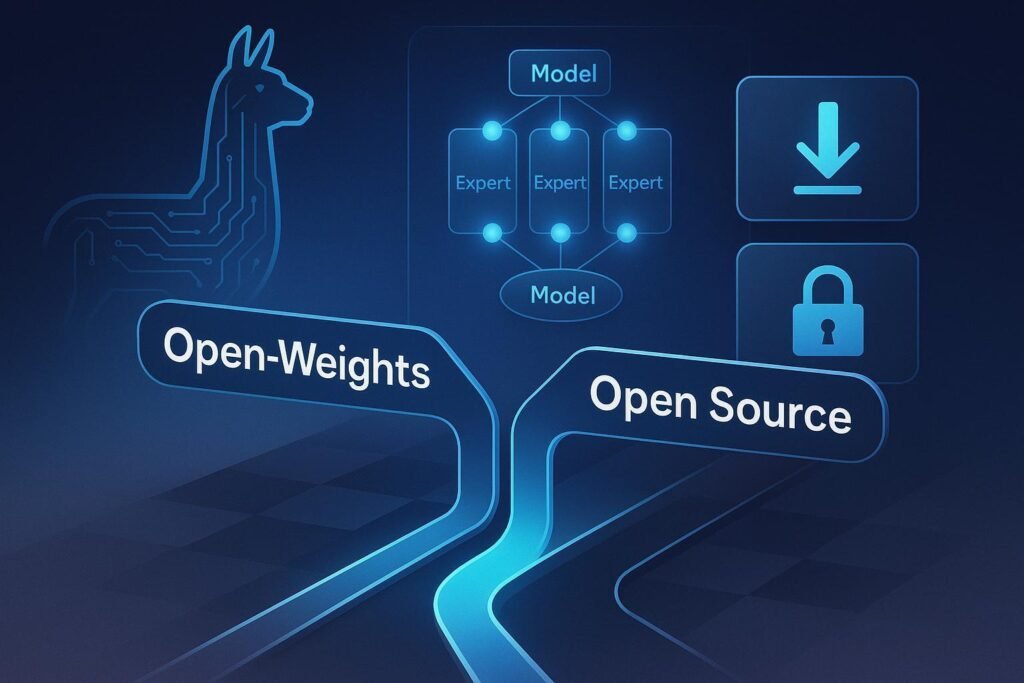
During training, an AI model adjusts large numbers of parameters. These parameters contain the learned information that influences how the model responds to inputs.
The resulting files are commonly called model weights.
If someone gives you downloadable model weights, you may be able to run the model yourself. You may also be able to fine-tune or modify it, depending on the architecture, tools, and license.
However, downloadable weights alone do not automatically make a model open source under the OSI definition.
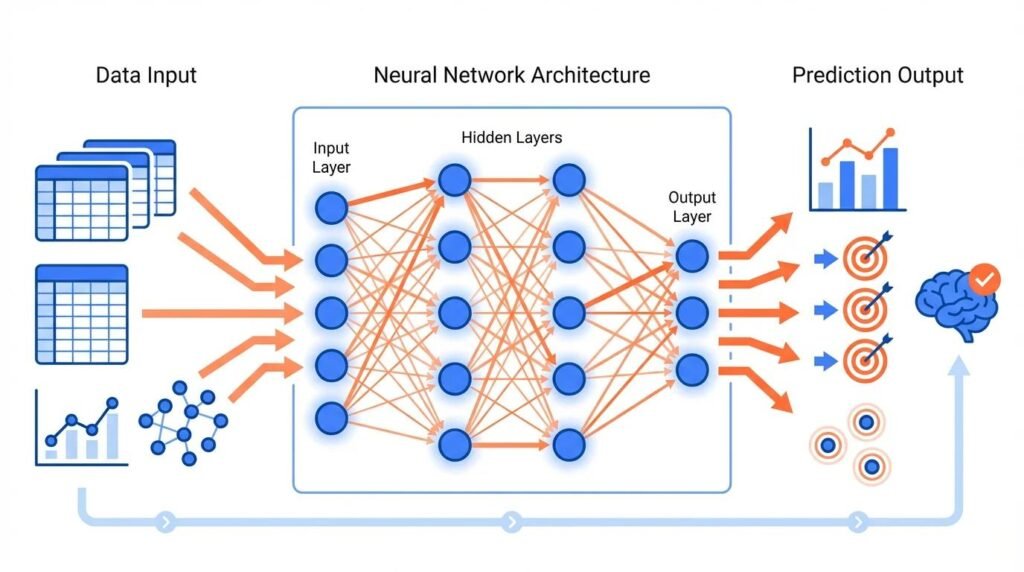
Open Source vs. Open Weight: What’s the Difference?
This is one of the biggest sources of confusion in AI.
An open-weight model generally makes trained model weights available to users. That can make the model downloadable and locally deployable.
An open-source AI system, in the stricter OSI sense, goes further by providing the necessary components and legal freedoms for meaningful study and modification, including relevant data information and code.
| Feature | Open-weight model | Open-source AI |
|---|---|---|
| Model weights available | Usually | Yes |
| Can potentially run locally | Often | Yes |
| Can inspect model files | Usually | Yes |
| Modification permitted | Depends on license | Yes, under the applicable open terms |
| Training code available | Not necessarily | Required by the OSI definition |
| Training-data information available | Varies | Required under the OSI definition |
| Automatically qualifies as OSI-defined Open Source AI? | No | Yes, when the requirements are met |
This distinction matters because the word “open” can describe several different levels of accessibility.
Before using a model commercially or modifying it, always read its actual license and documentation. Model repositories can use many different licenses and terms, including model-specific licenses.
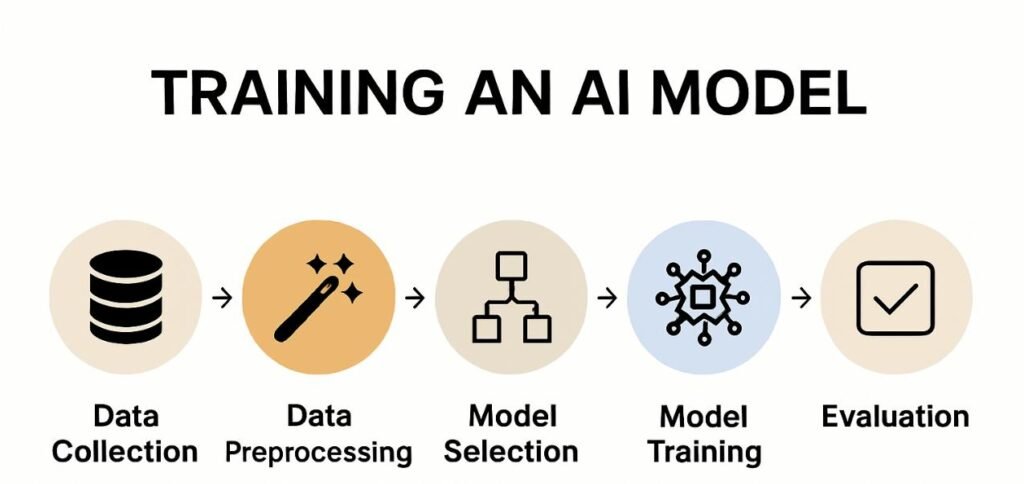
How Do Open Source AI Models Work?
The underlying process is similar to other machine-learning systems.
1. Data is collected and prepared
A model needs training information.
For a language model, this can include large collections of text. Other models may be trained using images, audio, video, code, or combinations of different data types.
The data is normally processed before training. This can involve filtering, cleaning, formatting, deduplication, labeling, or other preparation.
2. The model is trained
During training, the system processes examples and adjusts its parameters.
For a language model, one common training objective involves learning patterns in sequences of tokens. Over many training examples, the model’s parameters are adjusted so that it becomes better at producing useful outputs.
Training a large model can require substantial computing resources.
3. The trained parameters become model weights
After training, the learned parameters can be saved as model checkpoints or weights.
These weights can then be distributed so that other people can use the trained model without repeating the original training process.
4. Developers run the model
A developer can load the model into suitable software and provide an input.
For example:
User question → tokenizer → model → generated tokens → decoded response
The exact implementation differs between models, but this basic process explains why a downloadable model can potentially operate without sending every request to a company’s cloud service.
5. Developers can adapt the model
Depending on the model and its license, developers may:
- Fine-tune it for a particular task
- Connect it to private data
- Build an application around it
- Run it on their own infrastructure
- Quantize it to reduce memory requirements
- Modify supporting software
- Evaluate and benchmark its behavior
The available options depend heavily on the model’s architecture, tooling, hardware requirements, and license.
Why Do People Use Open Source AI Models?
There is no single reason.
Greater control
A company using a model locally can have more control over where inference happens and how the surrounding application is designed.
For organizations handling sensitive information, local deployment may be attractive because data does not necessarily have to be sent to an external AI API.
That does not automatically make a local model private or secure. Developers still need to consider logs, application architecture, access controls, model files, and the data being processed.
Customization
A downloadable model can provide more flexibility than a fixed chatbot interface.
Developers can potentially fine-tune or otherwise adapt a model to specific requirements.
For example, a company could build an internal assistant that is designed around its own documentation rather than asking employees to use a general-purpose chatbot.
Local deployment
Open models can sometimes be run on a developer’s own computer, workstation, private server, or cloud infrastructure.
Smaller models are particularly interesting for local experimentation because they can require substantially fewer resources than very large models.
Whether a particular model can run comfortably on a given machine depends on factors such as model size, quantization, context length, architecture, and available memory.
Lower dependence on a single provider
With an externally hosted AI API, your application depends on the provider’s infrastructure, pricing, availability, policies, and API behavior.
A model that you can download and operate yourself can give developers greater control over deployment.
That does not mean self-hosting is always cheaper. Hardware, electricity, storage, maintenance, engineering time, and inference optimization all have costs.
Real-World Examples of Open AI Models
The open-model ecosystem includes models designed for different purposes.
Local AI assistant
Imagine a developer wants to build a private writing assistant for an organization.
Instead of sending every document to an external API, the developer could select a suitable downloadable language model and deploy it on infrastructure controlled by the organization.
The application might work like this:
Employee → internal application → locally deployed model → response
The important part is that the model becomes one component of a larger application.
Customer-support assistant
A business could use a language model together with its own knowledge base.
Suppose the company has documentation about:
- Product specifications
- Return policies
- Troubleshooting procedures
- Internal support instructions
A retrieval system could find relevant documents and provide them to the model as context.
The model then generates an answer based on that retrieved information.
This is often more practical than trying to make the model memorize every company document through fine-tuning.
Coding assistant
An organization could deploy a model designed for programming-related tasks and connect it to development tools.
For example, an internal coding assistant might help explain functions, generate boilerplate, or suggest changes while keeping source code within the organization’s infrastructure.
The quality of the result depends on the model, context provided, evaluation process, and surrounding software.
AI on an edge device
Smaller models can also be useful when AI needs to run closer to the user or device.
A model might be deployed on:
- A workstation
- An embedded computer
- A private server
- An edge device
Smaller models are generally easier to deploy in constrained environments, although they may not match the capabilities of much larger systems on every task.

Open Source AI Models vs. Proprietary AI Models
The difference is primarily about access, control, and licensing—not simply whether one model is “better.”
| Area | Open models | Proprietary models |
|---|---|---|
| Access | Often downloadable | Often accessed through a service or API |
| Local deployment | Often possible | Depends on provider |
| Customization | Can be extensive, depending on license | Usually controlled by provider |
| Infrastructure | User may manage it | Provider generally manages it |
| Transparency | Can be greater, depending on openness | Internal details may be unavailable |
| Maintenance | User may be responsible | Provider handles infrastructure |
| Costs | Hardware and operational costs may apply | Often usage or subscription based |
| License | Must be examined carefully | Provider terms apply |
Neither approach is automatically superior.
A startup might prefer an API because it can begin without managing GPU infrastructure. A company with strict deployment requirements might prefer a model it can operate itself.
The right choice depends on the application.
Also Read: Best AI Tools for Financial Advisors 2026
Benefits of Open Source AI Models
1. Flexibility
Developers can build applications around models instead of being restricted to a single interface.
2. Customization
Some models can be fine-tuned or otherwise adapted for specific domains.
3. Local deployment
Running a model yourself can be useful when latency, infrastructure control, or data-handling requirements matter.
4. Research and education
Accessible model files and code can make experimentation easier for developers, students, and researchers.
5. Community development
Open ecosystems can allow developers to create tools, integrations, improvements, evaluations, and specialized versions of existing systems.
Limitations and Risks
Open source does not mean perfect, free, safe, or automatically trustworthy.
Hardware requirements
Large models can require significant memory and computing power.
Downloading a model is only the beginning. Running it efficiently can require appropriate hardware and technical knowledge.
Model quality varies
An open model may perform extremely well for one task and poorly for another.
You should evaluate the model using the tasks that actually matter to your application rather than choosing it solely because it is popular.
Hallucinations still happen
Open models can generate incorrect information.
A model can produce an answer that sounds convincing while being factually wrong. Important applications should therefore include testing, validation, and appropriate human oversight.
Licensing can be complicated
This is one of the most important practical issues.
A model repository may contain a license that places specific conditions on how the model can be used, modified, or redistributed. Some model families use licenses or terms that differ from conventional software licenses.
Never assume that “downloadable” means “use it however you want.”
Read the model’s current license before deploying it, particularly for commercial applications.
Openness does not eliminate security risks
An openly available model can still have weaknesses.
Applications built around models can introduce additional risks through:
- Malicious prompts
- Unsafe tool access
- Poor authentication
- Insecure plugins
- Sensitive data exposure
- Untrusted model files
- Weak output validation
The model is only one part of the security system.
How to Choose an Open Source AI Model
If you’re planning to use one, avoid choosing based solely on the model’s name or parameter count.
Use this process instead.
1. Define the task
Ask what you actually need.
Is it:
- General conversation?
- Coding?
- Summarization?
- Document analysis?
- Translation?
- Image generation?
- Speech recognition?
- Classification?
A model optimized for one task may not be the best choice for another.
2. Check the license
Read the current license and usage terms.
Pay particular attention to commercial use, redistribution, modification, attribution requirements, and any special restrictions.
3. Check the hardware requirements
Determine:
- Model size
- Required memory
- Quantization options
- Supported hardware
- Inference framework
- Expected performance
A model that looks impressive on paper may be impractical for your available hardware.
4. Test it on your own data
This is more useful than relying entirely on general benchmarks.
Create a small evaluation set representing the tasks your users will actually perform.
Then compare several models using the same inputs.
5. Examine documentation
Look for information about:
- Training
- Intended uses
- Limitations
- Evaluation
- License
- Supported formats
- Deployment instructions
Good documentation can save significant development time.
Common Misconceptions About Open Source AI
“If I can download it, it’s open source.”
Not necessarily.
Downloadability usually tells you that some model artifacts are available. It does not by itself establish that the complete system meets an open-source definition.
“Open source means the training data is always public.”
No.
The OSI’s definition specifically addresses data information and recognizes that legal and practical constraints can affect whether underlying datasets can be distributed directly.
“Open source means free.”
Not necessarily.
The software or model may be available without a purchase price, but running AI can still require GPUs, cloud infrastructure, storage, electricity, engineering work, and maintenance.
“A bigger model is always better.”
No.
A larger model may have advantages on certain tasks, but it also generally brings greater resource requirements. A smaller model that performs well on your specific workload can be the more practical choice.
Frequently Asked Questions
What are open source AI models?
Open source AI models are AI systems made available under terms that provide freedoms to use, study, modify, and share them, together with the components needed to exercise those freedoms. The OSI definition considers elements such as model parameters, code, and data information.
Are open source AI models free?
They can often be downloaded without paying a model-access fee, but “free” does not mean that deployment costs nothing. Hardware, cloud computing, storage, electricity, and development can all cost money.
What is the difference between open source and open-weight AI?
Open-weight generally means the trained model weights are available. Open source, under the OSI definition, requires broader access and freedoms, including the relevant code and data information needed to meaningfully modify the system.
Can I run open source AI models on my own computer?
Many downloadable models can be run locally, but requirements vary considerably. Model size, quantization, available memory, hardware acceleration, and software support all affect whether a particular model is practical on your computer.
Can I use open source AI models commercially?
It depends on the specific model and its license. Always check the current license and usage terms before using a model in a commercial product.
Can I fine-tune an open source AI model?
Some models can be fine-tuned, but the exact process depends on the architecture, available training tools, hardware, and license. Fine-tuning also requires suitable training data and evaluation.
Are open source AI models more private?
They can provide greater control over data because some can be deployed on infrastructure you control. However, local deployment does not automatically guarantee privacy. The complete application and data-handling architecture still matter.
Where can I find open source AI models?
Model repositories and developer communities provide access to many downloadable AI models. However, you should check each model’s license, documentation, intended use, and actual level of openness rather than assuming every model labeled “open” has the same rights.
Conclusion
Open source AI models give developers an alternative to relying entirely on centrally hosted AI services. They can provide greater control over deployment, customization, experimentation, and integration into private systems.
The most important lesson is to look beyond the word “open.” A model with downloadable weights is not necessarily an open-source AI system in the formal sense. The model’s license, weights, code, training information, documentation, and permitted uses all matter.
For developers choosing a model, the best approach is practical: define the task, examine the license, check the hardware requirements, test the model on representative data, and evaluate its limitations before putting it into production.
Open AI models can be powerful building blocks—but the quality of the final AI application depends just as much on the data, software, evaluation, security, and decisions surrounding the model.