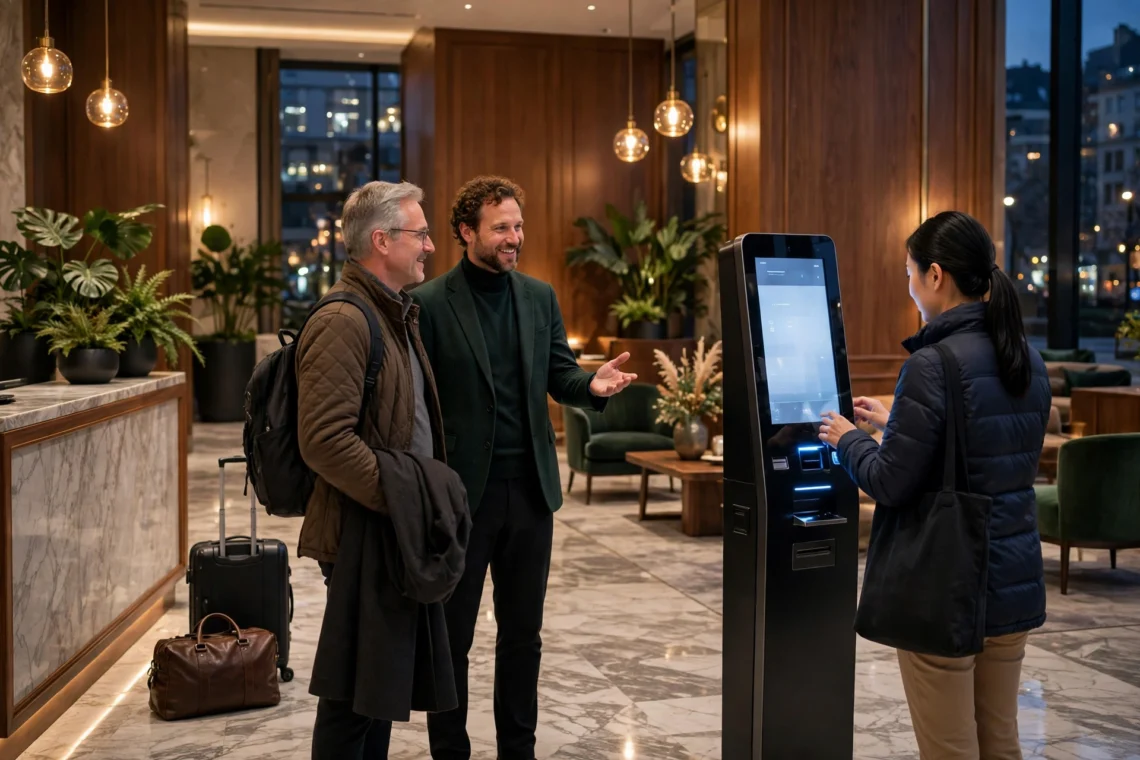
A guest lands at midnight after a delayed flight, walks into a hotel lobby, and checks in without queuing at a desk. Their room is already set to the temperature they like, the restaurant has a table held for breakfast, and a message on their phone offers a late check-out because their flight home leaves in the evening. None of this needed a phone call, a form, or a member of staff working through the night. That is ai in hospitality working the way it is meant to: quietly, in the background, removing friction from a stay.
Hotels have always been a service business, and service has always depended on people noticing things. A good receptionist remembers a returning guest. A good housekeeper spots a room that needs attention before the guest does. What has changed is that software can now do some of that noticing at a scale no team can match, reading thousands of bookings, messages, reviews and sensor readings and turning them into decisions in seconds.
This guide explains ai in hospitality in plain language. You will learn what it actually means beyond the marketing, the seven most useful ways hotels are putting it to work in 2026, the benefits owners and guests genuinely see, the problems that catch hotels out, and a practical five-step plan for starting small without a huge budget or a technology team.
What Is AI in Hospitality?
Ai in hospitality means using artificial intelligence — machine learning, natural language processing, computer vision and generative AI — to run a hotel better and serve guests better. It covers everything from the moment a traveller searches for a room to the moment they check out, and the work that happens behind the scenes in between: pricing, staffing, cleaning, maintenance, energy use and marketing.
The simplest way to think about ai in hospitality is in three layers. The first layer is guest-facing AI: chatbots, virtual concierges, voice assistants and booking tools that talk to guests directly. The second layer is operational AI: forecasting, scheduling, pricing and maintenance systems that help managers make better decisions. The third layer is in-room AI: smart controls for lighting, temperature and entertainment that adapt to whoever is staying in the room.
Most hotels do not use all three layers at once, and they do not need to. A small independent hotel might start with a single chatbot that answers common questions, while a large chain might run all three layers across hundreds of properties. The technology is the same; only the scale changes.
What makes ai in hospitality different from the automation hotels have used for years is that it handles judgement, not just repetition. An old property management system could send the same confirmation email to every guest. An AI system can read a guest’s booking history, notice they always ask for a quiet room away from the lift, and flag that preference before they arrive. One repeats a rule; the other adapts to the person.
The shift is happening fast. In its 2025 global analysis of AI adoption, Boston Consulting Group found that fewer than 10% of hospitality companies could be called “future built”, with cutting-edge AI capability generating real returns, while 25% were already scaling AI across parts of their business. Analyst estimates cited by NetSuite put the market for AI technology in hospitality at roughly $90 million in 2023, growing at about 60% a year and expected to top $8 billion by 2033. And according to Mews’s Hotelier Survey 2026, 98% of hoteliers had used AI somewhere in their operations in the previous six months, across an average of 11 of the 19 most common hotel tasks. The question for most hotels is no longer whether to use AI, but where to start.

7 Powerful Ways Hotels Are Using AI in 2026
The seven uses below are the ones delivering real results for hotels right now. Each one solves a specific, everyday problem, and each one is already running in real hotels rather than sitting in a research lab.
1. Smarter Booking and Personalised Search
The first place most travellers meet ai in hospitality is the search box. Instead of filtering through lists of rooms by price and dates, guests can now describe what they want in ordinary words — “a quiet room with a sea view near the beach, under $200” — and get results that match the request, not just the filters.
Marriott Bonvoy, for example, uses AI-powered search to personalise natural-language searches across the 140,000 luxury home rental properties in its Homes and Villas line. The system understands what the traveller means, not just the words they typed, and surfaces properties that fit the intent behind the search.
For hotels using ai in hospitality, the same idea works on their own websites. AI search tools can:
- Understand intent: a guest typing “somewhere quiet for working” gets rooms with desks and good Wi-Fi, not just the cheapest room.
- Personalise results: returning guests see rooms and offers matched to how they have stayed before.
- Answer questions instantly: “Is there parking?” and “What time is breakfast?” get answered during the booking, before the guest gives up and books elsewhere.
This matters because most hotel bookings are lost in the gap between a question and an answer. When the answer arrives in seconds, more searches turn into bookings.
2. AI Concierges and Guest Messaging
The AI concierge is the most visible face of ai in hospitality. It is a chatbot or voice assistant that answers guest questions at any hour, in the guest’s own language, without making them wait on hold or walk to the front desk.
A good AI concierge handles the questions hotels hear a hundred times a day: Wi-Fi passwords, breakfast times, check-out times, directions, restaurant bookings, extra towels, late check-out requests. It can also take simple bookings — a table at the restaurant, a spa slot, a taxi to the airport — and pass anything complicated to a human with a summary of what has already been discussed.
The best systems learn from every conversation. If guests keep asking where the nearest pharmacy is, the concierge starts offering the answer before being asked. If a guest mentions a birthday during booking, the concierge can arrange a note or a small gesture in the room. That is the kind of personal service that used to depend on one exceptional member of staff remembering everything, and now it can happen consistently, at 3am, in twelve languages.
The rule that makes ai in hospitality work is simple: the AI handles the routine, and people handle the rest. A guest with a complaint, a special request, or a problem that needs empathy should reach a person quickly, and the person should already know what the guest asked the AI. Hotels that hide their staff behind a chatbot lose guests; hotels that use the chatbot to free their staff to do the human work gain them.
3. Faster, Contactless Check-In and Check-Out
Few parts of a hotel stay frustrate guests more than queuing to check in. AI in hospitality is removing that queue. Guests can now check in from their phone before they arrive, verify their identity with a document scan, receive a digital key, and walk straight to their room.
Some hotels have gone further. Universal Orlando Resort has started using facial recognition to validate identity at park entrances, and similar technology is appearing in hotel lobbies, where a camera check can replace the passport-and-form ritual at the desk. Used well, it cuts the check-in process from minutes to seconds. Used badly, with unclear consent or no alternative for guests who prefer the desk, it creates the kind of complaint that travels further than any good review.
Check-out is changing in the same way through ai in hospitality. AI systems can settle the bill automatically, confirm there are no extra charges to query, and send the receipt before the guest reaches the lift. The front desk stops being a bottleneck and becomes what it should be: a place guests go when they want help, not a place they are forced to queue.
4. Dynamic Pricing and Revenue Management
A hotel room is a perishable product. An empty room tonight earns nothing, and a room sold too cheaply on a busy weekend leaves money behind. Pricing it well means watching demand, local events, competitor prices, weather, flight schedules and booking pace all at once — far more than any person can track by hand.
This is where ai in hospitality earns its keep most directly. Revenue management systems use machine learning to:
- Forecast demand: predict how full the hotel will be on a given date, weeks ahead, from booking patterns and local events.
- Adjust prices continuously: raise rates when demand rises and lower them early when it falls, instead of waiting for a weekly review.
- Recommend the right offer: suggest a minimum stay, a package, or a discount for a specific room type on a specific date.
- Spot booking patterns: notice that business travellers book late and pay more, while leisure guests book early and hunt for deals, and price each group accordingly.
A small hotel that once changed its prices once a week can now change them several times a day, automatically, with a person approving the strategy rather than doing the arithmetic. The result is usually the same rooms earning more, with fewer empty nights — which is why revenue management is often the first place a hotel’s investment in AI pays for itself.

5. Housekeeping and Maintenance Scheduling
Behind every smooth stay is a schedule: which rooms to clean, in what order, with which staff, and which repairs to fix first. AI in hospitality turns that schedule from a fixed rota into a live plan that reacts to what is actually happening.
When a guest checks out early, the system can move that room to the top of the cleaning list so it can be sold again the same day. When a sensor reports a slow drain or a failing air-conditioning unit, the system can raise a maintenance ticket before the next guest notices. When a large group arrives on Tuesday, the system can shift staff hours to match, instead of running the same rota every week regardless of who is staying.
Predictive maintenance is the quiet star of ai in hospitality here. By reading data from lifts, boilers, air-conditioning units and kitchen equipment, AI models can spot the patterns that come before a breakdown — a vibration, a temperature drift, a small rise in energy use — and flag the machine for service while it is still working. A repair planned for a quiet Tuesday costs far less than an emergency repair on a sold-out Saturday night, and it never ruins a guest’s stay.
6. Smarter Energy Use and Sustainability
Hotels are energy-hungry buildings. Heating, cooling, lighting and hot water run around the clock, and a large share of it is wasted on empty rooms and unused spaces. AI in hospitality is cutting that waste without asking guests to accept a worse stay.
Smart building systems learn how each room is used and adjust accordingly. They can lower the heating in a room that is empty, raise it an hour before the guest returns, dim the corridor lights when nobody is there, and shift laundry and kitchen loads to cheaper, off-peak hours. AI-powered building management telemetry makes it easier for hotels to track all of this and prove the savings, which matters as much for reporting as it does for the electricity bill.
Guests notice the results of ai in hospitality more than the technology. A room that is already comfortable when they walk in, without the hotel heating every empty room on the floor, feels like good service. And for hotels working towards sustainability targets, the data these systems produce — exactly how much energy, water and waste each stay involves — turns a vague promise into a number they can report honestly.
7. Staff Support and Training
The least talked-about use of ai in hospitality may be the most important: helping the people who work in hotels do their jobs better. AI tools now draft replies to guest reviews, summarise long email threads for the front desk, translate messages between staff and guests, and prepare shift briefings that tell each team member what matters today — which guests are arriving, who has a special request, what went wrong yesterday.
Training is changing too as ai in hospitality spreads. New staff can practise difficult conversations with an AI that plays the role of an unhappy guest, getting feedback on tone and wording before they face a real one. Housekeeping teams get checklists that adapt to the rooms they are cleaning that day. Managers get a daily summary of what guests are saying in reviews and messages, instead of discovering a problem weeks later.
None of this replaces hospitality skills. It removes the paperwork and the guesswork around them, so the people in the hotel spend more of their shift with guests and less of it staring at screens. In an industry where good staff are hard to find and harder to keep, that is not a small thing.
Also Read: RPA vs AI: 7 Key Differences and How to Choose the Right One
AI in Hospitality at a Glance
The table below summarises the seven uses, what each one does, and who benefits most from it.
| Use case | What it does | Who benefits most |
|---|---|---|
| Smarter booking and search | Matches guests to rooms from natural-language requests | Guests and the bookings team |
| AI concierges and messaging | Answers questions and takes simple bookings around the clock | Guests and the front desk |
| Contactless check-in and check-out | Verifies identity and issues digital keys before arrival | Guests in a hurry |
| Dynamic pricing | Forecasts demand and adjusts room rates continuously | Owners and revenue managers |
| Housekeeping and maintenance | Schedules cleaning and flags repairs before they fail | Operations and housekeeping |
| Energy and sustainability | Cuts waste by heating, cooling and lighting rooms only when needed | Owners, the planet and the budget |
| Staff support and training | Drafts replies, briefs shifts and trains new staff | Every team in the hotel |
The Benefits Hotels Actually See
The benefits of ai in hospitality fall into three groups, and hotels feel them in a clear order. First comes time: the hours saved when routine questions, bookings and admin are handled automatically. A front desk team that no longer spends its shift answering the same five questions can spend it solving the problems that actually need a person.
Second comes money. Dynamic pricing earns more from the same rooms, predictive maintenance avoids expensive emergency repairs, and energy systems cut utility bills. These savings are measurable, which is why owners who were sceptical about AI often change their minds after the first quarter of results.
Third comes guest satisfaction, which is harder to measure but easy to lose. Guests who check in without queuing, get an answer at midnight, and find their room already the way they like it leave better reviews and come back. In a business where a single review can sway dozens of future bookings, that is worth more than any single cost saving.
There is a fourth benefit of ai in hospitality that matters for small hotels in particular: levelling the playing field. A twenty-room hotel cannot hire a revenue manager, a data analyst and a round-the-clock concierge team. With AI in hospitality, it can rent the capability for a monthly fee and offer a standard of service that used to belong only to large chains. That is a genuine change in who can compete.
The Challenges Hotels Must Handle
None of this is free of problems, and an honest guide should say so. The first challenge for ai in hospitality is data. AI systems are only as good as the information they are fed, and many hotels keep guest data in three or four separate systems that do not talk to each other — the booking engine, the property management system, the restaurant till, the review sites. Until those are connected, the AI is working with half the picture.
The second challenge for ai in hospitality is privacy. Guests share sensitive information with hotels: passports, payment details, travel plans, health needs. AI systems that read messages and track behaviour must handle that data carefully, with clear consent and strong security. A hotel that uses facial recognition or tracks guests around the building without explaining why will lose trust faster than any efficiency gain can repay.
The third challenge is the cost and complexity of ai in hospitality. Some AI tools are cheap and simple; others need integration work, staff training and ongoing maintenance. A hotel that buys a system nobody on the team understands will end up with an expensive dashboard nobody opens. The fix is to start with one problem, prove the return, and only then buy the next tool.
The fourth challenge is over-automation in ai in hospitality. Guests choose hotels partly because they want to be looked after by people. A hotel that replaces every human contact with a screen has misunderstood what it is selling. The best use of ai in hospitality keeps people at the centre and uses the technology to give them more time with guests, not less. Boston Consulting Group makes the same point in its research on AI-first hotels: the hotels that win are the ones that redesign the work around the technology, not the ones that simply bolt a chatbot onto the same old processes.
How to Start With AI in Hospitality: 5 Practical Steps
Hotels that get the best results from ai in hospitality usually start small and follow the same five steps.
- Pick one problem, not one product: start with the pain that costs the most time or money — unanswered guest messages, empty rooms on weekdays, or a front desk buried in admin. Choose the problem first, then find the tool that solves it.
- Clean up the data you already have: connect the booking engine to the property management system and make sure guest preferences are recorded in one place. Most hotels find their data is messier than they thought, and fixing it pays off before any AI is bought.
- Run a small pilot: test the tool on one part of the hotel — one floor, one restaurant, or the overnight shift — for a month. Measure what changes: response times, bookings, costs, review scores. A pilot that works is the best argument for spending more.
- Train the team properly: show staff what the tool does, what it cannot do, and when to take over from it. The staff who trust the system will use it; the staff who were never shown how it works will work around it.
- Review and expand slowly: check the results every month, keep what works, drop what does not, and add the next use case only when the first one is running smoothly. Hotels that try to automate everything at once usually automate nothing well.
Frequently Asked Questions
What is ai in hospitality in simple terms?
Ai in hospitality is the use of artificial intelligence in hotels and travel businesses to serve guests better and run operations more smoothly. It includes chatbots that answer guest questions, systems that set room prices based on demand, tools that schedule cleaning and maintenance, and smart controls that manage energy in rooms. The common thread is software that learns from data and makes decisions, instead of simply following fixed rules.
How are hotels using AI right now?
Hotels use ai in hospitality for personalised booking search, AI concierges and guest messaging, contactless check-in, dynamic pricing, housekeeping and maintenance scheduling, energy management and staff support. The most common starting points are a guest messaging chatbot and a revenue management system, because both show measurable results within weeks rather than months.
Will AI replace hotel staff?
No — and hotels that try usually regret it. AI in hospitality takes over repetitive work such as answering the same questions, adjusting prices and scheduling routine tasks. It does not replace the welcome, the judgement call, the apology, or the personal touch that guests remember. The hotels seeing the best results use AI to give their staff more time with guests, not to remove staff from the building.
Is ai in hospitality only for large hotel chains?
No. Large chains were first because they could afford custom systems, but most AI tools for hotels are now sold as monthly subscriptions that small and independent hotels can afford. A twenty-room hotel can use a chatbot, a pricing tool and a smart thermostat for a modest monthly cost. The advantage for small hotels is often bigger, because the tools replace roles they could never afford to hire for.
What does ai in hospitality cost?
It varies widely. A simple guest messaging chatbot can cost less than a single night’s room revenue per month, while a full revenue management system or a building-wide energy platform costs considerably more and usually needs integration work. The sensible approach is to start with one tool, measure what it saves or earns, and let the result decide the next spend.
Is guest data safe with hotel AI?
It can be, but only if the hotel treats data properly. Guests should know what information is collected and why, their payment and identity details should be stored securely, and AI tools should only access the data they need. Hotels should check that every ai in hospitality supplier they use follows data protection rules, keeps data encrypted, and deletes guest information when it is no longer needed. When in doubt, ask the supplier exactly where guest data goes before signing anything.
Conclusion
Ai in hospitality is not a futuristic idea waiting for the technology to catch up. It is already answering guest questions at midnight, pricing rooms while managers sleep, spotting a failing boiler before it breaks, and helping a small hotel offer the kind of service that once needed a team of fifty. The hotels using it well are not the ones with the biggest budgets. They are the ones that picked a real problem, started small, trained their staff, and kept people at the centre of the stay.
The technology behind ai in hospitality will keep improving, and the gap between hotels that use it and hotels that do not will keep widening. But the goal has not changed since the first innkeeper lit a lamp for a late traveller: make the guest feel looked after, and make the stay easy. AI in hospitality is simply the newest way to do that — and for hotels willing to start with one problem and one tool, 2026 is a good year to begin.