
Artificial intelligence can produce different responses to the same question depending on the information available, the user’s needs, and the situation in which a task occurs. This ability to adjust its behavior based on surrounding information is known as AI contextual adaptation.
For example, an AI assistant helping a beginner learn programming may explain a concept using simple language and basic examples. When assisting an experienced developer, it may provide technical details, discuss performance trade-offs, and assume familiarity with programming terminology. The underlying technology may be similar, but the response changes to suit the context.
AI contextual adaptation makes intelligent systems more useful in situations where a fixed response is not enough. It plays a role in conversational AI, personalized learning, customer service, recommendation systems, and business automation.
Understanding how it works also means understanding its limitations. An AI system can misinterpret a situation, rely on incomplete information, or adapt in ways that produce inaccurate or inappropriate results. This article explains the concept, its underlying mechanisms, practical applications, benefits, and challenges.
What Is AI Contextual Adaptation?
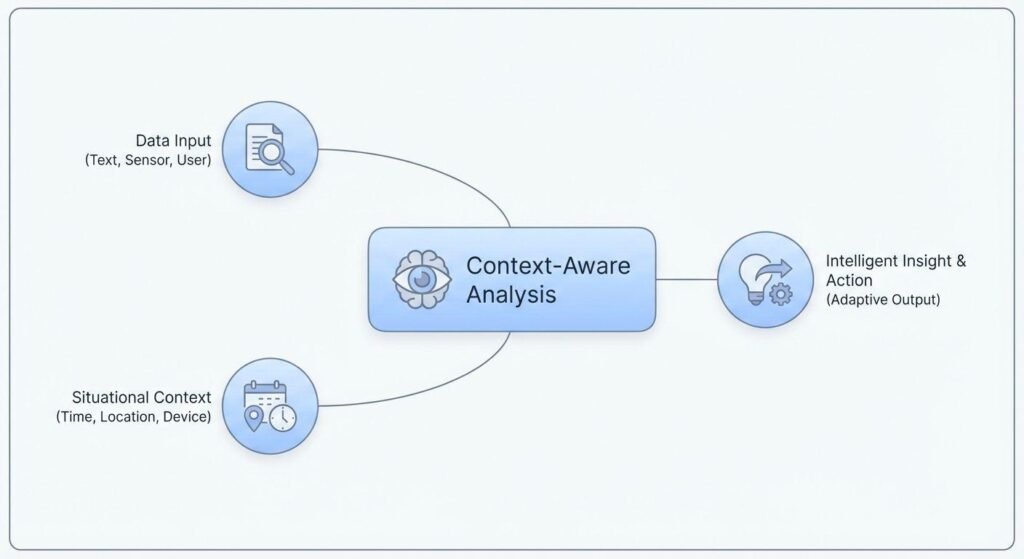
AI contextual adaptation is the ability of an artificial intelligence system to adjust its responses, decisions, or behavior according to the context in which it operates.
Context refers to the information that helps determine what a particular input means and what response would be appropriate.
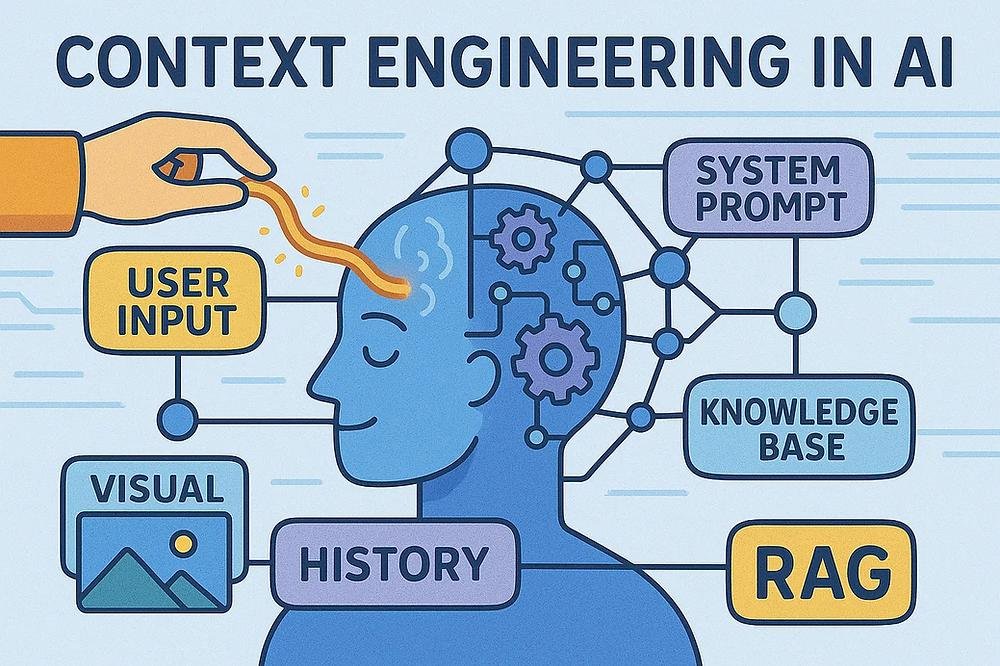
Depending on the application, context can include:
-
User information: Preferences, experience level, language, and previously stated requirements.
-
Conversation history: Earlier questions, answers, and details shared during an interaction.
-
Task requirements: The goal, constraints, and expected outcome of a request.
-
Environmental information: Location, time, device conditions, or other relevant circumstances.
-
Available data: Documents, records, product information, or other information supplied to the system.
Consider a customer asking, “Can I change it?”
Without context, an AI assistant cannot know what “it” refers to. The customer might mean a delivery address, a subscription plan, or an item in an order.
If the preceding conversation concerned a delivery address, the system can interpret the question accordingly. It can then provide instructions for changing that address rather than asking the customer to explain everything again.
That is contextual adaptation in practice: using relevant information to interpret an input and produce a response suited to the situation.
Contextual Adaptation vs. Ordinary AI Responses
A basic AI system may respond to each input using a relatively fixed set of rules or a limited amount of information. A context-aware system considers additional details that can change how it handles the same input.
For instance, a basic support chatbot might provide the same return policy to every customer. A context-aware assistant could use the product category, purchase date, and applicable return conditions to explain the options relevant to a particular order.
The difference is not necessarily the complexity of the model. It is how effectively the system uses relevant context when generating an answer or making a decision.
How Does AI Contextual Adaptation Work?
AI contextual adaptation can involve several technical processes. The exact implementation depends on whether the system is a language model, recommendation engine, autonomous agent, or another type of AI application.
A typical contextual AI workflow involves the following stages.
1. Collecting Relevant Context
The system first obtains information that may help it understand the current task.
This information can come from the user’s current message, previous conversation turns, connected databases, documents, or sensors.
For example, an AI shopping assistant might receive:
-
The customer’s request for a laptop.
-
A stated budget of $800.
-
A preference for lightweight devices.
-
A requirement for long battery life.
These details help narrow the task. Instead of recommending any laptop, the system can focus on products that fit the customer’s stated needs.
Context collection should be selective. More information is not always better, particularly when the additional data is outdated, irrelevant, or sensitive.
2. Interpreting the Situation
After gathering information, the AI system must determine which details matter.
This process may involve natural language processing, classification, information retrieval, or reasoning over structured data.
Suppose a user asks, “Make this shorter.”
If the conversation includes a long email draft, the system can infer that the user wants the email shortened. If the current task involves a product description, the same instruction refers to that description instead.
The system uses the surrounding information to resolve ambiguity and identify the intended task.
However, contextual interpretation is not guaranteed to be correct. If several possible references exist, the system may need to ask a clarifying question.
3. Selecting an Appropriate Response or Action
Once the system interprets the context, it can adjust its output.
Adaptation may involve changing:
-
The level of technical detail.
-
The tone or language of a response.
-
The information included in a recommendation.
-
The order in which instructions are presented.
-
The action taken by an automated system.
For example, an AI tutor might explain fractions using a visual analogy for a young learner, then provide equations and practice problems for someone preparing for an advanced mathematics exam.
The goal is not simply to generate a different answer. It is to generate an answer that better fits the learner’s needs and current objective.
4. Using Feedback to Refine Future Responses
Some AI systems use feedback to improve how they respond during an interaction or across multiple interactions.
A user might say, “I understand the basics. Please explain the technical details.”
The assistant can use that feedback to make its next response more advanced.
In a recommendation system, a user’s selections, ratings, or skipped suggestions may help refine future recommendations.
There is an important distinction here: adapting during an interaction does not necessarily mean the AI model is learning or retraining itself.
A system may simply use updated conversation context, adjust a set of preferences, or retrieve different information. Permanent model updates require a separate training or learning process.
Key Technologies Behind AI Contextual Adaptation
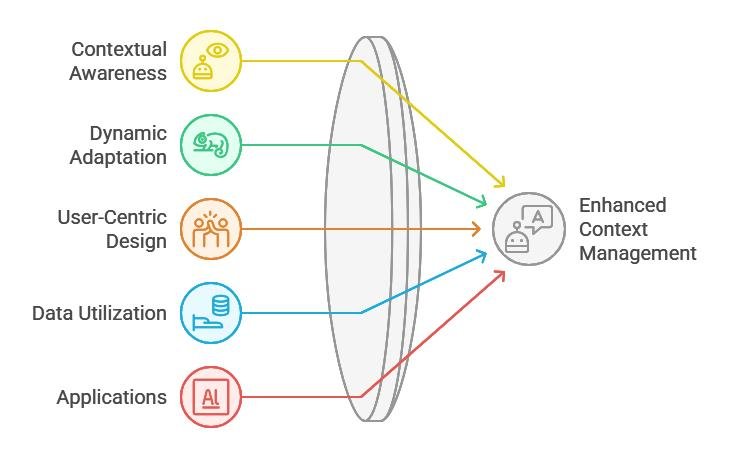
Contextual adaptation is not one specific algorithm. It is a capability that can be built using several AI techniques and supporting technologies.
Natural Language Processing
Natural language processing (NLP) helps AI systems interpret human language, including intent, meaning, and relationships between words.
It is particularly important when context is expressed through conversation.
For example, if a user says, “I want the cheaper one,” an AI assistant needs to identify which products are being compared and understand that price is the deciding factor.
NLP helps connect the latest message to the relevant parts of the conversation.
Large Language Models
Large language models (LLMs) can use the text provided in their context window to generate responses that reflect instructions, conversation history, and supporting information.
This makes them useful for tasks such as adapting explanations, summarizing documents for different audiences, and answering follow-up questions.
However, an LLM does not automatically have access to every previous conversation, personal preference, or external fact. Its available context depends on the system’s design, the information supplied, and any connected memory or retrieval features.
Retrieval-Augmented Generation
Retrieval-augmented generation (RAG) combines a generative model with a process that retrieves relevant information from an external source.
Instead of relying only on information encoded in its model parameters, the system can retrieve documents or records related to the current request.
For example, an AI assistant used by a software company could retrieve the documentation for a particular product version before answering a technical question.
The answer can then reflect the relevant documentation rather than providing a generic explanation.
RAG is especially useful when information changes frequently or when responses must be grounded in an organization’s own knowledge base.
Memory and User Profiles
Some AI applications maintain information about previous interactions, preferences, or ongoing tasks.
A writing assistant might remember that a user prefers concise explanations. A learning platform might track which lessons a student has completed.
This information can help the system personalize future responses.
Memory must be handled carefully. Preferences can change, stored information can become outdated, and users should have appropriate control over personal data.
Reinforcement Learning and Feedback-Based Optimization
Reinforcement learning involves learning to select actions based on rewards or feedback. It can be used in environments where an AI system makes decisions and receives signals about their outcomes.
In some applications, reinforcement learning or related optimization techniques can help a system improve its behavior under changing conditions.
However, not every adaptive AI system uses reinforcement learning. Many contextual applications operate through prompts, rules, retrieval, or conventional predictive models without updating their underlying parameters.
Real-World Examples of AI Contextual Adaptation
The value of contextual adaptation becomes clearer when looking at how it changes everyday tasks.
1. Customer Service Chatbots

Imagine a customer contacts an online store because a package has not arrived.
The customer first provides an order number. After receiving an update, they ask, “Can I get my money back instead?”
A context-aware assistant can connect the follow-up question to the delayed order and determine whether a refund is available under the store’s policies.
It may need to retrieve the order status, delivery details, and refund conditions before responding.
Why it matters: Customers do not need to repeat every detail in each message, and the system can provide answers relevant to their actual situation.
For actions such as issuing refunds, the system should also enforce authorization rules and obtain human approval when required.
2. Personalized Education
An AI learning platform can adjust its explanations based on a student’s demonstrated understanding.
Suppose a student repeatedly makes mistakes when converting fractions into decimals. The platform can provide additional examples, explain the conversion process, and offer targeted exercises.
Once the student demonstrates understanding, it can introduce more challenging problems.
This is different from giving every learner the same lesson in the same order.
Why it matters: Instruction can respond to individual learning needs rather than relying entirely on a fixed sequence.
The system still needs reliable assessments. A few incorrect answers do not necessarily mean a student lacks understanding, and automated evaluations can misjudge a learner’s progress.
3. E-Commerce Recommendations
An online shopping platform may use browsing activity, previous purchases, product attributes, and stated preferences to recommend relevant items.
A shopper looking for a lightweight laptop for university may receive different suggestions from someone searching for a high-performance gaming computer.
The system can also adapt when the shopper changes their requirements, such as lowering their budget or prioritizing battery life.
Why it matters: Recommendations become more relevant to the shopper’s current needs.
However, recommendations based on incomplete behavior can be misleading. A person may research a product for someone else, and past purchases do not always represent future preferences.
4. AI Writing and Productivity Tools
An AI writing assistant can adapt its output to the intended audience and purpose.
Consider a user preparing a technical explanation about cloud computing. The same source material might need to become:
-
A beginner-friendly blog introduction.
-
A detailed explanation for software engineers.
-
A short summary for company executives.
-
A presentation script for a general audience.
The underlying subject remains the same, but the vocabulary, length, emphasis, and examples change.
Why it matters: Users can reuse information across different formats without manually rewriting every section from scratch.
The user should still review the result to ensure that simplification has not removed important qualifications or changed the original meaning.
5. Smart Devices and Environmental Systems
Contextual adaptation also applies to AI systems that interact with the physical environment.
A smart building system might use occupancy information, temperature readings, and predefined operating constraints to adjust heating or cooling.
A robot operating in a warehouse might use sensor data to change its route when an obstacle appears.
In these examples, context is not limited to language. It includes current conditions and information from the environment.
Why it matters: The system can respond to changing circumstances rather than following a single fixed action in every situation.
For systems that affect physical safety, adaptation must operate within carefully tested limits. Incorrect sensor readings or unexpected conditions can lead to harmful decisions.
AI Contextual Adaptation vs. Personalization and Context Awareness
These terms are related, but they describe different aspects of an AI system.
| Concept | What it means | Example |
|---|---|---|
| Context awareness | Recognizing relevant information about a situation. | Identifying which order a customer is discussing. |
| Contextual adaptation | Adjusting a response or action based on that information. | Explaining the refund options for that order. |
| Personalization | Tailoring an experience to an individual. | Using a customer's preferred language. |
| Continuous learning | Updating a model or policy using new data or feedback. | Training a recommendation model on new interaction data. |
A system can be context-aware without adapting its behavior. It might recognize that a customer is asking about a delayed order but still provide the same generic response to everyone.
Similarly, personalization can use long-term preferences, while contextual adaptation may respond to a temporary situation.
For example, a user who normally prefers detailed answers might request a one-sentence summary. The system should follow the immediate instruction rather than blindly applying the user’s usual preference.
These capabilities often work together, but they are not interchangeable.
Also Read: Droven io Artificial Intelligence News
Benefits of AI Contextual Adaptation
When implemented well, contextual adaptation can make AI systems more useful, efficient, and responsive.
More Relevant Responses
By considering the user’s objective and surrounding information, AI can avoid generic answers that fail to address the actual question.
This is particularly useful for complex requests that depend on earlier messages, specific documents, or individual constraints.
Better User Experiences
Users can communicate naturally, provide information over multiple messages, and refine their requests as they go.
They do not always need to restate their goals or explain the same background details repeatedly.
Greater Efficiency
In business applications, context-aware systems can help employees find relevant information, handle routine customer questions, and organize tasks.
When the system retrieves the correct information and applies the appropriate rules, it may reduce unnecessary back-and-forth.
The actual efficiency gains depend on implementation quality, the task being automated, and how much human review remains necessary.
Flexibility Across Different Tasks
The same underlying AI capability can support different audiences, environments, and objectives.
A language model, for instance, may assist with technical documentation, customer support, and internal knowledge searches when supplied with the appropriate context and instructions.
This flexibility can reduce the need to build a completely separate conversational experience for every use case.
Limitations and Risks of AI Contextual Adaptation
Contextual adaptation is not automatically reliable. Its effectiveness depends on the quality of the information, the model’s interpretation, and the safeguards surrounding its decisions.
Incorrect or Incomplete Context
If a system receives inaccurate information, it may produce an answer that is inappropriate for the situation.
An AI assistant might retrieve an outdated refund policy or confuse two customer orders with similar details.
Even a capable model cannot reliably compensate for missing information in every case.
What helps: Validate important data, identify its source, and ask for clarification when key details are missing.
Privacy and Data Protection
Personalized systems may process sensitive information, including purchase histories, customer records, location data, or private conversations.
Collecting more information than necessary increases privacy risks. Storing information also creates responsibilities around access, retention, security, and deletion.
Organizations should limit data collection to what the task requires and provide appropriate transparency and user controls.
The specific legal obligations depend on the jurisdiction and type of data involved, so current requirements should be checked against authoritative legal sources.
Overpersonalization
An AI system can rely too heavily on a user’s previous behavior.
For example, a recommendation engine might repeatedly suggest products similar to those a person has already purchased, making it harder to discover alternatives.
A learning system might continue presenting basic material because of an earlier assessment, even after the student has improved.
What helps: Allow users to change preferences, account for recent instructions, and provide ways to explore alternatives.
Hallucinations and Misinterpretation
Context can make a response more relevant, but it does not guarantee factual accuracy.
An AI model may incorrectly connect two pieces of information, misunderstand a user’s intention, or generate a plausible-sounding answer that is not supported by the available evidence.
Retrieval can help ground responses, but retrieved documents may themselves be incomplete or outdated.
For high-impact decisions, systems should use verifiable sources, communicate uncertainty, and escalate cases that require human judgment.
Cost and Technical Complexity
Contextual adaptation may require additional infrastructure, such as document retrieval, databases, user profiles, monitoring systems, and access controls.
Long conversation histories can also increase processing requirements for some language-model applications.
The cost depends on the architecture, data volume, model, and frequency of use. A simple rule-based system may be sufficient for a narrowly defined task, while a large organization may need a more elaborate design.
How to Implement AI Contextual Adaptation Effectively
Organizations do not need to make every AI system highly complex. The right approach begins with a clearly defined problem.
Step 1: Identify What Context Actually Matters
Start by defining which information can change the correct response.
For a customer support assistant, this might include the customer’s question, order status, product type, and current policy.
Avoid collecting unrelated personal information simply because it is available.
Step 2: Choose an Appropriate Adaptation Method
Different tasks call for different approaches.
-
Use clear rules when decisions are predictable and tightly defined.
-
Use conversation history when the system needs to understand follow-up questions.
-
Use retrieval when answers depend on external documents or frequently updated information.
-
Use user preferences when personalization provides a clear benefit.
-
Use predictive or learning-based methods when the task requires patterns to be learned from data.
These methods can be combined when necessary.
Step 3: Establish Data and Access Controls
Determine where contextual information comes from, who can access it, and how long it should be retained.
For business applications, access permissions should prevent the system from retrieving records that the user is not authorized to see.
Retrieved documents and user-provided content should also be treated as information to evaluate, not as instructions that automatically override the system’s rules.
Step 4: Test Different Situations
Test the system with more than straightforward examples.
Include cases involving:
-
Missing or conflicting information.
-
Ambiguous questions.
-
Outdated records.
-
Changes in user preferences.
-
Requests outside the system’s permitted scope.
-
Attempts to access information without authorization.
Measure whether the system uses context correctly, produces accurate responses, and knows when to ask for help.
Step 5: Monitor and Improve
After deployment, monitor errors, user feedback, retrieval quality, response consistency, and operating costs.
A system that performs well during initial testing may behave differently when exposed to real-world data and changing user needs.
Improvements might involve updating documents, refining instructions, correcting data pipelines, changing rules, or retraining a model. Retraining should not be assumed necessary for every problem.
The Future of AI Contextual Adaptation
AI contextual adaptation is closely connected to the development of more capable assistants and automated systems. As applications combine language models with tools, external data, and longer-running tasks, the ability to maintain relevant context becomes increasingly important.
An AI assistant may need to remember the goal of a project, track completed steps, retrieve current information, and adjust its next action when circumstances change.
However, greater contextual capability also increases the importance of reliable memory, data permissions, transparency, and human oversight.
Future developments should be evaluated by what systems can demonstrate in practice: whether they interpret context correctly, handle uncertainty, respect user preferences, and remain reliable when conditions change.
Claims about specific future capabilities or performance improvements should be checked against current technical documentation and independent evaluations rather than treated as guaranteed outcomes.
Frequently Asked Questions
1. What is AI contextual adaptation in simple terms?
AI contextual adaptation is when an AI system changes its response or behavior based on the situation. It might adjust an explanation for a beginner, answer a follow-up question using conversation history, or recommend a product based on a customer’s requirements.
2. How does AI contextual adaptation work?
It typically involves gathering relevant information, interpreting the current situation, and using that information to select an appropriate response or action. Some systems also use feedback to refine future behavior.
3. Is AI contextual adaptation the same as personalization?
No. Personalization focuses on tailoring an experience to an individual, often using preferences or past behavior. Contextual adaptation is broader: it can respond to the immediate task, conversation, environment, or other circumstances, even without a long-term user profile.
4. Does contextual adaptation mean an AI learns automatically?
No. An AI system can adapt its response by using the information available in the current interaction without changing its underlying model. Automatic learning or retraining is a separate process that depends on the system’s design.
5. What are some examples of AI contextual adaptation?
Examples include chatbots that use previous messages to answer follow-up questions, learning platforms that adjust exercises to a student’s needs, recommendation systems that account for current preferences, and robots that modify their routes when obstacles appear.
6. What are the main challenges of contextual AI?
The main challenges include inaccurate or incomplete context, privacy risks, incorrect interpretation, hallucinations, overpersonalization, and implementation costs. Reliable data, appropriate safeguards, and ongoing testing can help address these issues.
7. What is the role of context in generative AI?
Context helps a generative AI system understand what the user is asking and what information should shape its response. Instructions, conversation history, and retrieved documents can all influence the output. The quality of the result still depends on the model and the reliability of the supplied information.
8. Can AI contextual adaptation be used in business?
Yes. Businesses can use it in customer support, internal knowledge systems, personalized recommendations, workflow automation, and employee assistance. The system should be designed around a specific business need, with appropriate privacy controls and human oversight for consequential decisions.
Conclusion
AI contextual adaptation enables artificial intelligence systems to respond to the circumstances surrounding a task rather than treating every input in isolation. By using conversation history, user preferences, external information, and environmental data, these systems can provide more relevant answers and adjust their actions as needs change.
The technology can improve customer service, education, recommendations, and business workflows. However, its value depends on more than the ability to personalize an answer. Context must be accurate, relevant, and handled responsibly.
The key takeaway is that effective AI contextual adaptation combines useful context with reliable interpretation and appropriate safeguards. When those elements work together, AI systems can become more responsive and practical without sacrificing accuracy, privacy, or user control.