Generative AI has moved beyond being a novelty for creating text, images, and simple computer code. It is increasingly becoming a general-purpose technology that can assist with knowledge work, software development, research, education, design, customer service, and many other activities. The important question is no longer simply what generative AI can do today, but how its capabilities, costs, and role in everyday work may evolve.
The generative AI future will likely involve systems that are more multimodal, better at reasoning, more capable of using software and external tools, and more deeply integrated into existing products and workflows. At the same time, progress will not eliminate fundamental problems such as inaccurate outputs, privacy risks, security concerns, energy requirements, and the need for human judgment.
Understanding this future requires looking beyond predictions about machines replacing humans. The more useful question is how people and organizations will change the way they work as AI becomes a more capable and accessible tool.
What Does the Generative AI Future Mean?
Generative AI refers to systems that can produce new content from a user’s instructions. Depending on the system, that content can include:
- Text
- Images
- Audio
- Video
- Software code
- Presentations
- Structured data
- Computer actions
The future of generative AI is therefore not limited to better chatbots. The technology is developing toward systems that can understand different types of information, reason through more complicated tasks, interact with software, and complete sequences of actions.
Recent evidence suggests that this development is already underway. Stanford’s 2026 AI Index reports that AI capabilities continue to improve and that generative AI adoption has expanded rapidly, while AI agent deployment remains relatively early.
This distinction matters. A chatbot that answers a question and an AI system that researches a topic, works with files, uses software, checks its results, and completes a task are very different levels of automation.
How Generative AI Is Likely to Evolve
Several developments are especially important when considering the generative AI future.
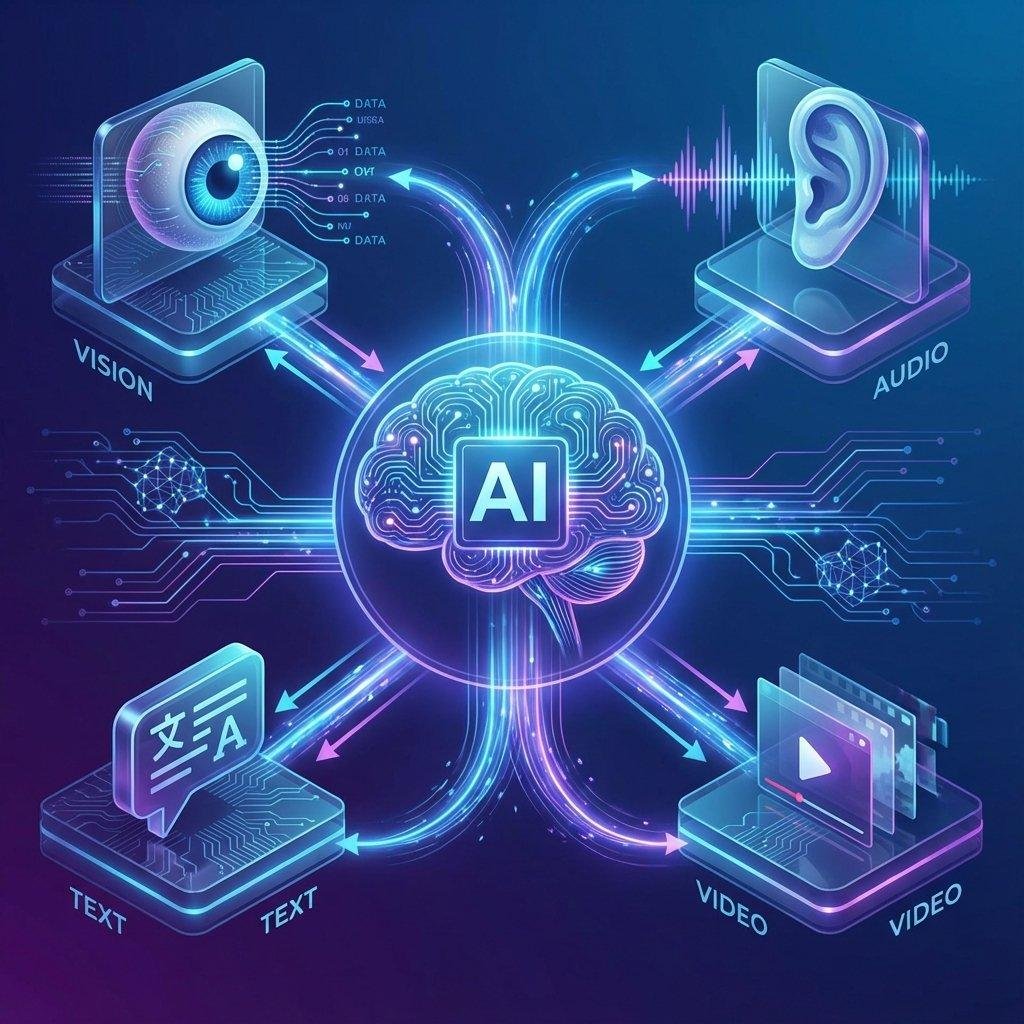
1. AI Will Become More Multimodal
Early generative AI tools were often designed around one primary type of input or output, particularly text.
Future systems are increasingly expected to work across multiple forms of information at once.
For example, a user could provide:
- A written description
- A photograph
- A spreadsheet
- A voice instruction
- A video
- A software project
An AI system could then combine these inputs to understand the situation and produce a useful response.
This could make AI considerably more practical. Instead of explaining a problem in detail, a user might show the AI the problem and ask it to analyze what it sees.
Multimodal AI could be useful in areas such as customer support, engineering, education, design, healthcare administration, software development, and content production.
2. AI Agents Will Move Beyond Simple Conversations
One of the biggest potential changes is the development of AI agents.
A conventional chatbot generally waits for a prompt and produces an answer. An agent can potentially break a larger objective into smaller steps and interact with tools to accomplish it.
For example, instead of asking:
“How can I research five competitors?”
a future AI system might be able to:
- Identify the competitors.
- Collect information from permitted sources.
- Organize the findings.
- Compare pricing and features.
- Create a report.
- Highlight important differences.
- Ask the user for a decision when human approval is necessary.
This does not mean every AI agent will reliably complete complicated tasks without supervision. Current agent deployment is still relatively early, according to the 2026 AI Index.
The important shift is from generating an answer toward helping accomplish an objective.

Generative AI Future and the Workplace
The workplace is likely to experience some of the most significant changes.
Generative AI can already assist with tasks such as drafting documents, summarizing information, writing code, analyzing material, generating ideas, and communicating with customers.
The future may involve AI becoming embedded directly into the applications people already use rather than requiring them to open a separate chatbot.
Imagine a marketing employee working inside a customer relationship management system. Instead of manually examining customer records and writing a report, an AI assistant could summarize recent interactions, identify patterns, prepare a draft response, and recommend possible next steps.
The employee would still decide what should actually happen.
This distinction between automation and augmentation is important. Some tasks may become highly automated, while other jobs may change because workers can accomplish more with AI assistance.
Research reviewed by the OECD indicates that generative AI’s productivity effects depend heavily on the task, the user’s experience, and the ability to evaluate AI-generated output.
Will Generative AI Replace Jobs?
Some jobs and tasks will almost certainly change. But predicting the exact number of jobs that will disappear is much harder.
A job is usually made up of many different tasks. AI might automate some of them while increasing the importance of others.
For example, a software developer may spend less time writing routine code but more time:
- Defining system requirements
- Reviewing AI-generated code
- Testing software
- Designing architecture
- Investigating unexpected behavior
- Making technical decisions
Similarly, a writer might spend less time creating a first draft and more time researching, editing, verifying facts, interviewing sources, and developing original ideas.
The likely result is not simply “AI versus humans.” In many occupations, the more realistic transition is humans working differently because AI handles parts of the workflow.
The labor-market effects are already uneven, and current evidence should not be interpreted as a definitive forecast of the future. Stanford’s 2026 AI Index reports that employment effects are appearing disproportionately in some AI-exposed entry-level groups while large-scale economy-wide job losses have not yet appeared in overall employment data.
Generative AI in Education
Education is another area where the future of generative AI could be significant.
An AI tutor can potentially explain a concept at different levels of difficulty, generate practice questions, provide feedback, and help students identify gaps in their understanding.
For example, a student learning programming could ask an AI system to explain a Python error. Instead of only providing corrected code, the system could explain why the error occurred and generate a simpler example for practice.
Teachers could also use generative AI to create draft lesson materials, exercises, quizzes, or explanations.
However, there is an important risk: using AI to avoid learning rather than support learning.
If a student asks AI to solve every problem without understanding the reasoning, the technology may reduce the learning value of the exercise.
That is why future education systems will need to focus not only on whether students can use AI, but whether they can evaluate, question, and improve AI-generated information.
Also Read: How Mogothrow77 Software Is Built
Generative AI and Software Development
Software development is likely to remain one of the most important areas for generative AI.
AI systems can already assist with code generation, debugging, documentation, testing, and understanding unfamiliar codebases.
The next stage could involve AI systems working across larger portions of the development lifecycle.
A developer might describe a feature and have an AI system:
- Interpret the requirements.
- Suggest an implementation.
- Create code.
- Generate tests.
- Run those tests.
- Identify failures.
- Modify the implementation.
- Prepare a change for human review.
The human developer would still need to evaluate the result, particularly for security, architecture, performance, and business requirements.
This is an important example of why AI capability alone does not determine its practical value. Reliable software requires more than producing code that looks correct.
Generative AI in Healthcare and Scientific Research
Generative AI could also become increasingly useful in research and healthcare-related workflows.
Potential applications include:
- Summarizing scientific literature
- Assisting with documentation
- Helping researchers explore hypotheses
- Analyzing complex information
- Supporting medical administrative tasks
- Generating research code
- Explaining technical material
The key word is assisting.
High-stakes applications require stronger validation because an incorrect answer can have serious consequences. Generative AI should not be treated as automatically reliable simply because it produces a confident response.
In scientific research, for example, an AI-generated hypothesis can be useful as a starting point, but researchers still need experiments, evidence, and independent validation.
What Will Happen to AI-Generated Content?
The internet is likely to contain substantially more AI-generated text, images, audio, and video.
This creates both opportunities and problems.
Businesses can produce localized content more efficiently. Small teams can create marketing materials without large production departments. Individuals can experiment with designs, videos, music, and software that previously required specialized skills.
But increased content production creates another challenge: knowing what deserves attention.
If generating content becomes extremely cheap, the value of human judgment may increase.
People may place greater importance on:
- Original research
- First-hand experience
- Trusted sources
- Editorial judgment
- Expert review
- Authenticity
- Verification
In other words, when content becomes abundant, deciding what is accurate and useful becomes increasingly important.
The Biggest Limitations of the Generative AI Future
The future of generative AI is promising, but several problems could limit how quickly it becomes dependable.
Accuracy and Hallucinations
Generative AI can produce incorrect information while presenting it confidently.
Better models and improved retrieval systems may reduce this problem, but users should not assume that more capable models are automatically correct in every situation.
For important information, outputs should be checked against appropriate sources.
Privacy
AI systems may process sensitive business, personal, or proprietary information.
Organizations therefore need clear policies covering what employees can upload and which AI services are permitted.
Privacy concerns will become increasingly important as AI becomes integrated into workplace systems rather than being used only as a standalone chatbot.
Security
AI can create new security opportunities and new risks.
For example, AI can help developers identify vulnerabilities, but similar capabilities can potentially be misused. AI-generated phishing messages, malicious code, impersonation, and synthetic media are examples of risks that organizations need to consider.
Cost and Infrastructure
Generative AI may look inexpensive from a user’s perspective, but advanced models require significant computing infrastructure.
The AI industry is already experiencing substantial spending on computing and data-center infrastructure. Stanford’s 2026 AI Index reports that compute spending and infrastructure investment have reached record levels alongside rapid AI growth.
Future AI development will therefore depend partly on improvements in computing efficiency, hardware, data-center infrastructure, and energy availability.
Human Overreliance
Perhaps the most underestimated problem is overreliance.
If people stop checking AI-generated work, small errors can become large problems.
The OECD’s review of experimental evidence emphasizes that AI’s effectiveness depends partly on whether users understand its limitations and whether its capabilities match the task.
The strongest future users of AI may therefore not be the people who trust it most. They may be the people who understand when to trust it and when not to.
A More Realistic View of the Generative AI Future
It is tempting to imagine two extreme futures.
In one, AI changes everything overnight and humans become unnecessary.
In the other, AI turns out to be mostly hype and has little lasting impact.
Neither is a particularly useful way to think about the technology.
A more realistic possibility is gradual integration.
AI becomes part of search engines, office software, programming environments, creative applications, educational platforms, customer-service systems, research tools, and business processes.
People may eventually use generative AI without thinking of it as a separate technology at all.
This is one reason the OECD has examined whether generative AI could become a general-purpose technology. Its research points to characteristics such as broad applicability, continued improvement, and the ability to stimulate additional innovation, while also noting that productivity benefits may take time to appear fully.
How People Can Prepare for the Generative AI Future
You do not need to become an AI researcher to prepare.
A practical approach is to develop skills that complement AI.
Learn How AI Actually Works
You do not need advanced mathematics, but understanding concepts such as models, training data, context windows, prompting, retrieval, multimodal systems, and AI agents can help you use these tools intelligently.
Develop Strong Domain Knowledge
AI can generate useful output, but knowledgeable users are better positioned to recognize mistakes.
A person who understands accounting, programming, marketing, engineering, law, design, or another field can evaluate AI output more effectively than someone who simply accepts whatever the system produces.
Improve Verification Skills
Learn how to check important claims, compare sources, test generated code, inspect calculations, and recognize uncertainty.
Verification is likely to become a core digital skill.
Learn to Work With AI, Not Just Prompt It
Prompting is useful, but the broader skill is workflow design.
Instead of asking, “What prompt should I use?” a more useful question is:
“Which part of this task should AI handle, which part should I handle, and where should the result be checked?”
That mindset is more durable as AI products change.
Frequently Asked Questions About the Generative AI Future
What is the generative AI future likely to look like?
The generative AI future is likely to involve more capable multimodal systems, AI agents, deeper integration into software, greater workplace adoption, and more automation of individual tasks. The exact pace remains uncertain.
Will generative AI replace humans?
Generative AI is likely to automate some tasks and change many jobs, but that does not mean humans will become unnecessary. Human judgment, domain expertise, accountability, creativity, and decision-making will remain important, particularly where errors are costly.
Will AI agents replace chatbots?
AI agents may handle more complex tasks than traditional chatbots because they can potentially use tools and complete multiple steps. However, agents are still an emerging technology, and reliable autonomous operation remains a significant challenge.
Is the generative AI future good for workers?
It can create productivity benefits and new opportunities, but the effects will not necessarily be evenly distributed. Workers whose tasks are heavily exposed to automation may face greater disruption, while people who learn to use AI effectively may benefit from increased productivity.
Will generative AI become more accurate?
AI systems are likely to improve, but greater capability does not guarantee perfect accuracy. Users will still need to verify important information, especially in high-stakes situations.
What skills will matter in the generative AI future?
Useful skills include domain expertise, critical thinking, communication, data literacy, AI literacy, problem-solving, software skills, and the ability to evaluate AI-generated output.
Will generative AI make content creation easier?
Yes. Generating drafts, images, videos, audio, and other forms of content can become faster and more accessible. However, producing content will become less distinctive if everyone has access to similar tools, making originality, expertise, research, and editorial judgment more valuable.
Is the future of generative AI certain?
No. Technical progress, regulation, infrastructure costs, public adoption, business economics, and safety developments can all influence the direction of the technology. Current trends can inform forecasts, but they cannot guarantee a particular outcome.
Conclusion
The generative AI future is unlikely to be defined by a single breakthrough. It will probably emerge through thousands of smaller improvements that make AI more capable, affordable, multimodal, and integrated into everyday software.
The biggest change may be the shift from AI as a tool that produces content to AI as a system that helps people complete tasks. That could affect software development, education, research, customer service, creative work, and many other fields.
But capability is only one part of the equation. Accuracy, privacy, security, cost, regulation, human oversight, and responsible use will determine how much value society actually gets from these systems.
For individuals and businesses, the most useful approach is neither blind optimism nor fear. Learn what generative AI can do, understand where it fails, develop expertise that complements it, and build workflows where important results can be checked.
That is likely to be more valuable than trying to predict exactly what AI will look like years from now.