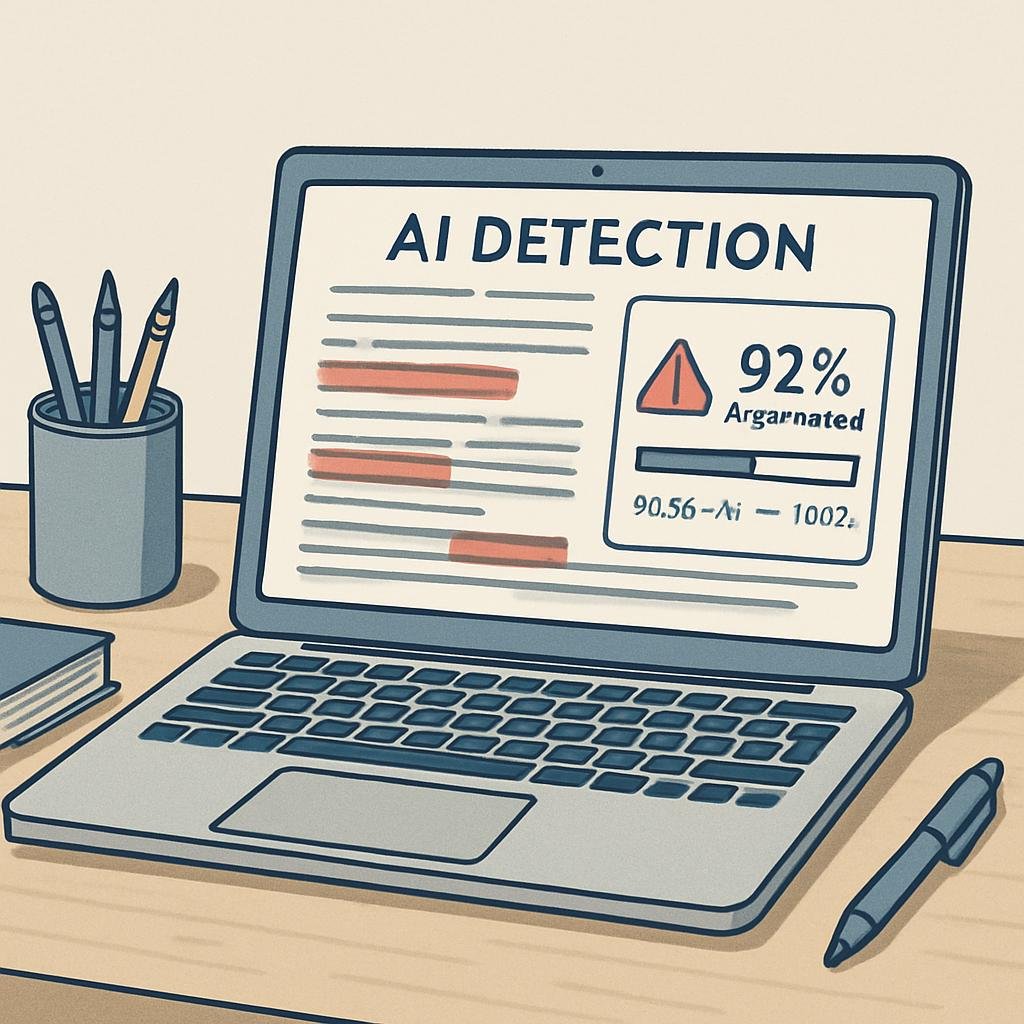
An AI detector is a tool designed to estimate whether a piece of content was written by a human or generated using artificial intelligence. These tools are increasingly used by teachers, publishers, businesses, and website owners who want to understand how content was created.
However, identifying AI-generated writing is not as straightforward as it might seem. AI writing tools can produce natural-sounding text, while human writers can use predictable sentence structures and formal language. As a result, an AI detector can sometimes flag original human writing or fail to recognize text generated by AI.
Understanding how these tools work can help you interpret their results more carefully. This article explains the technology behind AI detection, its practical uses, how accurate it can be, and what to consider before relying on a detection score.
What Is an AI Detector?
An AI detector is a software tool that analyzes content to estimate the likelihood that it was produced by an artificial intelligence system rather than written entirely by a person.
AI detectors are commonly associated with text, but detection technology can also be used to examine images, audio, and video. The methods differ depending on the type of content being analyzed.
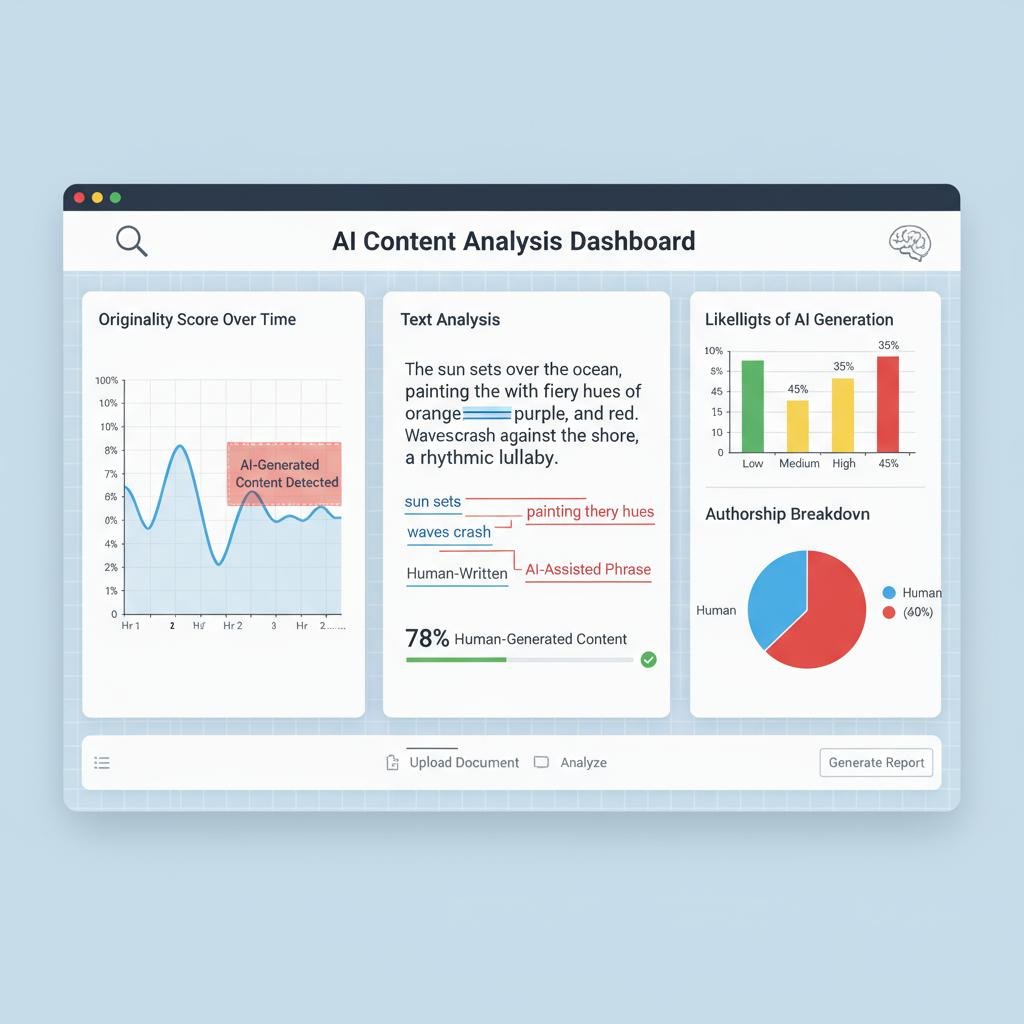
For example, an AI text detector might examine a student essay, a blog post, a product description, or a business report. It then evaluates patterns in the writing and produces a result, such as a classification of human-written or AI-generated content, or a percentage indicating its estimated likelihood of AI involvement.
That percentage needs careful interpretation. A result of 80% does not necessarily mean that 80% of the words were written by AI. Depending on the tool, it may represent a model’s confidence, an estimated likelihood, or the proportion of text classified as AI-generated.
An AI detector also does not automatically determine whether content is original, accurate, plagiarized, or ethically produced. Those are separate questions that require different forms of analysis.
How Does an AI Detector Work?
Most AI text detectors use machine learning or statistical techniques to identify patterns associated with machine-generated writing. They compare features of the submitted text with patterns learned from human-written and AI-generated examples.
The exact process varies between tools, and many providers do not disclose every detail of their detection systems.

1. Analyzing Predictable Language Patterns
Large language models generate text by predicting likely sequences of words or tokens based on their input and training.
AI detectors can look for patterns in how words and sentences are arranged. Some generated text may contain highly predictable phrasing, consistent sentence structures, or repeated linguistic patterns.
For instance, consider these two sentences:
-
“The tool helps teams organize tasks, monitor progress, and improve collaboration.”
-
“After testing the tool with our design team, I found that its shared task board made it easier to spot delays before our weekly meeting.”
Both sentences could have been written by a human or an AI system. However, their structure, specificity, and predictability may lead a particular detector to assign them different scores.
The important point is that a writing pattern is a clue, not proof of who wrote the text.
2. Measuring Perplexity
Perplexity is a statistical measure associated with how predictable a sequence of text is under a language model.
In simplified terms, text that a particular model finds easier to predict may have lower perplexity. Text containing less predictable word choices may have higher perplexity.
Some AI detection methods use this concept to identify writing that resembles the output of language models.
However, perplexity is not a reliable standalone test of authorship. A human writing a straightforward explanation may produce highly predictable language. An AI system can also generate unusual, varied, or less predictable text.
Results can change depending on the model used for analysis, the subject matter, the writing style, and the language.
3. Examining Sentence Variation
Some detectors also analyze variation in sentence length, structure, and complexity.
This is sometimes discussed through the concept of burstiness, which describes variation in the patterns of text. Human writing can contain a mixture of short statements, longer explanations, interruptions, and changes in rhythm.
AI-generated text may sometimes appear more uniform, particularly when a model produces a structured response to a general prompt.
But this distinction is not universal. Professional writers often use consistent sentence structures, while AI-generated content can be deliberately varied.
Sentence variation alone cannot establish whether a person or an AI system produced a passage.
4. Using Machine Learning Classifiers
Many AI detectors use classifiers trained on examples of human-written and AI-generated text.
During training, a model learns patterns that help it distinguish between the two categories. When new text is submitted, the classifier uses those learned patterns to produce a prediction.
The challenge is that language models and writing habits change over time. A detector trained on older AI systems may not perform equally well on newer models, unfamiliar subjects, or writing that has been substantially edited.
A detector may also perform differently when analyzing academic essays compared with marketing copy, technical documentation, or short social media posts.
5. Checking for Watermarks or Other Signals
Some AI detection approaches look for signals deliberately embedded during content generation.
A text watermark, for example, may influence token selection according to a specific pattern that can later be checked by a compatible detector.
This differs from ordinary AI text detection because the system is looking for a signal introduced by a generation process, rather than relying exclusively on writing style.
Watermarking has limitations. It requires compatible generation and detection methods, and certain edits or attempts to manipulate the text can weaken or interfere with detection. The National Institute of Standards and Technology discusses these challenges in its report on synthetic-content transparency.
What Types of AI Detectors Are Available?
AI detection tools can be grouped according to the content they analyze and the techniques they use.
| Type | What It Analyzes | Common Application |
|---|---|---|
| AI text detector | Words, sentences, and linguistic patterns | Essays, articles, reports |
| AI image detector | Visual features and, where available, provenance signals | Images and digital media |
| AI audio detector | Voice characteristics and audio signals | Voice recordings and synthetic speech |
| AI video detector | Visual frames, audio, and possible provenance data | Videos and manipulated media |
| Watermark detector | Signals embedded during content generation | Verifying compatible AI-generated content |
These categories are not interchangeable. A tool designed to analyze writing cannot automatically determine whether an image or audio recording is AI-generated.
For most people searching for an AI detector, the primary concern is text detection. However, image, audio, and video detection are becoming relevant in areas such as journalism, online safety, and digital content verification.
What Is an AI Detector Used For?
AI detectors have several practical applications. Their usefulness depends on the purpose of the analysis and how the results are interpreted.
1. Education and Academic Writing
Teachers and educational institutions may use AI detection tools to review assignments when they need to understand whether students have followed rules about AI assistance.
For example, an instructor reviewing an essay might receive a report suggesting that parts of the submission resemble AI-generated writing.
That result could prompt a discussion about the student’s research, drafting process, or use of writing tools. It should not automatically establish that the student violated an academic policy.
A responsible review considers the assignment instructions, the institution’s rules, the student’s explanation, and other relevant evidence.
2. Content Publishing and SEO
Website owners, editors, and content teams may use an AI detector when reviewing articles, landing pages, and other material submitted by writers.
For example, an editor managing a technology blog may want to know whether a freelancer relied heavily on automated writing tools.
A detector can provide one signal during the review process. However, it cannot establish whether an article is useful, original, factually correct, or suitable for publication.
For a website such as an AI knowledge blog, editorial checks should focus on:
-
Whether technical claims are accurate and supported by reliable sources.
-
Whether the article answers the reader’s actual question.
-
Whether examples are specific and relevant.
-
Whether the content offers original analysis or useful explanations.
-
Whether the writer followed the site’s AI-use and disclosure policies.
A well-researched article should not be rejected simply because a detector assigns it a high AI score.
3. Business and Professional Documents
Businesses may use AI detection tools to review reports, proposals, customer communications, and other professional documents.
Imagine a company that asks employees to prepare a market analysis independently. If a document receives an AI-generated classification, the company may want to clarify whether the employee used an AI assistant and whether that use was permitted.
The detector cannot determine whether the employee’s work meets the company’s requirements. A policy review and examination of the actual work are still necessary.
4. Research and Publishing
Academic publishers may use AI detection as one part of a broader review process.
A detector could identify a passage that deserves additional examination, but it cannot establish whether the underlying research is genuine, whether the references are valid, or whether the conclusions are scientifically sound.
Researchers and editors must independently evaluate evidence, methodology, citations, and disclosure requirements.
5. Identifying Potentially Synthetic Media
Outside text, AI detection may help people investigate whether an image, voice recording, or video was generated or manipulated using AI.
For example, a journalist checking a suspicious audio recording might use a specialized detector alongside source verification and contextual research.
A detector’s output should be treated as one piece of evidence. Establishing the origin of media may require original files, metadata, provenance records, and confirmation from trustworthy sources.
How Accurate Is an AI Detector?
An AI detector can identify patterns associated with AI-generated text, but its results are not definitive proof of authorship.
Accuracy varies by tool, model, language, content type, and testing conditions. A system that performs well on one dataset may produce less reliable results when examining different writing styles or newer AI models.
A 2025 study published in Acta Neurochirurgica evaluated three AI-output detectors using 250 human-written academic texts and 750 texts generated by ChatGPT versions 3.5, 4, and 4o. The researchers reported that the tools could distinguish between the groups to varying degrees, but none achieved perfect reliability. The study focused on academic abstracts and introductions, so its results should not be assumed to apply to every kind of writing.
A separate 2025 paper in the Findings of NAACL examined multiple detectors across different models and domains. It found that detection performance could deteriorate when the systems encountered unfamiliar models or text produced using different prompting strategies.
These findings highlight two important types of error.
False Positives: Human Writing Flagged as AI
A false positive occurs when a detector classifies human-written text as AI-generated.
This can happen when a person uses formal language, follows a predictable structure, writes in a second language, or produces text that resembles patterns found in the detector’s AI training examples.
Consider a student who writes a straightforward essay using simple vocabulary and standard paragraphs. A detector might interpret the consistent style as evidence of AI involvement, even if the student wrote the essay independently.
False positives can have serious consequences when detection scores are used to make decisions about grades, employment, or professional credibility.
False Negatives: AI Writing Not Detected
A false negative occurs when AI-generated text is classified as human-written or is not identified by the detector.
This may happen when the generated text differs from the patterns the detector recognizes. Editing, translation, changes in sentence structure, or the use of a different language model can also affect results.
A low AI score therefore does not prove that a person wrote the text without assistance.
Why Detection Scores Can Be Misleading
A detector’s percentage is meaningful only in the context of the tool’s scoring method and its performance on comparable material.
Three questions are especially important:
-
What does the percentage represent? It may refer to a confidence estimate or the amount of text classified in a particular way.
-
How was the tool tested? Performance on one collection of essays may not predict performance on technical articles or multilingual writing.
-
What happens when the tool is wrong? A result used to guide an editorial review has different consequences from one used to accuse a student of misconduct.
The National Institute of Standards and Technology explains that text provenance and detection methods have technical limitations, including vulnerability to manipulation and difficulties generalizing across writing styles and languages.
Also Read: Droven IO Best Tech Tools for Developers
How to Use an AI Detector Responsibly
If you want to check a document, use the detector as a starting point rather than a final judgment.
Step 1: Choose a Tool That Fits Your Purpose
Select a tool designed for the content you want to examine. A text detector is appropriate for written material, while audio and image analysis require specialized systems.
Check the tool’s documentation to understand what it claims to detect and which languages or content types it supports.
Step 2: Submit an Appropriate Sample
Follow the tool’s instructions about document length and formatting.
Very short passages may not provide enough information for a meaningful analysis. A single sentence, heading, or product description can be difficult to classify reliably.
If the tool specifies a minimum text length, follow that guidance rather than assuming a short sample will produce a dependable result.
Step 3: Read the Report Carefully
Look at the explanation provided with the result. Determine whether the tool identifies particular passages, reports an overall classification, or provides a numerical estimate.
Do not interpret a highlighted sentence as proof that AI generated it.
Step 4: Compare the Result With Other Evidence
If authorship matters, consider relevant evidence such as:
-
Drafts and revision history.
-
Notes and research materials.
-
The writer’s explanation of their process.
-
Applicable AI-use and disclosure policies.
-
The content’s factual quality and supporting sources.
No single item necessarily establishes authorship, but several independent sources of evidence can provide a more useful picture.
Step 5: Protect Private Information
Before uploading a document, check the service’s privacy policy and data-handling terms.
A document may contain unpublished research, confidential business information, personal details, or student work. Determine whether submitted text is stored, used for model improvement, shared with third parties, or retained after analysis.
For sensitive material, use an approved tool or an authorized internal review process.
AI Detector vs. Plagiarism Checker: What Is the Difference?
An AI detector and a plagiarism checker address different questions. They should not be treated as substitutes for each other.
| Feature | AI Detector | Plagiarism Checker |
|---|---|---|
| Main purpose | Estimate whether text resembles AI-generated content | Identify matching text or potential unattributed reuse |
| Typical method | Analyze linguistic patterns or other detection signals | Compare text against available sources and databases |
| Can identify copied material? | Not reliably as its primary function | Can identify potential matches |
| Can prove authorship? | No | No |
| Can assess factual accuracy? | No | No |
For example, an AI-generated paragraph may contain original wording and produce no significant plagiarism matches. Conversely, a human-written paragraph may reproduce another source without proper attribution.
A document can also contain both AI-generated material and copied content. Each issue requires its own review.
Advantages of AI Detectors
Despite their limitations, AI detectors can provide practical benefits when used carefully.
Faster Initial Screening
A detector can process a document quickly and identify passages that may deserve closer attention. This can help editors or reviewers prioritize their work.
Support for Editorial Review
Content teams can use detection reports as one part of an established quality-control process, especially when their policies require disclosure of certain AI-assisted work.
Greater Awareness of Synthetic Content
Detection tools can help users understand that some digital content may have been generated or altered using AI. This can encourage further verification rather than automatic acceptance.
Assistance With Research and Evaluation
Researchers can use detectors to study how AI-generated writing differs from human writing, provided they account for the tools’ limitations and testing conditions.
Limitations and Risks of AI Detection
AI detection is not a complete solution to questions of authorship or authenticity.
Detection Methods Can Become Outdated
AI writing systems evolve, and detectors must adapt to changing models and writing patterns. Performance against one generation of tools does not guarantee similar performance against future systems.
Human Writing Styles Differ
People write differently depending on their education, language, profession, and personal style. A detector may struggle when an individual’s writing does not resemble the examples used to train it.
Editing Can Change the Results
Rewriting or editing text can alter the patterns a detector examines. This can affect whether the same underlying material is classified as AI-generated.
Privacy May Be a Concern
Some online services require users to upload complete documents. Without understanding their data practices, users may expose information they did not intend to share.
Scores Can Be Misused
A detector can create a false sense of certainty. Treating a probability estimate as proof can lead to unfair accusations or incorrect decisions.
These limitations make it important to establish clear policies and use independent evidence when the outcome matters.
Common Misconceptions About AI Detectors
A High AI Score Proves That AI Wrote the Text
False. A high score indicates that the text matches patterns the detector associates with AI-generated writing. It does not establish who wrote it.
A Human-Written Article Will Always Pass
False. Human writing can be flagged, particularly when its style resembles patterns the detector has learned to associate with AI-generated content.
AI Detection and Plagiarism Detection Are the Same
False. AI detection estimates how content was produced, while plagiarism checking looks for similarities with existing material.
Every AI Detector Works the Same Way
False. Tools use different models, methods, training data, and scoring systems. Their results may disagree when analyzing the same document.
A Detector Can Identify Which AI Tool Wrote Something
Not necessarily. Some systems may attempt to classify text associated with particular models, but identifying the exact tool or model responsible is a separate and more difficult task.
Frequently Asked Questions
1. What is an AI detector?
An AI detector is a tool that analyzes content to estimate whether it was generated by artificial intelligence. Text detectors commonly examine linguistic patterns, statistical features, or other signals associated with machine-generated writing.
2. Are AI detectors accurate?
Their accuracy varies by tool, language, writing style, and testing conditions. They can produce both false positives and false negatives, so their results should not be treated as conclusive proof of authorship.
3. Can an AI detector detect ChatGPT?
Some AI detectors are designed to identify patterns associated with text generated by ChatGPT and other language models. However, they cannot reliably identify every AI-generated passage or guarantee which model produced it.
4. Can an AI detector mistakenly flag human writing?
Yes. Human-written text can receive an AI-generated classification because of its structure, vocabulary, predictability, or similarity to the detector’s training examples.
5. Is an AI detector the same as a plagiarism checker?
No. An AI detector estimates whether content resembles AI-generated writing. A plagiarism checker looks for text that matches existing sources. Neither tool independently establishes whether a document is accurate or properly researched.
6. Can an AI detector check an entire website?
Some services offer website or batch-content analysis, while others accept only pasted text or uploaded documents. The available features depend on the provider. Even when a site can be scanned, its results should be reviewed at the page level and interpreted cautiously.
7. Should teachers rely on AI detector scores?
AI detector scores should not be the sole basis for accusing a student of misconduct. Teachers should consider institutional policies, assignment requirements, the student’s explanation, and other relevant evidence.
8. Are free AI detectors reliable?
A free tool may be useful for an initial check, but price alone does not determine accuracy. Compare the tool’s documented capabilities, supported languages, privacy practices, and independently evaluated performance. Do not assume that a paid detector is automatically more reliable.
Conclusion
An AI detector can help identify writing patterns associated with artificial intelligence, making it useful for preliminary checks in education, publishing, business, and research. However, it cannot reliably establish authorship on its own.
Its results depend on the detection method, the text being examined, and the conditions under which the tool was evaluated. False positives can affect genuine human writers, while false negatives can allow AI-generated content to go undetected.
The most practical approach is to treat AI detection as one source of information, not a final verdict. Combine it with careful human review, relevant evidence, transparent policies, and appropriate privacy safeguards.
The key takeaway: an AI detector can estimate whether text resembles AI-generated content, but understanding how that content was actually created requires more than a score.