
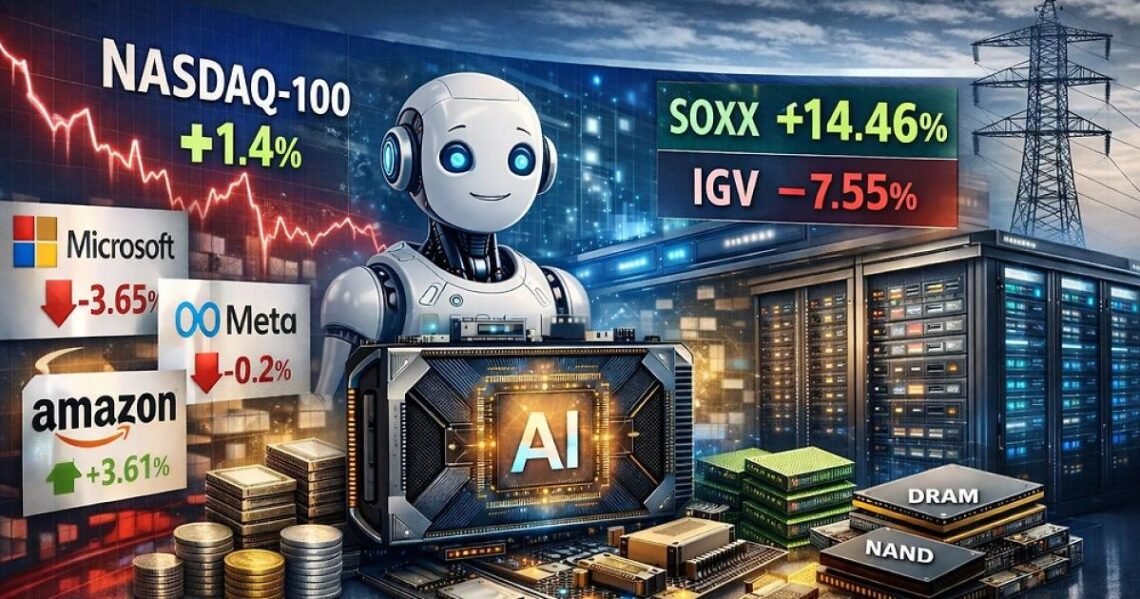
Artificial intelligence has become much more than a software trend. It now supports a large technology ecosystem that includes advanced semiconductors, cloud computing, data centers, networking equipment, enterprise software, advertising, cybersecurity, and automation. That makes the search for the best AI stocks more complicated than simply finding companies that mention AI in their earnings reports.
For investors, the important question is not only which company has the most impressive AI technology. It is also whether that technology can generate durable revenue, whether the company has a competitive advantage, how much it must spend to maintain that advantage, and whether the stock’s valuation already reflects years of future growth.
This guide explains how to evaluate AI stocks, examines several major companies with significant AI exposure, and discusses the risks investors should understand before putting money into the sector. Because stock prices, valuations, analyst estimates, and company strategies change frequently, current figures should always be verified using recent company filings and reliable financial sources before making an investment decision.
What Are AI Stocks?
AI stocks are shares of publicly traded companies that are meaningfully involved in developing, supplying, deploying, or monetizing artificial intelligence.
They can be divided into several broad groups:
| AI segment | What companies provide | Examples |
|---|---|---|
| AI chips | GPUs, accelerators and processors | Nvidia, AMD, Broadcom |
| Semiconductor manufacturing | Advanced chip production | TSMC |
| Data-center infrastructure | Networking and related hardware | Arista Networks |
| Cloud AI | Computing, storage and AI services | Microsoft, Amazon, Alphabet |
| AI software | Enterprise and consumer applications | Microsoft, Adobe, Palantir |
| AI platforms | Models, tools and developer ecosystems | Alphabet, Microsoft and others |
| AI-enabled businesses | Companies using AI to improve existing businesses | Meta, Amazon, many others |
This distinction matters because an AI investment does not necessarily have to come from a company whose primary product is an AI model.
For example, a semiconductor manufacturer can benefit from AI because AI models require enormous amounts of computing hardware. A cloud provider can benefit by renting that computing capacity to businesses. A software company can benefit by adding AI features to products customers already pay for.
The AI economy therefore works more like a chain than a single industry.
How the AI Investment Chain Works
A simple way to understand AI investing is to follow what happens when an organization uses an AI application.
1. Chips provide the computing power
Training and running sophisticated AI models requires specialized computing hardware.
Companies such as Nvidia have become major suppliers of the processors and supporting platforms used in AI data centers.

2. Semiconductor manufacturers produce the chips
Designing a processor and manufacturing it are different activities.
Taiwan Semiconductor Manufacturing Company, commonly known as TSMC, operates as a major semiconductor foundry and manufactures advanced chips for companies across the technology industry.
3. Data centers connect everything
AI workloads require large clusters of processors, high-speed networking, storage, cooling, and electricity.
This creates opportunities beyond traditional chip companies.
4. Cloud companies rent the infrastructure
Instead of purchasing their own enormous computing systems, many businesses can access AI computing through cloud platforms.
Microsoft Azure, Amazon Web Services, and Google Cloud are examples of major cloud businesses investing heavily in AI infrastructure and services.

5. Software companies turn AI into products
The final layer is where businesses attempt to make AI useful to customers.
Examples include coding assistants, productivity tools, enterprise search, content creation, analytics, customer service automation, and other applications.
This explains why the best AI stocks are not necessarily concentrated in one category.
Best AI Stocks to Watch
There is no universally correct list of the “best” AI stocks. The right choice depends on valuation, risk tolerance, investment horizon, and the type of AI exposure an investor wants.
However, several large companies currently have significant positions in the AI ecosystem.
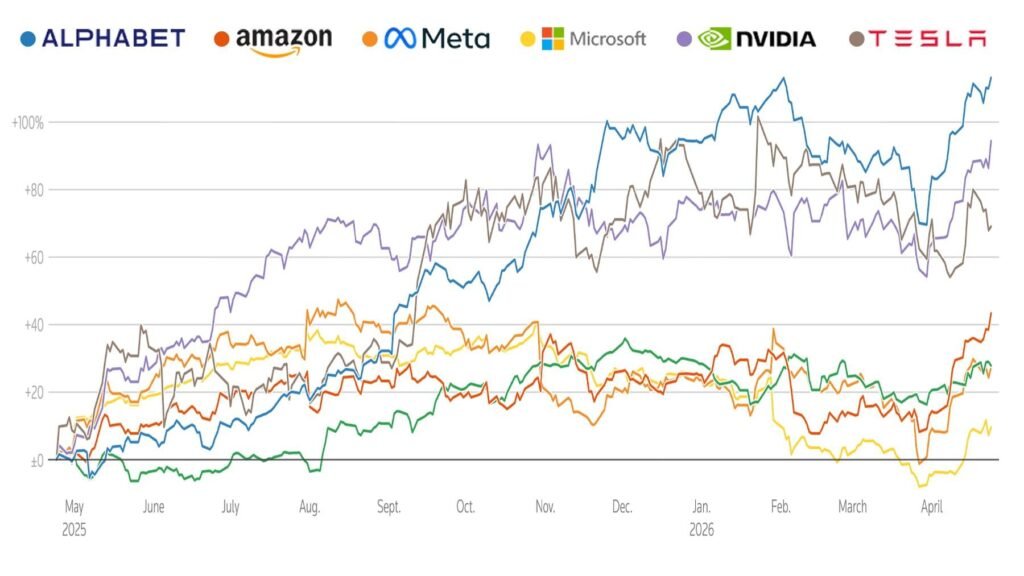
Nvidia (NVDA)
Nvidia is one of the clearest examples of a company positioned at the infrastructure layer of AI.
Its graphics processors and broader computing platforms are widely used for AI workloads. The company’s importance extends beyond individual chips because its ecosystem includes software, networking, systems, and development tools.
That ecosystem can be an important competitive advantage because customers building AI infrastructure are not simply buying a processor; they are often building an entire computing environment around it.
Why investors watch Nvidia:
- Strong exposure to AI data-center spending
- Large ecosystem surrounding its computing platforms
- Significant software and developer support
- Position at a critical part of the AI infrastructure chain
Risks: Nvidia’s success has attracted competitors, and its stock valuation can reflect very high expectations. AI infrastructure spending could also slow, while changes in chip architecture or competing accelerators could affect future demand.
Recent market coverage continues to focus heavily on Nvidia’s AI position, while also highlighting the risk that investors are paying high prices for expected future growth.
Microsoft (MSFT)
Microsoft provides a different type of AI exposure.
Its cloud business, Azure, provides computing infrastructure and AI services, while products such as Microsoft 365 and GitHub incorporate AI capabilities.
The advantage here is diversification. Microsoft does not depend on a single AI product. AI can potentially strengthen several existing businesses at once.
Why investors watch Microsoft:
- Azure provides AI infrastructure
- AI is being integrated into productivity software
- GitHub offers AI-assisted developer tools
- Large existing enterprise customer base
- Multiple potential ways to monetize AI
The main challenge is that AI infrastructure requires substantial investment. Investors therefore need to consider whether increased AI spending eventually produces enough additional revenue and profit to justify the costs.
Alphabet (GOOGL, GOOG)
Alphabet has been involved in artificial intelligence research and development for years.
Its AI exposure comes from several areas, including Google Search, Google Cloud, advertising, AI models, specialized processors, and consumer products.
This makes Alphabet particularly interesting because AI can both create opportunities and threaten existing businesses. For example, changes in how people search for information could affect traditional search behavior while simultaneously creating new AI-powered products.
Alphabet is also investing heavily in infrastructure. In September 2026, Google announced plans for more than $15 billion in AI infrastructure investment in Finland for 2027–2028, illustrating the scale of infrastructure spending surrounding the industry.
Key question for investors: Can Alphabet use AI to defend and expand its existing businesses while building new sources of revenue?
Amazon (AMZN)
Amazon is another example of why an AI stock does not have to be an AI-only company.
Amazon Web Services provides cloud computing and AI services to businesses. At the same time, Amazon uses machine learning and AI throughout areas such as advertising, recommendations, search, logistics, and its broader retail operation.
AWS gives Amazon a particularly important connection to enterprise AI spending.
Amazon has also expanded its relationship with AI companies and infrastructure providers. Recent reporting, for example, described a major Qualcomm partnership involving AI data-center chips for Amazon.
Potential advantages:
- AWS exposure to enterprise AI
- AI applications throughout Amazon’s retail operation
- Advertising business that can benefit from better AI systems
- Large infrastructure footprint
Risks: Amazon’s AI opportunity requires enormous infrastructure spending, and cloud competition remains intense.
Broadcom (AVGO)
Broadcom is an important company to understand if you want exposure to AI infrastructure beyond Nvidia.
The company supplies networking technology and develops custom semiconductor solutions used in large-scale data centers.
Custom AI accelerators are particularly important because large technology companies may want chips optimized for their own workloads rather than relying exclusively on general-purpose processors.
Broadcom has reported rapidly growing AI semiconductor demand, while recent market coverage has also highlighted concerns around expectations and its revenue outlook.
That combination illustrates an important investing principle: a company can have strong AI fundamentals and still be a risky stock if expectations become too high.
Taiwan Semiconductor Manufacturing Company (TSM)
TSMC provides exposure to the manufacturing side of the AI semiconductor industry.
Rather than competing directly with chip designers in the same way as Nvidia, TSMC manufactures advanced processors designed by companies such as Nvidia and other semiconductor firms.
This gives investors a different way to participate in AI growth.
The company’s position is particularly relevant because increasingly advanced AI processors require sophisticated manufacturing and packaging capabilities.
Potential advantage: TSMC can benefit from demand across multiple chip designers rather than depending on the success of one AI product.
Important risks: Semiconductor manufacturing is capital intensive, cyclical, and exposed to geopolitical and supply-chain risks.
Meta Platforms (META)
Meta uses AI extensively across its advertising systems, recommendation algorithms, content-related systems, and consumer products.
AI can therefore affect Meta’s business in several ways rather than existing as a standalone product.
One important investment consideration is that Meta spends heavily on computing infrastructure and AI research. Investors have to determine whether those expenditures improve advertising efficiency, user engagement, product development, or other measurable business outcomes enough to justify the investment.
Arista Networks (ANET)
AI data centers require extremely fast networking because large numbers of processors need to communicate with each other.
Arista Networks provides networking equipment used in data-center environments, giving investors another example of an “indirect” AI stock.
This can be useful when thinking about the AI supply chain: the companies supplying the infrastructure around AI computing can benefit even when they do not manufacture AI processors or create AI models.
What Makes an AI Stock Attractive?
Simply calling a company an “AI company” is not enough.
Before buying an AI stock, consider several questions.
1. Does AI actually contribute to revenue?
A company may talk extensively about AI without generating significant revenue from it.
Look for evidence that AI products or AI-enabled services are becoming economically meaningful.
2. Does the company have a competitive advantage?
A strong AI business might have an advantage based on:
- Specialized hardware
- Proprietary technology
- Distribution
- Customer relationships
- Data
- Software ecosystems
- Manufacturing capabilities
- Switching costs
- Brand recognition
The strongest advantage is one competitors cannot easily reproduce.
3. Can the company make money from AI?
Revenue growth alone does not automatically mean a good investment.
Ask:
How does the company turn AI spending into profit?
A company may spend billions building infrastructure but struggle to earn an attractive return if customers are unwilling to pay enough for the resulting services.
4. How expensive is the stock?
This is one of the most important questions.
A fantastic company can become a poor investment if the stock price assumes unrealistic growth.
Investors commonly examine measures such as:
- Price-to-earnings ratio
- Forward earnings expectations
- Price-to-sales ratio
- Free cash flow
- Revenue growth
- Operating margins
- Capital expenditures
- Debt
- Expected future growth
These figures should be considered together rather than used individually.
AI Stocks Are Not All the Same
One common mistake is treating every AI stock as if it carries the same risk.
Consider three hypothetical companies:
Company A: A profitable semiconductor leader whose products are essential for AI infrastructure.
Company B: A large cloud company spending heavily to build AI infrastructure while integrating AI into existing products.
Company C: A small company whose stock price depends heavily on one new AI product that has not yet demonstrated sustainable demand.
All three could be described as AI investments, but their risk profiles are completely different.
This is why investors should look beyond the label.
The Biggest Risks of Investing in AI Stocks
AI offers significant opportunities, but it also introduces substantial investment risks.
High valuations
AI enthusiasm can push stock prices far ahead of current earnings.
If future growth disappoints, the stock can fall even when the underlying business remains successful.
AI spending could slow
Many AI infrastructure companies depend on enormous capital expenditures from cloud providers and technology companies.
If those companies reduce spending, suppliers throughout the AI ecosystem can be affected.
Recent market analysis has specifically identified dependence on hyperscaler AI capital expenditure as an important risk across the sector.
Competition
Technology leadership rarely remains permanent.
New chips, models, cloud platforms, open-source software, and specialized AI systems could change competitive positions.
Rapid technological change
The hardware and software that are considered essential today may become less important as AI architectures evolve.
Regulation
AI companies face growing questions involving privacy, copyright, competition, safety, data use, and regulation.
Changes in regulation can affect costs and business models.
Capital expenditure
AI infrastructure requires enormous amounts of computing equipment, data centers, energy, networking equipment, and other infrastructure.
High spending can create growth while simultaneously putting pressure on free cash flow.
Also Read: Best AI Humanizer
How to Research the Best AI Stocks Yourself
Instead of blindly copying an online list, investors can use a simple process.
Step 1: Identify the AI exposure
Determine whether the company makes money from:
- AI chips
- Cloud computing
- Data centers
- Networking
- AI software
- Enterprise services
- AI-enabled advertising
- Automation
Step 2: Read the company’s latest results
Look at the most recent earnings release and annual or quarterly filing.
Pay attention to revenue growth, margins, cash flow, capital expenditures, and management’s explanation of AI demand.
Step 3: Separate AI revenue from AI spending
A company spending billions on AI is not necessarily benefiting financially from AI yet.
Ask how much additional revenue the investment is expected to generate.
Step 4: Compare competitors
Do not evaluate a company in isolation.
Compare its technology, margins, growth, valuation, customer concentration, and competitive position with alternatives.
Step 5: Consider valuation
Ask what expectations are already built into the stock price.
A great company can still be an unattractive purchase at the wrong price.
Step 6: Think about your time horizon
AI stocks can experience large price swings.
Investors considering the sector should understand whether they are comfortable holding through periods when enthusiasm, valuations, or technology trends change.

Should You Buy AI Stocks or an AI ETF?
Buying individual AI stocks gives you more control but also concentrates your risk.
An individual investment in Nvidia, for example, gives you much more direct exposure to Nvidia’s specific performance than an ETF containing dozens of technology companies.
An AI-focused exchange-traded fund can spread exposure across multiple companies and parts of the AI ecosystem.
However, diversification does not eliminate risk. An ETF focused heavily on semiconductor or technology companies can still decline significantly during a sector downturn.
For some investors, a broader market index may also provide AI exposure indirectly because major technology companies already represent substantial portions of broad-market indexes.
Common Mistakes Investors Make With AI Stocks
Mistake 1: Buying because a company uses the word “AI”
Almost every major technology company discusses AI.
That does not mean AI is a significant source of its future earnings.
Mistake 2: Assuming the biggest AI company is automatically the best stock
Business quality and stock valuation are different questions.
A company can dominate its industry while its shares remain expensive.
Mistake 3: Ignoring infrastructure
AI applications depend on physical infrastructure.
Chips, manufacturing, networking, data centers, energy, and cloud computing are all part of the ecosystem.
Mistake 4: Looking only at revenue growth
Rapid revenue growth is useful, but investors should also examine profitability, cash flow, spending requirements, and the sustainability of that growth.
Mistake 5: Treating analyst rankings as guarantees
Analyst price targets and “buy” ratings are opinions, not promises of future performance.
They can change as earnings, valuations, economic conditions, and company strategies change.
Frequently Asked Questions
What are the best AI stocks?
There is no single objectively best AI stock. Major companies with significant AI exposure include Nvidia, Microsoft, Alphabet, Amazon, Broadcom, TSMC, Meta, and Arista Networks. Which is most attractive depends on valuation, financial performance, risk, and the type of AI exposure an investor wants.
Is Nvidia still one of the best AI stocks?
Nvidia remains one of the most important publicly traded companies in AI infrastructure because of its position in accelerated computing and its broader technology ecosystem. However, investors should evaluate its current valuation, competitive environment, earnings expectations, and risks rather than assuming past performance will continue.
Are Microsoft and Alphabet AI stocks?
Yes. Both companies have substantial AI exposure through cloud computing, software, AI models, infrastructure, and other products. Their large existing businesses also mean that AI is only one component of their overall investment case.
Are AI stocks risky?
Yes. AI stocks can be particularly sensitive to valuation changes, technology shifts, competition, infrastructure spending, regulation, and changing investor expectations. Even profitable AI companies can experience substantial stock-price declines.
Should beginners invest in individual AI stocks?
Beginners should first understand diversification, valuation, risk tolerance, and basic financial statements before concentrating money in individual technology stocks. A diversified fund may be easier to manage for investors who do not want company-specific risk.
How do I find the best AI stocks before buying?
Start by identifying the company’s actual AI-related revenue opportunity, competitive advantage, profitability, cash flow, capital requirements, valuation, and major risks. Then compare the company with competitors and review its latest financial filings.
Can AI ETFs be better than individual AI stocks?
They can provide greater diversification than owning one company, but whether they are better depends on the investor. An ETF can reduce company-specific risk, although a narrowly focused AI ETF may still have significant sector and technology exposure.
Are AI stocks in a bubble?
That cannot be answered with a simple yes or no. Some AI companies have very strong businesses and substantial earnings, while certain stocks can still become expensive relative to their expected growth. Investors should evaluate individual companies and valuations rather than treating the entire AI sector as one investment.
Conclusion
The search for the best AI stocks should start with a better question: Which companies are most capable of turning the growth of artificial intelligence into durable profits at a reasonable valuation?
Nvidia represents AI computing infrastructure. TSMC represents advanced semiconductor manufacturing. Microsoft, Amazon, and Alphabet provide cloud infrastructure and AI services. Broadcom and Arista Networks participate in the hardware and networking layers, while Meta demonstrates how AI can strengthen an established consumer and advertising business.
These companies are not interchangeable, and none is automatically the right investment simply because AI is growing.
The most useful approach is to understand the AI value chain, examine how each company makes money, evaluate its competitive advantage, study its financials, and compare the stock’s current valuation with realistic expectations for future growth. AI may create enormous economic opportunities, but successful AI investing still requires the same discipline as investing in any other industry.