
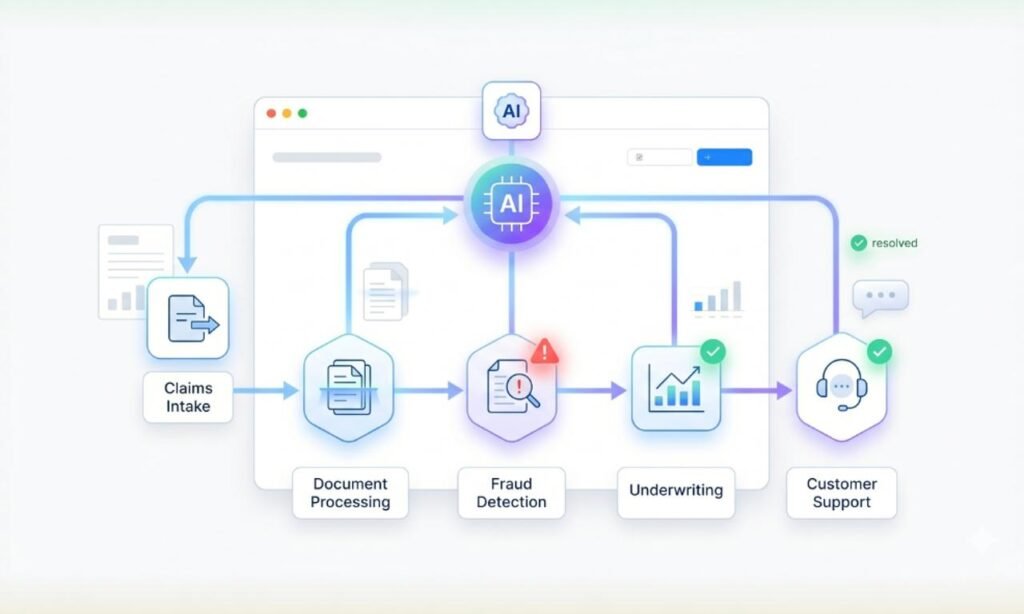
Insurance companies handle large volumes of repetitive work. Claims must be reviewed, policy information must be updated, documents must be checked, and customer requests must be routed to the right people. Much of this work follows established processes, but it can still consume significant employee time.
This is where RPA and AI in insurance can work together. Robotic Process Automation (RPA) can handle repetitive, rule-based tasks, while artificial intelligence can help systems understand documents, identify patterns, classify information, and support decisions.
The important point is that these technologies do different jobs. RPA is not simply another name for AI, and AI does not automatically replace every insurance process. Understanding how they complement each other is essential for insurers planning automation projects.
This article explains what RPA and AI are, how they are used in insurance, where they work best, their limitations, and what a practical implementation can look like.
What Are RPA and AI?
Before looking at insurance use cases, it helps to separate the two technologies.
What Is Robotic Process Automation?
Robotic Process Automation uses software bots to perform repetitive digital tasks according to defined instructions.
For example, an RPA bot might:
- Log into an insurance system
- Copy information from an email or form
- Enter that information into another application
- Check whether required fields are complete
- Generate a confirmation message
- Update the status of a case
The bot does not necessarily understand the information in the way a person does. It follows the workflow and rules it has been given.
RPA is generally most suitable when a process is:
- Repetitive
- Structured
- Based on clear rules
- Performed across digital systems
- Relatively predictable
What Is Artificial Intelligence?
Artificial intelligence is a broader category of technologies that can perform tasks involving capabilities such as pattern recognition, classification, prediction, language processing, or content generation.
In an insurance environment, AI may be used to:
- Extract information from documents
- Classify incoming claims
- Analyze large volumes of data
- Detect unusual patterns for further review
- Assist customer service agents
- Estimate or predict certain outcomes using appropriate models
Unlike a traditional RPA workflow, an AI system may be able to handle information that is less structured, such as scanned documents, written messages, or images.
However, AI outputs can contain errors. The appropriate level of human review depends on the task, the consequences of mistakes, regulatory requirements, and the reliability of the specific system.
RPA and AI in Insurance: How They Work Together
The real value often comes from combining RPA with AI rather than treating them as competing technologies.
A useful way to think about the relationship is:
| Technology | Main Strength |
|---|---|
| RPA | Executes repetitive, rule-based processes |
| AI | Understands, classifies, predicts, or analyzes information |
| RPA + AI | Uses intelligent analysis as part of an automated workflow |
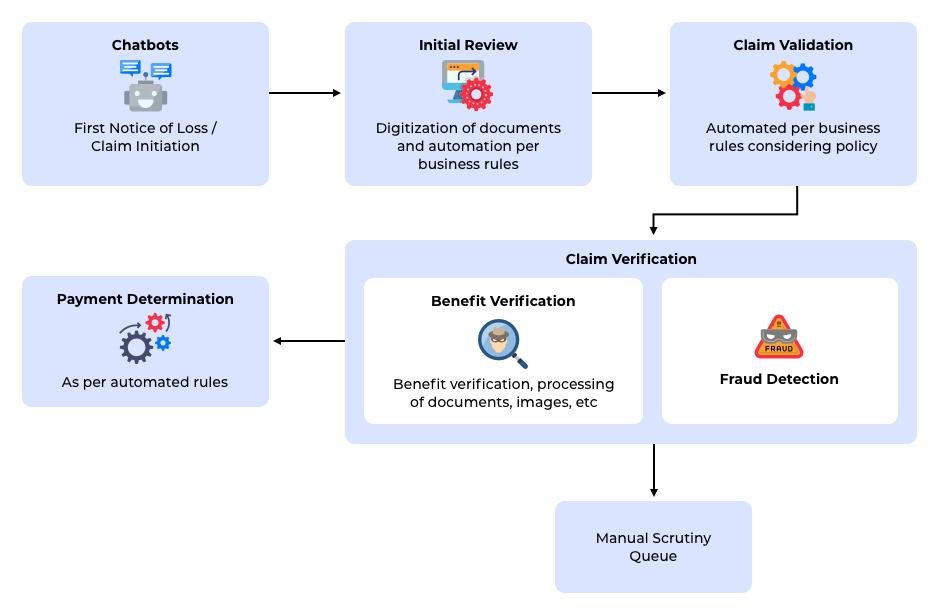
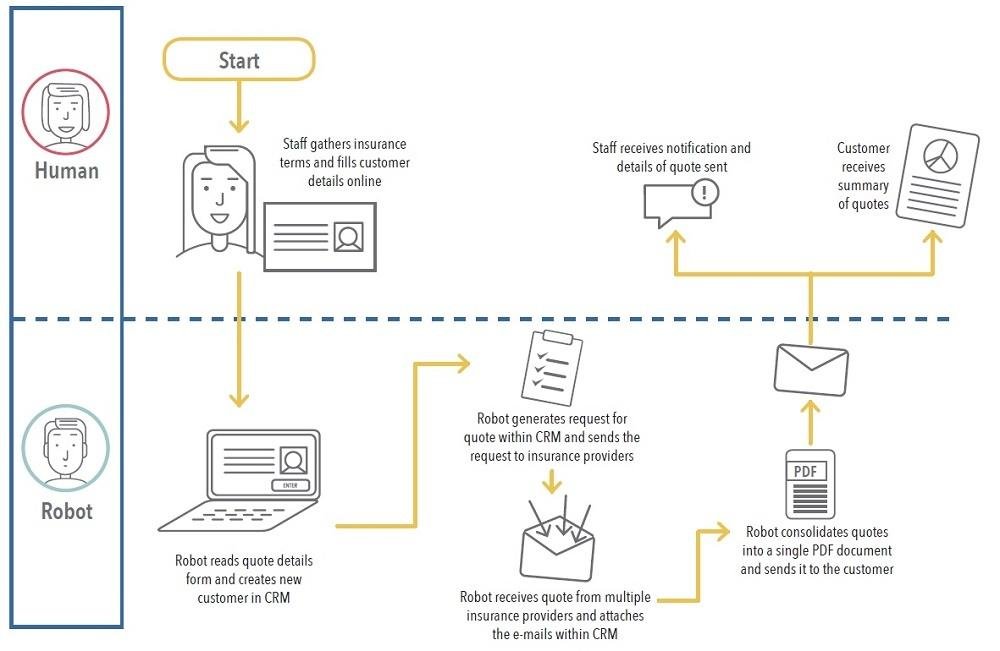
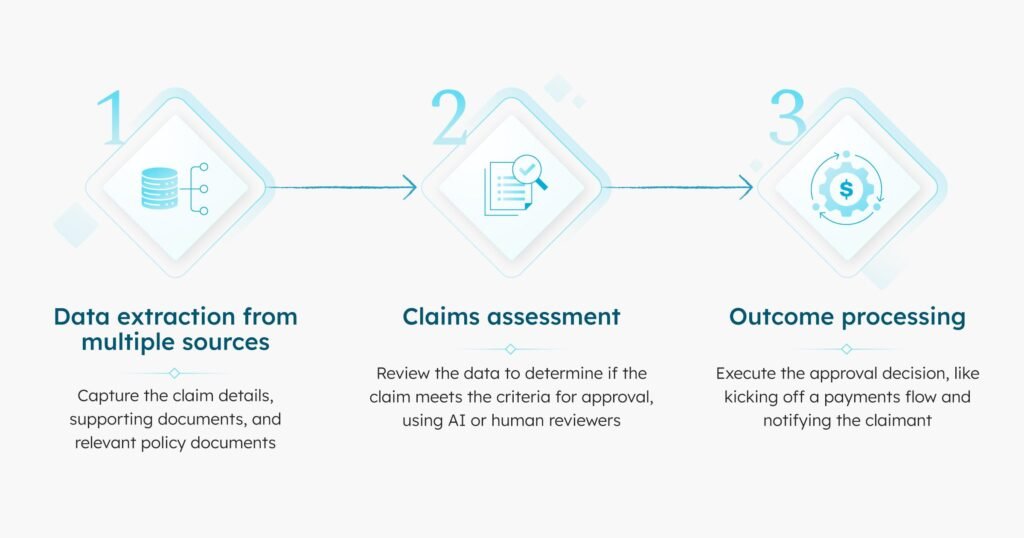
Consider a customer submitting an insurance claim with a scanned document.
A combined workflow could look like this:
- The claim arrives through a customer portal or email.
- AI extracts information from the document, such as names, policy numbers, dates, or claim details.
- The AI system classifies the document or identifies the type of claim.
- RPA transfers the information into the insurer’s internal systems.
- Business rules check the submission for missing information or conditions requiring review.
- The case is routed either for further automated processing or to a human employee.
- The customer receives an update based on the workflow.
In this example, AI helps interpret the incoming information, while RPA performs the repetitive system actions.
This distinction matters because trying to use RPA for an unpredictable process can create fragile automation. Likewise, using AI where a simple rule would work can add unnecessary complexity.
Key Applications of RPA and AI in Insurance
Claims Processing
Claims processing is one of the clearest applications for automation because it often involves multiple systems, documents, checks, and repetitive administrative tasks.
RPA can help with activities such as:
- Creating claim records
- Moving data between systems
- Checking whether required information is present
- Updating claim statuses
- Sending routine notifications
- Preparing information for claims professionals
AI can add capabilities such as document classification, information extraction, image analysis, or identification of cases that may require additional review.
For example, a customer may upload a repair estimate after a vehicle accident. An AI-based document processing system could identify important information in the estimate. RPA could then enter the extracted data into the claims platform and trigger the next step in the workflow.
A complex or unusual claim would still be routed to a qualified claims professional.
Policy Administration
Insurance policies generate administrative work throughout their lifecycle.
Common activities include:
- New policy setup
- Policy changes
- Address updates
- Coverage changes
- Renewals
- Cancellations
If employees repeatedly move information between systems or perform the same checks, RPA may be useful.
For example, a customer requests a change to their contact information. After appropriate validation, an automated workflow could update the relevant policy administration system, customer relationship system, and communication records.
The key is to automate the stable, repeatable parts of the process rather than forcing every possible exception into a bot.
Document Processing
Insurance companies receive many types of documents, including:
- Claim forms
- Medical documents
- Repair estimates
- Policy applications
- Identification documents
- Invoices
- Correspondence
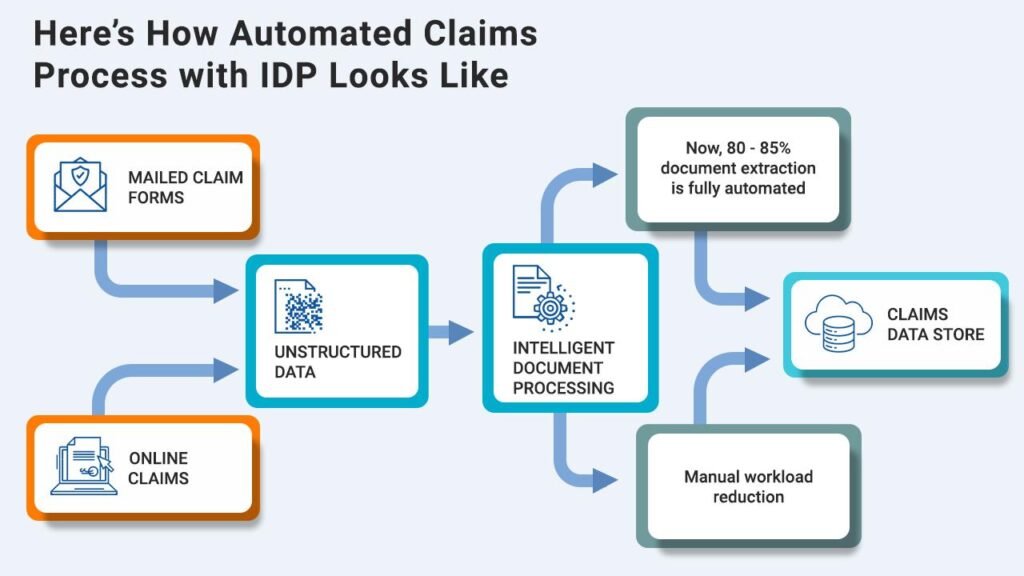
Traditional RPA works best with structured information. AI-based document processing can help when documents vary in layout or contain large amounts of unstructured text.
A practical workflow might involve AI identifying the document type and extracting selected fields. The extracted information can then be checked against validation rules before RPA enters it into downstream systems.
Human review is particularly important when poor document quality, ambiguous information, or high-impact decisions are involved.
Customer Service
RPA and AI can also support insurance customer service.
For example, an AI system may classify an incoming customer message as relating to:
- A new claim
- A policy change
- A billing question
- A cancellation request
The automation workflow can then route the request to the appropriate team or system.
RPA can also retrieve information from multiple internal applications, reducing the number of screens an employee needs to navigate.
Generative AI may assist agents by summarizing information or drafting responses, but organizations should carefully control how customer data is used and ensure that important responses are reviewed when necessary.
Underwriting Support
Underwriting can involve collecting information from different sources, checking eligibility criteria, and evaluating risk.
Automation can support the administrative parts of this process.
For example:
- A new application is received.
- AI extracts relevant information from submitted documents.
- RPA gathers required information from internal systems.
- Business rules check whether the application meets defined criteria.
- Straightforward cases may continue through the workflow.
- Complex or unusual cases are sent to an underwriter.
Automation can reduce manual data handling, but it does not mean that every underwriting decision should be fully automated.
The appropriate approach depends on the product, available data, regulatory requirements, and the potential consequences of an incorrect decision.
Fraud and Anomaly Review
AI can analyze patterns in data and identify cases that may warrant further investigation.
This does not mean that an AI system should automatically label every unusual claim as fraudulent.
A better approach may be:
- An analytical system identifies a claim with unusual characteristics.
- The case receives a review flag or priority score.
- RPA gathers relevant information and prepares the case.
- A qualified investigator reviews the evidence.
This approach uses automation to focus human attention rather than treating an automated prediction as final proof.
Real-World Workflow Examples
Example 1: First Notice of Loss
A customer reports an accident through an online form.
The automation process could:
- Capture the submitted information
- Check whether the policy number exists
- Create a claim record
- Classify the claim type
- Identify missing information
- Send an acknowledgment to the customer
- Route the claim to the appropriate team
RPA handles the system actions, while AI may help classify written descriptions or process supporting documents.
The benefit is not necessarily the complete removal of human involvement. Instead, employees can spend less time on repetitive data entry.
Example 2: Insurance Renewal Processing
An insurer may process large numbers of policy renewals.
RPA can:
- Retrieve policies approaching renewal
- Collect required data
- Apply predefined workflow rules
- Generate renewal communications
- Update records when appropriate
AI could potentially support document analysis or identify cases that differ significantly from expected patterns.
However, insurers should ensure that pricing, eligibility, and other regulated decisions follow appropriate governance and review requirements.
Example 3: Email and Document Triage
A shared insurance inbox may receive hundreds of messages containing different requests.
An AI system can classify the incoming communication based on its content. RPA can then:
- Create a case
- Attach relevant documents
- Update a system
- Route the request
- Notify the appropriate team
If the system is uncertain about the classification, the message can be sent for human review instead of allowing the automation to guess.
That uncertainty threshold is an important part of a well-designed automation system.
Benefits of RPA and AI in Insurance
When applied to suitable processes, automation can provide several advantages.
Faster Processing
Bots can perform repetitive digital tasks consistently and without requiring employees to manually switch between multiple applications.
This can reduce delays in processes that involve large amounts of administrative work.
Reduced Manual Data Entry
Repeated copying and pasting can create both workload and opportunities for human error.
Automation can reduce the amount of manual data transfer, although automated outputs should still be validated where accuracy is critical.
Better Employee Focus
Employees may spend less time on routine tasks and more time handling:
- Complex claims
- Customer issues
- Exceptions
- Investigations
- Professional judgment
Automation is often most useful when it supports people rather than simply attempting to remove them from every process.
More Consistent Workflows
A properly configured bot follows the same process each time.
This can help standardize routine activities, provided that the underlying rules and process design are correct.
Improved Scalability
Automation can make it easier to handle fluctuations in workload for suitable digital processes.
However, scaling automation also requires reliable infrastructure, monitoring, security, and governance.
Also Read: Which Approach Is Necessary for AI Projects?
Limitations and Risks
RPA and AI in insurance are not automatically successful just because a company installs automation software.
RPA Can Be Fragile
An RPA bot may depend on the layout or behavior of another application.
If a button changes location, a screen is redesigned, or a workflow changes, the automation may require updates.
Whenever possible, more stable integrations or APIs may be preferable to relying entirely on screen-based automation.
AI Can Make Mistakes
AI systems can misclassify documents, extract incorrect information, or produce inaccurate outputs.
This is especially important in insurance because errors can affect customers, financial outcomes, and regulatory obligations.
Organizations should define:
- Accuracy requirements
- Confidence thresholds
- Human review procedures
- Monitoring processes
- Escalation paths
Poor Processes Can Become Automated Poor Processes
Automation does not fix a badly designed workflow.
If a process contains unnecessary steps, inconsistent rules, or unreliable data, automating it may simply make the existing problems happen faster.
Process improvement should come before or alongside automation.
Privacy and Data Security Matter
Insurance data can contain sensitive personal and financial information.
Before using AI or automation tools, organizations need to understand:
- Where data is stored
- Who can access it
- How it is protected
- How long it is retained
- Whether third parties process the information
- What legal and regulatory obligations apply
Specific requirements vary by jurisdiction and should be verified using applicable laws, regulatory guidance, and up-to-date official sources.
Automation Requires Ongoing Maintenance
Automation is not a one-time project.
Systems change. Business rules change. Data formats change. Models may need monitoring and reassessment.
A successful program needs ownership and maintenance after deployment.
How to Implement RPA and AI in an Insurance Organization
A practical approach is to start with a clearly defined problem rather than choosing a technology first.
1. Map the Existing Process
Document:
- Each process step
- Systems involved
- Inputs and outputs
- Decision points
- Exceptions
- Manual work
This helps identify whether RPA, AI, integration, process redesign, or a combination is actually needed.
2. Choose a Suitable Starting Point
A good early candidate often has:
- High repetition
- Clear inputs
- Stable rules
- Significant manual effort
- Manageable exceptions
Avoid starting with the most complicated process simply because it appears to offer the largest theoretical benefit.
3. Decide Where AI Adds Value
Ask a simple question:
Does the process require the system to understand, classify, predict, or interpret information?
If the answer is no, traditional automation may be enough.
If the answer is yes, AI may be useful for that specific part of the workflow.
4. Build Human Review Into Important Decisions
Not every process should run from start to finish without oversight.
Define when the system should stop and ask for human intervention.
Examples include:
- Low-confidence document extraction
- Unusual claims
- Missing information
- Conflicting records
- High-value cases
- Decisions with significant customer consequences
5. Monitor the Results
After deployment, measure whether the automation is achieving its intended purpose.
Useful measures may include:
- Processing time
- Error rates
- Exception rates
- Rework
- System failures
- Customer service outcomes
The exact metrics should match the goals of the specific project.
Common Misconceptions About RPA and AI in Insurance
“RPA and AI are the same thing.”
They are not.
RPA primarily automates defined tasks and workflows. AI can analyze, classify, predict, or interpret information depending on the technology being used.
They can work together, but they solve different problems.
“AI can automate the entire insurance process.”
Some parts of a process may be highly automated, but insurance workflows often contain exceptions, professional judgment, regulatory requirements, and situations that require human review.
The goal should be appropriate automation, not automation for its own sake.
“Every repetitive task should use RPA.”
Not necessarily.
A direct system integration, API, or process redesign may be more reliable than an RPA bot.
The best technical solution depends on the systems and workflow involved.
“If the AI model is accurate, human review is unnecessary.”
Accuracy alone does not determine whether human oversight is appropriate.
The importance of the decision, the consequences of an error, applicable rules, and the nature of the data all matter.
Frequently Asked Questions
What is RPA and AI in insurance?
RPA and AI in insurance refers to using robotic process automation for repetitive tasks and artificial intelligence for capabilities such as document understanding, classification, analysis, or prediction. Together, they can automate parts of insurance workflows.
What is the difference between RPA and AI?
RPA follows defined instructions to complete repetitive tasks. AI can interpret information, recognize patterns, classify data, or make predictions depending on the system. RPA is often best for predictable workflows, while AI can help with less structured information.
Can RPA be used for insurance claims?
Yes. RPA can support claims administration by creating records, transferring data, checking required fields, updating systems, and triggering routine communications.
Can AI automatically approve or reject insurance claims?
It may be technically possible to automate parts of claim decisions, but whether it is appropriate depends on the specific process, risk, applicable laws, governance requirements, and the consequences of errors. High-impact decisions may require human oversight.
How does AI help with insurance documents?
AI-based document processing can classify documents and extract selected information from forms, scanned files, and other records. The extracted information can then be validated and used in an automated workflow.
Will RPA and AI replace insurance employees?
These technologies can automate specific tasks, but many insurance activities require judgment, investigation, customer communication, and expertise. In many cases, automation changes how employees work rather than eliminating the need for people.
What are the biggest risks of using AI in insurance?
Important risks include inaccurate outputs, biased or poorly designed models, privacy and security issues, weak governance, poor data quality, and insufficient human oversight.
Is RPA or AI better for insurance automation?
Neither is universally better. RPA is often useful for structured, rule-based tasks. AI is more useful when the process requires interpreting or analyzing information. Many effective insurance workflows combine both.
Conclusion
RPA and AI in insurance can improve workflows by combining reliable task automation with technologies that can interpret and analyze information. RPA is well suited to repetitive, rule-based activities, while AI can help with documents, classification, pattern analysis, and other tasks that are difficult to manage with simple rules alone.
The most effective approach is not to automate everything. It is to understand the process, identify where automation genuinely helps, choose the right technology for each step, and maintain human oversight where errors or decisions could have significant consequences.
For insurers, the opportunity is not simply faster processing. When implemented carefully, RPA and AI can reduce administrative workload, improve workflow consistency, and give employees more time to focus on the situations where human expertise matters most.