
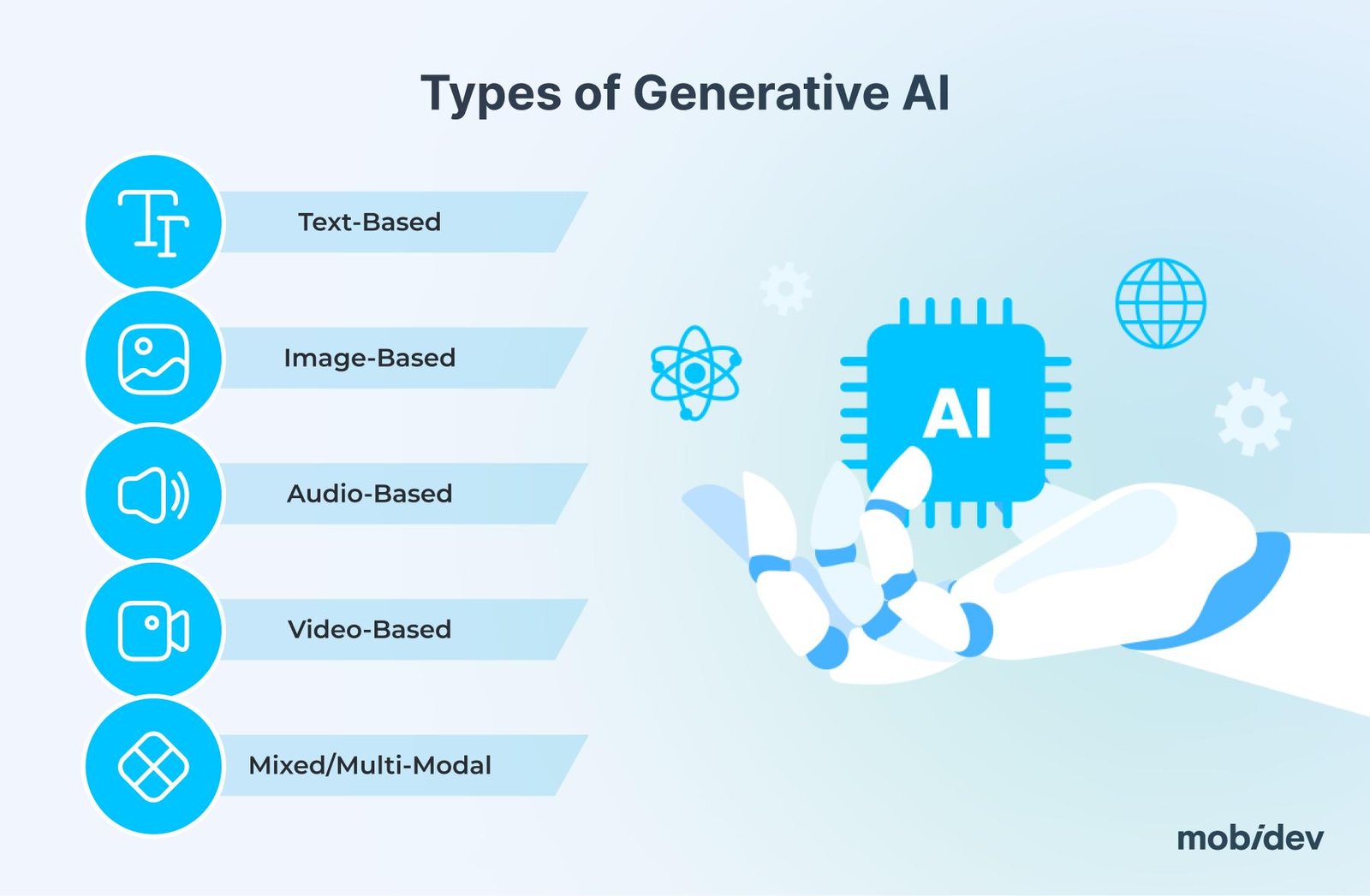
Generative AI models are the technology behind tools that can write articles, create images, generate software code, produce audio, and even turn written descriptions into video. They learn patterns from training data and use those patterns to generate new outputs in response to instructions or other inputs.
Although these models are often associated with chatbots, their capabilities extend far beyond answering questions. Businesses use them to assist with software development, process documents, create product content, and build applications that interact with information in more natural ways.
Understanding generative AI models helps you make better decisions about which tools to use, what these systems can realistically accomplish, and where their limitations matter. This guide explains how they work, the main types, practical applications, and the differences between a model and the product built around it.
What Are Generative AI Models?
Generative AI models are machine learning systems designed to produce new content based on patterns learned during training. Depending on their design, they can generate text, images, audio, video, code, or other forms of data.
Traditional AI systems are often built to classify information, recognize objects, predict outcomes, or identify patterns. For example, a classification model might examine an email and determine whether it is likely to be spam.
A generative model approaches a different kind of task. It might draft a reply to that email, summarize its contents, or rewrite it in a more professional tone.
The distinction is about the model’s primary purpose, not an absolute separation between technologies. Some modern AI systems combine generative capabilities with classification, prediction, search, and other functions.
Generative AI models also differ from ordinary databases. A database retrieves stored information, while a generative model constructs an output based on its learned patterns and the information available to it at the time of generation. Some applications combine both approaches.
How Do Generative AI Models Work?
The technical details vary by model type, but most generative systems follow a process involving training, input processing, and generation.
1. Training on Data
During training, a model processes examples from a training dataset and adjusts its internal parameters to learn statistical patterns.
A language model, for example, may learn relationships between words, sentence structures, concepts, and different styles of writing. An image-generation model may learn relationships between visual features and descriptions.
The training process does not mean that every model stores a searchable copy of all its training material. Instead, much of what it learns is represented in its parameters, although models can sometimes reproduce memorized information.
Training methods differ across architectures and tasks. Some models learn by predicting missing or subsequent information, while others use different objectives suited to their intended outputs.
2. Receiving an Input
After training, a model can receive an input, often called a prompt.
A prompt might be a question, instruction, image, document, audio recording, or combination of inputs.
For example:
“Explain cloud computing to a beginner in three short paragraphs, using a simple business example.”
The model uses this instruction and its available context to determine what kind of output to generate.
Clear instructions can improve results, especially when the user specifies the intended audience, relevant facts, format, and constraints.
3. Generating an Output
The model then produces an output using the generation process appropriate to its architecture.
For an autoregressive language model, this commonly involves predicting one token at a time, with each generated token helping determine what comes next. A token may represent a word, part of a word, punctuation, or another text unit.
Image-generation models often use a different process. Diffusion models, for instance, learn to transform noisy representations into coherent images through a sequence of denoising steps.
These examples illustrate why it is misleading to assume that every generative AI model works like a chatbot. Different models use different techniques to generate different kinds of content.
4. Refining and Delivering the Result
The generated output may be delivered directly or processed further by the surrounding application.
A product might check formatting, retrieve supporting information, apply safety filters, or allow a user to edit the result.
These additional features can significantly affect the final experience. A model may generate text, but the application determines how that text is presented, stored, reviewed, or integrated into a business workflow.
Main Types of Generative AI Models
Generative AI includes several model families. Each has strengths suited to particular tasks.
Large Language Models (LLMs)
Large language models generate and interpret text. Many can also work with code and structured information.
Common applications include:
- Drafting and editing documents
- Answering questions
- Summarizing long reports
- Generating and explaining code
- Translating text
- Extracting information from documents
For example, a software developer could ask a language model to explain an unfamiliar function, suggest a clearer implementation, and draft tests for the revised code.
The model can provide useful assistance, but its suggestions still need to be checked for correctness and security.
Diffusion Models
Diffusion models are widely used for image generation and are also applied to other media.
A typical diffusion model learns to reverse a process that progressively adds noise to training examples. During generation, it starts with a noisy representation and repeatedly refines it toward an output that matches the conditioning information, such as a text prompt.
For example, a user could request an illustration of a modern library with natural lighting and minimalist furniture. An image-generation model can use that description to produce a visual concept.
Diffusion is not the only technique for generating images. Other approaches, including autoregressive and transformer-based methods, are also used.
Generative Adversarial Networks (GANs)
Generative adversarial networks consist of two neural networks trained in competition.
The generator attempts to produce realistic examples, while the discriminator tries to distinguish generated examples from real ones. Through this competition, the generator can learn to produce increasingly convincing outputs.
GANs have been used for image synthesis, image translation, and other visual tasks. They remain important in the history of generative AI, although other approaches have become prominent in many newer applications.
Variational Autoencoders (VAEs)
Variational autoencoders learn a compressed representation of data and use it to reconstruct or generate examples.
A VAE typically maps an input into a latent representation, which captures useful characteristics of the data. A decoder then uses a representation sampled from the learned distribution to produce an output.
These models have applications in image generation, representation learning, and scientific research.
Their outputs can be useful for exploring variations in data, although image sharpness and other characteristics depend on the model and task.
Autoregressive Models
Autoregressive models generate sequences by predicting subsequent elements based on preceding elements.
In language generation, a model may predict the next token and continue until it reaches a stopping condition. Similar principles can be applied to other sequential data, including audio and certain image representations.
This approach is central to many language models because it allows them to generate coherent sequences while using the context already produced.
Autoregressive generation can also accumulate errors: an incorrect early element may influence later output.
Multimodal Generative Models
Multimodal models work with more than one type of information, such as text, images, audio, or video.
Depending on their capabilities, they may interpret an image and answer questions about it, analyze spoken input, or generate content across multiple modalities.
For example, a training team could provide a product photograph and ask a multimodal model to describe visible features, identify details that need verification, and draft a product listing.
The model’s ability to process multiple formats does not guarantee that it interprets every detail correctly. Visual ambiguity, missing context, and inaccurate descriptions remain possible.
Generative AI Models vs. AI Tools and Applications
A generative AI model is not the same as a chatbot, image generator, or business application.
A model provides the underlying generation capability. A product combines that capability with an interface and additional software.
Consider an online retailer building a system to draft product descriptions.
The model generates the text. The application retrieves product specifications, supplies them to the model, checks the result, and presents the draft to an employee for approval.
The overall system might look like this:
Product database → Application logic → Generative AI model → Validation → Human review → Published description
This distinction matters when choosing technology. Two products may use similar underlying models but offer very different levels of privacy, integration, document handling, reliability, and administrative control.
A business may also access a model through an application programming interface (API) rather than using a ready-made product.
Also Read: Generative AI Services
Real-World Applications of Generative AI Models
Content Creation and Publishing
Publishers and content teams can use language models to develop outlines, summarize research material, brainstorm headlines, and edit drafts.
For example, a technology publisher preparing an article about data privacy could use a model to organize the main topics and identify questions readers may have. The writer would still need to consult reliable sources, confirm current claims, and ensure the final article offers accurate, useful information.
The model can assist with the workflow, but it does not automatically establish the truth of its output.
Software Development
Developers can use generative models to draft functions, explain code, suggest tests, and help investigate errors.
Imagine a developer building a form that validates customer information. A coding model could propose an initial implementation and identify possible edge cases.
The developer would then run tests, inspect the code, and check whether it handles invalid input securely.
This approach can reduce repetitive work, but accepting generated code without review may introduce bugs or vulnerabilities.
Customer Service
A company can integrate a language model with its approved support documentation.
When a customer asks how to return a product, the application can retrieve the relevant policy and use it to draft a response.
A well-designed system should provide answers grounded in the current policy and direct unusual or sensitive cases to a human employee. Without reliable information retrieval and appropriate safeguards, the model may produce an incorrect answer.
Image and Design Production
Design teams can use image-generation models to explore concepts before investing time in finished artwork.
For example, a small business planning a new website could generate several visual directions for its homepage. Designers could compare layouts, colors, and imagery before creating the final assets.
The resulting images may require editing to correct visual inconsistencies, improve text rendering, or meet licensing and brand requirements.
Scientific and Technical Research
Generative models can assist researchers with tasks such as proposing molecular structures, generating candidate designs, analyzing documents, and exploring possible solutions.
These uses can be valuable when outputs can be tested against scientific or engineering constraints.
However, a generated candidate is not proof that a discovery is valid, safe, or practically achievable. Domain-specific evaluation and experimental validation remain necessary.
Benefits of Generative AI Models
Generative AI models offer several practical advantages when they are matched to suitable tasks.
Faster initial work: A model can create a first draft, code example, or design concept that a person can then refine.
Flexible interaction: Users can describe tasks in natural language rather than learning a separate command for every operation.
Content variation: Models can generate alternative explanations, formats, or creative directions from the same source material.
Support for complex workflows: When integrated with databases, search systems, and business software, models can help automate multiple steps rather than perform isolated tasks.
Accessibility: Text generation, transcription, summarization, and speech features can help people interact with information in different ways.
These benefits are not automatic. They depend on output quality, the task being performed, and how much verification or correction is required.
Limitations and Risks of Generative AI Models
Hallucinations and Factual Errors
A generative model can produce an answer that sounds confident but contains incorrect information.
This is particularly important for technical explanations, historical details, legal information, and other tasks where accuracy matters.
Users should verify important claims against trustworthy sources rather than judge accuracy by how natural the output sounds.
Training Data and Knowledge Gaps
Models learn from training data, which may contain errors, biases, gaps, or outdated information.
A model’s internal knowledge may not reflect recent developments. Some applications address this by retrieving current information from external sources, but retrieval does not eliminate the possibility of errors.
For time-sensitive decisions, current authoritative documentation should be consulted.
Privacy and Security
Sending sensitive information to an AI service can create privacy and security concerns.
Before using a model with confidential documents, customer records, or proprietary code, check the provider’s current data-handling policies, retention practices, access controls, and available security features.
Organizations should also consider whether employees might unintentionally disclose sensitive information through prompts.
Bias and Unwanted Outputs
Models can reproduce biases found in training data or generate content that is inappropriate for a particular context.
Testing should include realistic examples, difficult edge cases, and the types of users affected by the system. Additional safeguards may be necessary for high-impact applications.
Cost and Computational Requirements
Training a large model can require substantial computing resources. Using a model also consumes resources, and costs depend on factors such as model size, input length, output length, hardware, and usage volume.
A larger model is not always the best choice. A smaller model may be sufficient for a narrow task, particularly when it is properly configured and evaluated.
Limited Reliability and Reasoning
Generative models can struggle with ambiguous instructions, unfamiliar situations, complex calculations, or tasks that require precise multi-step reasoning.
Their performance varies by model, task, and evaluation method. Even when a model performs well on common examples, unusual cases can expose weaknesses.
For critical workflows, use validation rules, appropriate testing, and human oversight instead of assuming that the model will always behave correctly.
How to Choose the Right Generative AI Model
Choosing a model should begin with the problem you need to solve, not with a popularity ranking.
Use the following steps to make a more informed decision.
- Define the task. Decide whether you need text generation, image creation, document analysis, code assistance, or multimodal capabilities.
- Set quality requirements. Determine what an acceptable result looks like and which errors would be costly.
- Test relevant examples. Use realistic inputs, including difficult cases, instead of relying only on demonstrations.
- Evaluate privacy and security. Check data policies, deployment options, permissions, and compliance requirements.
- Compare cost and speed. Measure performance at the expected workload, including the cost of reviewing and correcting outputs.
- Check integration requirements. Consider APIs, supported file types, retrieval systems, and compatibility with existing software.
- Plan for monitoring. Track output quality and reassess the model when requirements, data, or provider capabilities change.
A useful evaluation should include the complete workflow, not just the model’s raw output. A model that generates excellent answers but requires extensive correction may be less useful than a smaller, more predictable alternative.
Frequently Asked Questions
What are generative AI models used for?
Generative AI models are used to create text, images, audio, video, code, and other outputs. They also support tasks such as summarization, content drafting, software development, document analysis, and scientific research.
What is the difference between a generative AI model and a generative AI tool?
A model is the underlying machine learning system that generates content. A tool or application provides access to the model and may add features such as file uploads, search, editing, integrations, and security controls.
Are all generative AI models large language models?
No. Large language models are one category of generative AI. Other models can specialize in image generation, audio, video, or other data types. Some modern models support multiple modalities.
How are generative AI models trained?
Training generally involves processing examples from a dataset and adjusting model parameters to learn patterns. The specific method depends on the architecture and task. Some models learn to predict text, while others learn to generate or reconstruct visual or other data.
Can generative AI models produce incorrect information?
Yes. They can generate inaccurate statements, flawed code, misleading summaries, or unrealistic images. Important outputs should be checked, especially when mistakes could have significant consequences.
Are generative AI models free to use?
Some models are available as open-weight releases, and some services provide free access. Others require payment for access, computing resources, or usage. Availability, licensing, and pricing vary, so current terms should be checked before choosing a model.
Can businesses train their own generative AI models?
Yes, although training a model from scratch can be resource-intensive. Depending on their needs, businesses may instead use an existing model through an API, customize an available model, or connect it to company documents through a retrieval system.
Will generative AI models replace human workers?
Their effect varies by occupation and task. Models can automate or accelerate some activities, but people remain important for judgment, accountability, complex decisions, relationship management, and verification. The practical impact depends on how organizations implement the technology.
Conclusion
Generative AI models provide a way to create new content from learned patterns, with applications ranging from writing and software development to image generation and scientific research. Different architectures serve different purposes, so understanding the task is more useful than assuming one model can handle everything equally well.
Their value depends on more than generation quality. Accuracy, privacy, cost, integration, and the ability to evaluate results all influence whether a model is suitable for real-world use.
The most practical approach is to start with a clearly defined problem, test candidate models on realistic examples, and build in verification wherever errors matter. Used with appropriate safeguards, generative AI models can be useful components of larger systems without needing to be treated as infallible sources of information.