
Software developers spend much of their time doing more than writing code. They debug errors, test applications, manage databases, review changes, configure development environments, and deploy software. The tools they use for these tasks can influence how efficiently they work and how reliably their applications run.
The search for droven io best tech tools for developers is an opportunity to explore the software that supports these different stages of development. From code editors and AI coding assistants to API testing platforms and deployment services, each tool addresses a particular challenge.
One important distinction is that Droven.io is an editorial technology website, not a single developer software suite. Developers should treat it as a source for discovering technology topics and evaluate individual products through their official documentation.
This guide examines useful developer tools, explains where they fit into a typical workflow, and shows how to choose a practical combination without paying for unnecessary features or making a project harder to maintain.
What Is Droven.io and How Does It Relate to Developer Tools?
Droven.io covers technology topics, including artificial intelligence, software development, and emerging technologies. Developers researching the site may encounter discussions about coding software, automation, cloud services, and other tools used in modern engineering.
However, it is important to distinguish between a website that discusses developer tools and the companies that actually build and maintain them.
For example, Visual Studio Code is developed by Microsoft, Docker is associated with container technology, and GitHub Copilot is an AI coding assistant from GitHub. These are independent products, not features of one unified Droven.io development platform.
The phrase “Droven IO best tech tools for developers” is therefore best approached as a search for useful developer software and guidance on selecting it.
The most relevant tools generally fall into several categories:
-
Code editors and IDEs: Writing, navigating, and debugging code.
-
AI coding assistants: Generating code suggestions, explaining functions, and assisting with programming tasks.
-
Version control: Tracking changes and collaborating with other developers.
-
Development and testing: Running applications, testing APIs, and identifying bugs.
-
DevOps and deployment: Automating builds and delivering applications.
-
Monitoring: Detecting and diagnosing problems after software goes live.
Understanding these categories makes it easier to identify which tools a project actually needs.
Droven IO Best Tech Tools for Developers: A Quick Comparison
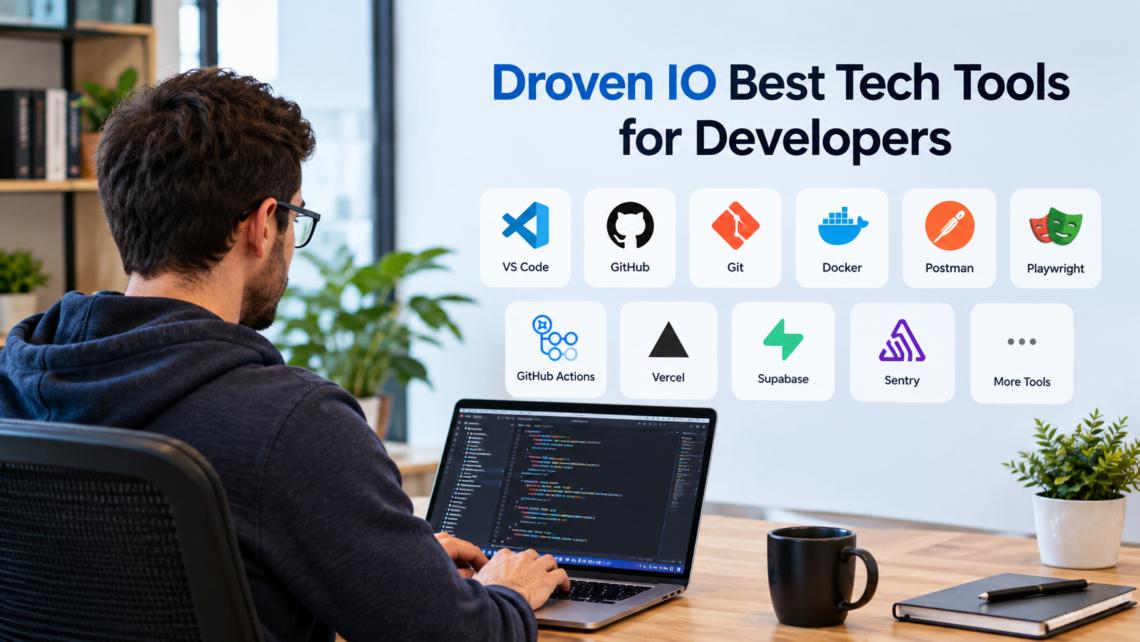
The following tools cover different parts of the development lifecycle. They are not an official Droven.io ranking; they are examples of established products that developers can evaluate for their own workflows.
| Tool | Category | Main Purpose |
|---|---|---|
| Visual Studio Code | Code editor | Writing and debugging code |
| GitHub Copilot | AI coding assistant | Code suggestions and AI-assisted development |
| Cursor | AI-focused code editor | Working with code across a project |
| Git and GitHub | Version control | Tracking changes and collaborating |
| Docker | Containerization | Creating consistent development environments |
| Postman | API development | Sending requests and testing APIs |
| Playwright | Automated testing | Testing applications in browsers |
| GitHub Actions | CI/CD automation | Automating builds and tests |
| Vercel | Deployment | Hosting and deploying web applications |
| Supabase | Backend platform | Providing database and backend services |
| Sentry | Monitoring | Investigating application errors |
The right combination depends on your programming language, project architecture, experience, budget, and deployment requirements.
1. Visual Studio Code: A Flexible Code Editor

Visual Studio Code, commonly called VS Code, is a code editor that supports a wide range of programming languages and development workflows.
It provides features such as syntax highlighting, code completion, debugging, source control integration, an integrated terminal, and an extensive extension ecosystem.
Instead of switching between separate applications for every task, developers can write code, inspect changes, run commands, and debug programs within one environment.
Why developers use VS Code
One of its main advantages is flexibility. A developer working with Python can install Python-related extensions, while someone building a website can configure tools for JavaScript, TypeScript, HTML, and CSS.
VS Code also supports Git integration, making it easier to review modifications and manage commits without leaving the editor.
Consider a developer building a small website. They can edit the frontend, run a local development server in the integrated terminal, inspect errors, and commit their changes through the same application.
Limitations
VS Code can become resource-intensive when developers install too many extensions or work with large projects. Some specialized programming environments also provide deeper language-specific functionality.
Best suited for: Beginners, web developers, Python programmers, and developers who want a customizable general-purpose editor.
2. GitHub Copilot: AI-Assisted Programming

GitHub Copilot helps developers write and understand code using AI. Depending on the editor, plan, and enabled features, it can provide inline suggestions, answer programming questions, explain existing code, and assist with larger coding tasks.
Its usefulness extends beyond generating entire functions. It can help with repetitive programming work that would otherwise require manually writing similar code.
Practical applications
A developer creating a registration form might use Copilot to draft input validation, suggest test cases, or explain an unfamiliar function.
A more experienced developer could ask it to propose a refactoring or identify potential edge cases in an existing implementation.
These suggestions can reduce repetitive work, but they still need to be checked.
AI-generated code may misunderstand requirements, introduce security weaknesses, use outdated APIs, or overlook unusual inputs. A function that looks correct can still fail when integrated into the wider application.
How to use it effectively
-
Explain the task and the expected behavior.
-
Provide relevant code or project context.
-
Review the proposed changes.
-
Run tests and inspect edge cases.
-
Verify security-sensitive logic before using it in production.
Best suited for: Developers who want assistance with routine coding, learning unfamiliar code, and accelerating parts of their existing workflow.
3. Cursor: An AI-Focused Development Environment

Cursor is a code editor designed around AI-assisted programming. It supports workflows in which developers ask questions about a codebase, generate changes, and work across multiple files.
This can be useful when a task involves more than a single line of code.
For example, suppose a developer wants to add a password-reset feature. The change may involve a frontend form, a backend endpoint, email handling, validation, and tests. An AI-focused editor can help draft changes across these parts while the developer supervises the implementation.
Cursor versus GitHub Copilot
The distinction is not simply that one uses AI and the other does not. Both offer AI-assisted development, and their capabilities overlap.
Cursor is an AI-focused editor, while GitHub Copilot integrates AI assistance into supported development environments and workflows.
A developer already comfortable with VS Code may prefer adding AI assistance to the existing setup. Someone who wants an editor organized around AI interactions may prefer trying Cursor.
The decision should account for workflow, supported models, usage limits, privacy settings, and subscription costs.
Best suited for: Developers who frequently work across files or want AI assistance closely integrated into their coding environment.
4. Git and GitHub: Managing Code Changes

Version control is fundamental to collaborative software development. Git records changes to files, allowing developers to inspect earlier versions, create branches, and combine work from different contributors.
GitHub provides a hosted platform for Git repositories, along with collaboration features such as pull requests, code reviews, issue tracking, and project automation.
Why version control matters
Imagine changing several parts of an application and discovering that a recent modification caused a serious bug. With Git, you can inspect the changes, identify the relevant commit, and restore or revise the affected code.
Branches also allow developers to work on separate features without immediately changing the main development branch.
For a team, pull requests provide a place to review proposed changes before merging them. This can catch mistakes and make technical decisions easier to discuss.
A simple workflow
-
Create a branch for a new feature.
-
Make and test the changes.
-
Commit the work with a clear message.
-
Push the branch to the remote repository.
-
Open a pull request for review.
-
Merge after the required checks pass.
Best suited for: Almost every developer, from someone building a personal project to a team maintaining a large application.
5. Docker: Consistent Development Environments

A program may work correctly on one computer but fail on another because of differences in dependencies, software versions, or configuration.
Docker helps address this problem through containers. A container packages an application with the components it needs to run, using the host operating system’s kernel.
Developers can define an environment that other team members can reproduce instead of relying on a long list of manual installation instructions.
Real-world example
Suppose a web application requires a particular version of Python and a PostgreSQL database.
Without a consistent setup, each developer might install different versions or configure the database differently. A Docker-based development environment can define the application and database services so team members can start them using a shared configuration.
This makes onboarding and troubleshooting more predictable.
Limitations
Docker introduces concepts such as images, containers, volumes, networks, and configuration files. Developers must also understand how to manage persistent data and avoid exposing sensitive information.
Not every small project needs containers from the beginning.
Best suited for: Teams with multiple services, applications with complex dependencies, and developers who need repeatable environments.
6. Postman: Building and Testing APIs

An application programming interface, or API, allows different software components to communicate. Postman provides tools for sending requests, inspecting responses, organizing API collections, and testing endpoints.
It is especially useful when developing a backend that serves a website, mobile application, or another service.
A practical example
Imagine a shopping application with an endpoint that returns a customer’s orders.
A developer can use Postman to send a request to that endpoint and inspect:
-
The HTTP status code.
-
The response body and returned data.
-
Authentication behavior.
-
How the endpoint handles missing or invalid parameters.
-
Whether errors are returned in an expected format.
This makes it easier to investigate backend problems before connecting the endpoint to the user interface.
Postman can also help teams share request collections and document expected API behavior.
Limitations
Testing an endpoint manually does not prove that the entire application works. Developers still need automated tests and checks for integration problems, authorization errors, and unusual inputs.
Best suited for: Backend developers, API engineers, and teams integrating third-party services.
7. Playwright: Automated Browser Testing

Playwright is a browser automation and testing framework used to test web applications. It can automate interactions such as clicking buttons, entering text, navigating between pages, and checking what appears on screen.
Its end-to-end testing capabilities help developers verify that important user journeys continue to work as an application changes.
Example: Testing a login flow
A developer can write a test that:
-
Opens the application’s login page.
-
Enters a test user’s credentials.
-
Submits the form.
-
Checks whether the dashboard appears.
-
Confirms that an expected account element is visible.
The test can run automatically whenever the application changes.
If a later update breaks the login flow, the test can reveal the problem before the code is released.
Limitations
Browser tests can become difficult to maintain when they rely on fragile selectors, unstable test data, or unpredictable external services.
Start with important workflows, such as account registration, login, checkout, and other actions that users depend on. Add tests where failures would have a meaningful impact.
Best suited for: Web developers and teams that need repeatable browser-based testing.
8. GitHub Actions: Automating Builds and Tests
Software projects often require the same checks every time code changes. These may include installing dependencies, running tests, checking code quality, building an application, and preparing a release.
GitHub Actions automates these tasks through workflows defined in a repository.
How it works
A developer can configure a workflow to run when someone opens a pull request or pushes a change.
For example, a website project might automatically:
-
Install the required packages.
-
Run unit tests.
-
Check formatting or linting.
-
Build the application.
-
Report whether the checks passed.
This reduces the need for developers to remember every manual step before merging code.
Why it matters
Automation creates a consistent process. Every change can go through the same checks, making it easier to detect problems early.
However, a passing workflow does not guarantee that software is free of bugs. The checks can only detect issues they are designed to test for.
Best suited for: Teams that want automated testing, repeatable builds, and more consistent software delivery.
9. Vercel: Deploying Web Applications

Vercel is a cloud platform for deploying web applications. It is particularly associated with frontend frameworks and Next.js projects.
A deployment platform can connect to a code repository, build an application, and make it available through a hosted URL. Depending on the configuration, developers can also create preview deployments to review changes before releasing them to production.
Practical example
A developer building a portfolio website can connect a repository to Vercel. After configuring the project, new commits can trigger deployments.
When the developer creates a new page, a preview deployment can help them check its layout and functionality before merging the change.
This reduces the amount of server administration needed for many web projects.
Limitations
Hosting platforms differ in their supported runtimes, usage limits, pricing, and infrastructure options. Applications with specialized backend requirements may need additional services or a different hosting arrangement.
Review current plans, deployment limits, and framework support before committing to a platform.
Best suited for: Frontend developers, portfolio projects, and many modern web applications.
10. Supabase: Database and Backend Services

Supabase provides backend services built around PostgreSQL, including a managed database and features such as authentication, storage, and APIs.
It can reduce the amount of infrastructure a developer needs to build and maintain when creating a web or mobile application.
Practical example
Consider a task-management application where users create accounts and save personal tasks.
The developer needs a database to store tasks, an authentication system to identify users, and a way for the application to access the data.
Supabase can provide several of these building blocks in one service. The developer can focus on application-specific features rather than implementing every backend component from scratch.
What developers should consider
A managed backend does not remove the need for database design or security.
Developers must configure access policies, protect credentials, validate requests, and ensure users can only access the data they are authorized to see.
They should also consider database performance, backups, service limits, and the cost of scaling.
Best suited for: Startups, prototypes, and web or mobile applications that need a managed PostgreSQL-based backend.
11. Sentry: Finding Problems in Production
An application can pass its tests and still encounter problems after launch. Users may have different devices, browsers, network conditions, or data than those represented in the test environment.
Sentry helps developers monitor application errors and investigate issues using information collected during runtime. Depending on the product and configuration, it can also provide performance monitoring.
Real-world example
Suppose users report that a checkout page sometimes fails after they submit an order.
Without monitoring, a developer may struggle to reproduce the problem. Error tracking can help identify the affected operation, the relevant error details, and patterns in when the failure occurs.
The developer can then investigate the underlying cause and release a fix.
Privacy considerations
Monitoring systems may collect information from application events and error reports. Developers should configure data collection carefully, avoid capturing passwords or other secrets, and follow applicable privacy requirements.
Best suited for: Applications used by real customers, particularly when developers need to investigate issues that are difficult to reproduce locally.
Also Read: AI Writing Tools Updates 2026
How to Choose the Right Developer Tools for Your Project
A useful development stack is not necessarily the one with the most features. It is the one that supports your workflow without adding unnecessary complexity.
Before adopting a tool, consider these factors.
1. Identify the problem
Start with a specific issue.
Are developers spending too much time writing repetitive code? Are local environments inconsistent? Are bugs reaching production? Is API testing difficult to share?
A clearly defined problem makes it easier to determine whether a tool is useful.
2. Check compatibility
Confirm that the tool supports your programming language, framework, operating system, and existing infrastructure.
A tool that works well with one technology stack may require workarounds in another.
3. Consider the total cost
The cost of a developer tool includes more than its subscription price.
Consider:
-
Setup and configuration time.
-
Training and onboarding.
-
Usage-based charges.
-
Maintenance requirements.
-
The effort needed to migrate away later.
A free tool can still be expensive to maintain if it introduces substantial complexity.
4. Review security and privacy
Check how the tool handles source code, credentials, logs, and other sensitive information.
For AI coding assistants, review the applicable data-use settings and organizational policies. For cloud services, understand access controls and where data is stored.
5. Test it on a real task
Try the tool on a small but representative project before making it part of the team’s standard workflow.
Measure whether it improves the process, not just whether its features look impressive in a demonstration.
Example Developer Stacks for Different Needs
Different projects require different combinations of tools. The following examples illustrate how a developer might assemble a stack without adopting every product discussed above.
| Project Type | Example Tool Combination | Main Purpose |
|---|---|---|
| Beginner learning web development | VS Code, Git, GitHub | Learn coding and version control |
| Solo web developer | VS Code, Copilot, GitHub, Vercel | Build and deploy a web project |
| Full-stack application | VS Code, GitHub, Docker, Postman, Supabase | Develop and test frontend and backend features |
| Collaborative web team | GitHub, Playwright, GitHub Actions, Sentry | Review, test, automate, and monitor software |
| Multi-service application | Docker, CI/CD, infrastructure tools, monitoring | Manage complex environments and deployments |
These are illustrative combinations, not mandatory setups. A beginner does not need a container platform, automated deployment pipeline, and production monitoring service just to learn the fundamentals of programming.
Likewise, a larger team may need additional infrastructure, access controls, and operational tooling that a small project can avoid.
Advantages and Limitations of Modern Developer Tools
Modern development software can reduce repetitive work and make complicated tasks easier to manage. However, each category introduces its own trade-offs.
| Advantage | Potential Limitation |
|---|---|
| AI assistance can speed up routine coding | Generated code may contain errors or security issues |
| Version control helps track and review changes | Branches and merges require a sound workflow |
| Containers improve environment consistency | Container configuration adds complexity |
| Automated tests catch regressions | Tests can miss scenarios or become fragile |
| Managed hosting reduces server administration | Usage limits and platform dependencies matter |
| Monitoring helps diagnose production issues | Poor configuration can expose sensitive data or create excessive alerts |
The key is to understand what each tool can and cannot do.
AI assistance does not replace engineering judgment. Automated tests do not prove that every possible situation works. A managed platform does not eliminate the need to understand security, reliability, and cost.
Tools are most useful when developers understand the problems they solve and the responsibilities that remain.
Common Mistakes When Choosing Developer Tools
Choosing tools because they are popular
A widely discussed tool may be useful, but popularity does not establish that it fits your project.
A simple application may not need the same infrastructure as a large production system.
Using several tools for the same task
Multiple overlapping applications can create duplicated configuration, additional subscriptions, and confusion about which tool is the source of truth.
Choose tools that complement each other rather than collecting alternatives without a clear reason.
Trusting AI-generated code without review
AI-generated code should be treated as a proposed change, not a verified solution. Read it, test it, and check whether it follows the project’s requirements.
Ignoring maintenance
Every dependency and service introduces something that may need updates, configuration, or troubleshooting.
Review your stack periodically and remove tools that no longer provide enough value.
Overlooking official documentation
Articles and tool roundups are useful for discovery, but product capabilities, pricing, and licensing can change.
Before adopting a tool, verify its current features and limitations through the official documentation and pricing pages.
Frequently Asked Questions
What does “Droven IO best tech tools for developers” mean?
It is a search phrase for discovering useful developer software and understanding how different tools support coding, testing, collaboration, deployment, and monitoring. Droven.io is an editorial technology website rather than a single developer application.
Is Droven.io a coding platform?
Droven.io is presented as a technology and information website. It should not be confused with a code editor, IDE, or cloud development environment. Developers should use the official websites of individual software vendors to access their products.
Which developer tools should beginners learn first?
Start with a code editor such as VS Code and Git for version control. Learn how to run programs, debug errors, and manage changes. Add tools for APIs, testing, containers, or deployment when your projects require them.
Are AI coding assistants worth using?
They can help with code suggestions, explanations, repetitive tasks, and initial drafts. Their value depends on the task and how carefully the developer reviews the output. They should not be treated as a substitute for understanding, testing, or securing an application.
What is the difference between VS Code and Cursor?
VS Code is a general-purpose code editor with extensions and integrated development features. Cursor is an AI-focused editor designed to make AI interactions a central part of coding. Both support AI-assisted workflows, so compare their current capabilities, costs, and integration with your preferred tools.
Do all developers need Docker?
No. Docker is useful when consistent environments, containerized services, or deployment requirements justify it. Someone learning basic programming or building a small script can often work without it.
Which tools help developers find bugs?
Different tools detect different types of problems. VS Code provides debugging features, Playwright can test browser-based workflows, GitHub Actions can run automated checks, and Sentry can help investigate errors in deployed applications.
Are developer tools free?
Some tools offer free versions, open-source editions, or free usage allowances. Others charge for advanced features, team collaboration, infrastructure, or higher usage. Check the current pricing and terms of each product before adopting it, especially for commercial projects.
Conclusion
Exploring droven io best tech tools for developers is a useful starting point for understanding the software that supports modern development. The important distinction is that Droven.io is a technology information source, while the actual development tools are separate products with their own features, pricing, and requirements.
A practical toolkit might begin with VS Code and Git, then expand to AI coding assistance, Docker, API testing, automated tests, deployment, or monitoring as the project grows.
There is no single combination that suits every developer. The right tools depend on what you are building, the problems you need to solve, and the complexity you are prepared to maintain.
Start with the essentials, add tools when a clear need arises, and verify important product details through official documentation. A focused development stack is easier to learn, maintain, and improve than one filled with software you rarely use.
